Published on:
Estimated Reading Time: 10 minutes
Written by Jasmina C., Head of Marketing at SDR.sg
👉 Book a strategy session: HERE
👉 Explore services: HERE
Founder-led sales can open early doors, but it rarely scales across APAC. Learn why B2B lead generation in APAC needs structure, local context, SDR ownership, and repeatable pipeline execution.
For many B2B companies, the first APAC conversations happen because of the founder.
A warm intro.
A LinkedIn message from an investor.
A partner in Singapore who knows someone.
A prospect in Australia who saw the product and asked for a call.
At the beginning, that works.
The founder knows the product better than anyone. They understand the story, the customer pain, the product roadmap, and the reason the company exists. In early conversations, that energy matters.
But B2B lead generation in APAC cannot depend on one person forever.
The founder can create sparks. APAC expansion needs a system that creates qualified conversations every week.
That is where many companies get stuck.
They do not have a demand problem. They have an ownership problem.
Founder-led sales is powerful until it becomes the bottleneck
Founder-led sales is not the enemy. In fact, it is often the reason a company gets its first customers.
First Round Review makes the point that founders need to figure out how their business will grow before delegating growth too early. The founder’s early conversations shape positioning, product direction, ICP clarity, and the first version of the sales story.
The issue starts when the same founder is still doing all of this six or twelve months later:
- Building account lists
- Writing outbound messages
- Checking LinkedIn profiles
- Following up with quiet prospects
- Qualifying every reply
- Joining every discovery call
- Chasing every partner introduction
- Trying to remember who asked to reconnect after budget season
That is not a sales motion.
That is one busy person trying to hold pipeline together.
And in APAC, the cracks show faster because every market behaves differently. B2B lead generation in Singapore does not work exactly like B2B lead generation in Malaysia or B2B lead generation in Japan. The tone, timing, proof points, channels, and buying committee dynamics can change quickly.
SDR.sg has written before about why APAC requires localized go-to-market planning, not copy-paste outreach from the US or Europe. Their APAC GTM guide highlights cultural differences, economic nuance, and the need to adapt strategy by market.
Table 1: When founder-led sales works and when it starts breaking
The table below shows the shift most B2B companies experience when early founder-led traction turns into a scaling challenge.
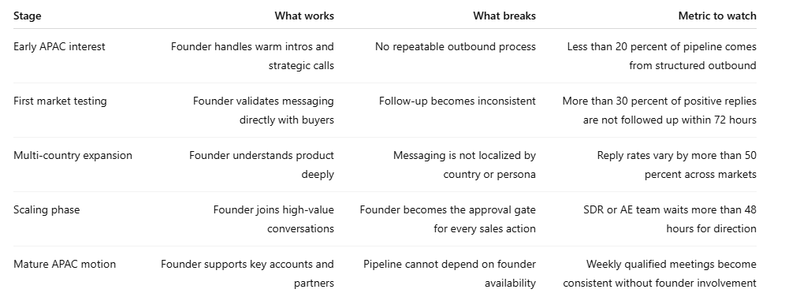
Table description:
Founder-led sales is effective for learning. It becomes risky when every pipeline activity still depends on founder time, founder memory, or founder approval.
APAC interest is not APAC pipeline
This is one of the most common mistakes in B2B sales expansion APAC.
A few prospects reply.
A few partners show interest.
A few demos happen.
A few companies say, “Keep us updated.”
It feels like momentum.
But interest is not pipeline.
Pipeline requires repeatability. It means the team knows:
- Which accounts to target
- Which titles are worth prioritizing
- Which problems matter by market
- Which proof points create trust
- Which channels work after the first touch
- Which replies are real buying signals
- Which prospects should be disqualified early
This is why how to generate B2B leads in APAC is not just a question of writing better emails. It is a question of building a system around targeting, messaging, sequencing, channel selection, qualification, and follow-up.
The LinkedIn B2B Institute’s 95-5 Rule is useful here. Most buyers are not in-market today, which means growth depends on being remembered before the buyer is ready and being relevant when the buyer becomes active.
In APAC, that matters even more because many buyers will not respond the first time they see you. They may check your website, review your founder profile, ask a peer, forward the email internally, or wait until a more relevant trigger appears.
A founder cannot manually manage all of that across multiple countries.
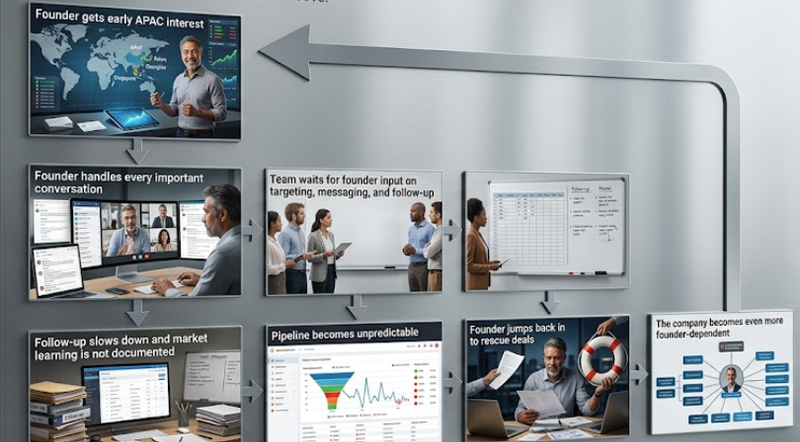
Infographic 1: The founder dependency loop
Use this infographic after the section above.
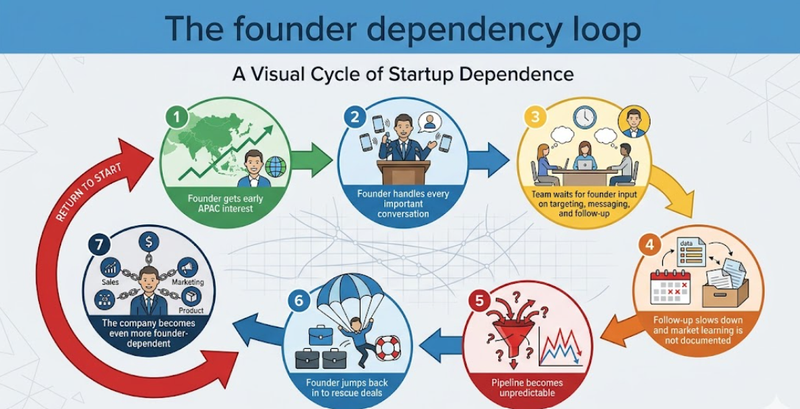
Infographic description:
This visual shows why founder-led sales can accidentally create a dependency loop. The more the founder rescues the pipeline, the less the team builds the operating muscle to create pipeline without them.
Why APAC buyers need more than founder passion
A founder can make the product sound exciting.
But APAC buyers are not only evaluating excitement. They are evaluating risk.
They are asking:
- Does this company understand our market?
- Have they worked with companies like us?
- Will they support our region properly?
- Is this vendor serious about APAC?
- Can they handle local buying processes, timing, and stakeholders?
This matters because modern B2B buyers are doing more research before speaking to sales. G2’s 2025 buyer behavior research found that 79 percent of software buyers say AI search has changed how they conduct research, while enterprise buyers rely heavily on review sites and AI search when researching software vendors.
That means the founder’s live pitch is often not the first impression.
The first impression may be:
- The outbound email
- The LinkedIn profile
- The company website
- The proof points
- The case study
- The local relevance
- The way the SDR follows up
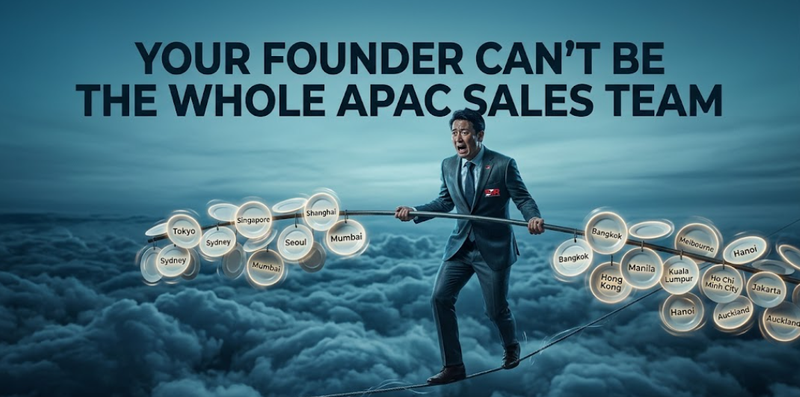
This is where multi-channel outbound sales APAC becomes important. If the outreach feels generic, the prospect may never get to the founder conversation at all.
SDR.sg has already covered how outbound structure matters in APAC, especially when companies decide between in-house SDR teams, outsourced SDR support, and hybrid AI plus human models. That article notes that outbound in APAC is often part of the go-to-market strategy itself, not just a sales tactic.
Table 2: Before and after founder dependency
Here is a realistic benchmark model for what changes when a company moves from founder-dependent outreach to a structured SDR-led APAC motion.
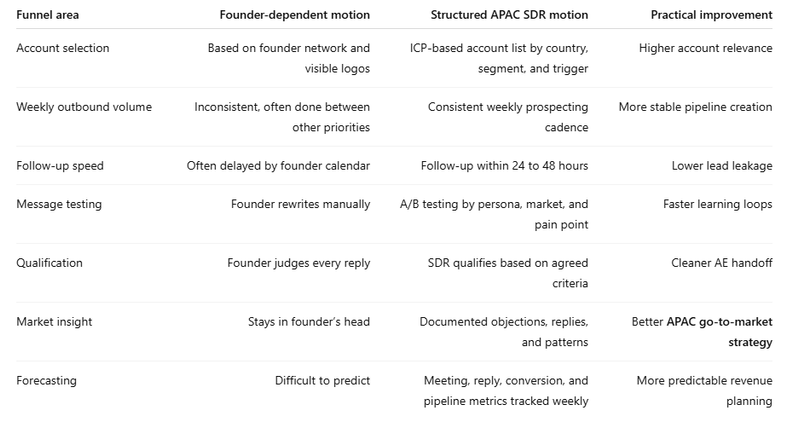
Table description:
The biggest improvement is not just more meetings. It is moving from founder memory to operating discipline. That discipline is what makes sales pipeline building for B2B companies scalable.
The founder should shape the story, not carry the whole motion
The founder should still be involved.
But there is a difference between founder involvement and founder dependency.
Founder involvement means the founder helps shape:
- ICP definition
- Market prioritization
- Product positioning
- Customer pain points
- Objection handling
- Competitive differentiation
- Strategic account strategy
Founder dependency means the whole pipeline slows down when the founder is busy.
This is especially risky in APAC because the market is attractive, but complex. Temasek’s 2025 e-Conomy SEA report says Southeast Asia’s digital economy is on track to surpass $300 billion in GMV by 2025, with revenue forecasted to reach $135 billion. It also notes over 680 million people in the region and more than 200 million new internet users added over the past decade.
The opportunity is real. So is the competition.
If a company is serious about outsourcing SDR teams for APAC expansion, the goal is not to replace the founder’s voice. The goal is to capture it, structure it, and turn it into a repeatable operating model.
That is why SDR.sg often starts with clarity before activity. In its article on turning data into GTM strategy, SDR.sg explains that companies often jump straight into outreach before answering the most important question: what exactly is the plan for this market?
Table 3: What needs to move from founder brain to SDR system
Before an SDR team can create quality pipeline, founder knowledge needs to become usable sales infrastructure.
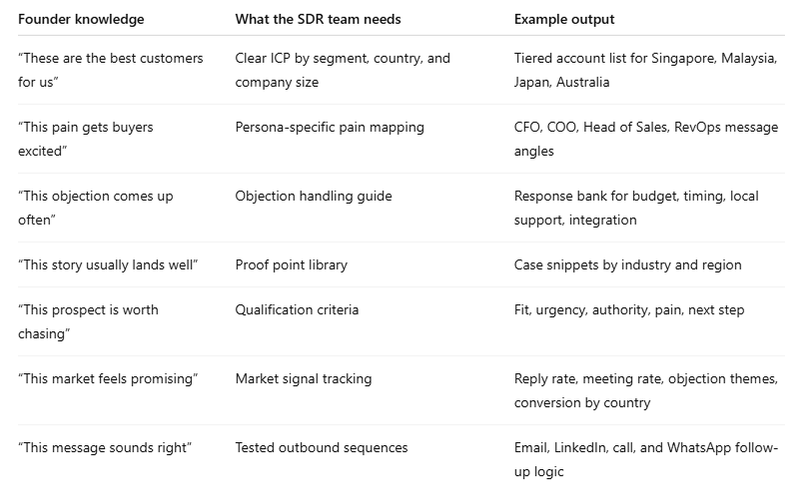
Table description:
Good SDR execution does not start with more activity. It starts by converting founder intuition into shared operating assets the team can execute, test, and improve.
Case study snapshot: From scattered APAC activity to structured meetings
SDR.sg previously shared a case where a US-based SaaS company targeting fintech buyers in Southeast Asia used a hybrid SDR program. AI tools surfaced target leads based on behavior and industry signals, while local SDRs created culturally relevant outreach. The campaign produced 31 qualified meetings in 6 weeks at 60 percent lower cost per meeting compared with in-house hiring.
The lesson is not that every company should copy that exact model.
The lesson is that structured ownership beats scattered founder activity.
A founder may personally create five good conversations through their network. A proper SDR motion can test 500 accounts, isolate the best segments, learn which objections repeat, and show whether a market is truly worth scaling.
That is the difference between activity and market learning.
It is also why APAC go-to-market strategies for startups should not be built only around founder instinct. Founder instinct is valuable, but it needs to be tested against market signals.
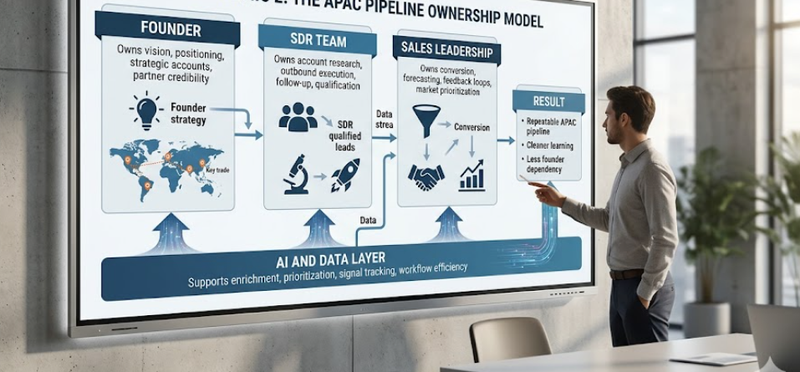
Infographic 2: The APAC pipeline ownership model
Use this infographic after the case study section.
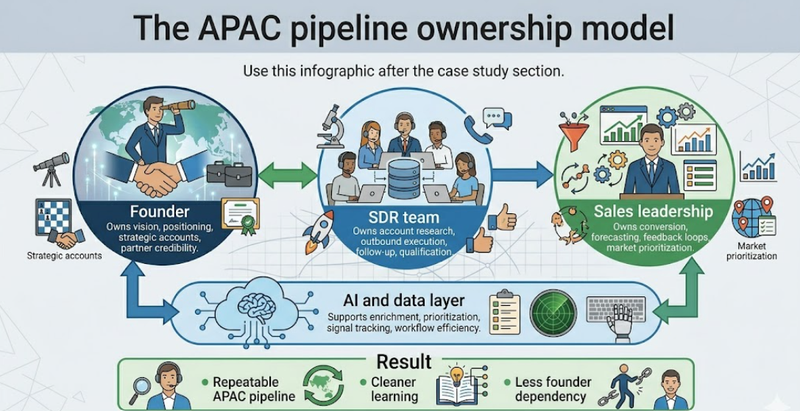
Infographic description:
This model shows how APAC pipeline ownership should be distributed. The founder remains important, but the company stops relying on the founder to personally carry every activity.
What metrics should founders watch?
If the founder wants to know whether B2B lead generation in APAC is becoming a system, they should stop looking only at meeting volume.
Meeting volume matters, but it is not enough.
Better metrics include:
- Account to contact coverage
- Reply rate by country
- Positive reply rate by persona
- Meeting booked rate by segment
- No-show rate
- Sales accepted meeting rate
- Opportunity conversion rate
- Time from first reply to meeting booked
- Percentage of follow-ups completed on time
- Top three recurring objections by market
Salesforce reported that sales reps typically spend only 28 percent of their week actually selling, with the rest going to administrative and other work.
That is exactly why founders should not personally own every manual step in prospecting. Their time should go where judgment matters most.
The SDR motion should own consistency.
FAQ: Founder-led sales and APAC pipeline
Q1. Is founder-led sales bad for APAC expansion?
No. Founder-led sales is often useful early on because founders understand the product, market, and customer pain deeply. The problem starts when the founder remains the only person who can create, qualify, and move pipeline forward.
Q2. When should a founder stop running outbound personally?
The founder should step back from daily outbound when the company has a clear ICP, repeatable pain points, early proof, and enough market signal to build a structured SDR motion.
Q3. Can outsourced SDRs really understand the founder’s message?
Yes, but only if onboarding is done properly. The founder’s knowledge needs to be turned into messaging, qualification criteria, objection handling, proof points, and market-specific playbooks.
Q4. What is the best first market for APAC expansion?
It depends on ICP, product category, urgency, regulatory drivers, budget maturity, and existing proof. Many companies start with Singapore because it is a strong regional hub, but that does not automatically make it the best first market for every company.
Q5. How long does it take to validate an APAC market?
A focused SDR-led validation sprint can often produce useful signal within 6 to 8 weeks. The goal is not just booked meetings. It is learning which segments, messages, and countries show the strongest traction.
Q6. Should startups use AI for APAC prospecting?
Yes, but AI should support research, enrichment, prioritization, and workflow efficiency. Human review is still needed for judgment, localization, tone, and qualification.
Q7. What is the biggest mistake companies make with APAC outbound?
They mistake interest for pipeline. A few positive replies do not mean the market is working. Real pipeline needs consistent targeting, localized messaging, multi-channel follow-up, qualification, and conversion tracking.
Final thought: Your founder should not be the whole APAC sales team
The founder should still shape the story.
They should join strategic conversations.
They should influence positioning.
They should help the team understand the customer better than anyone else.
But they should not be the whole APAC sales team.
If B2B lead generation in APAC depends on one person’s inbox, memory, and spare time, the company does not have a scalable sales motion yet.
It has founder effort.
That may open the first doors.
It will not build predictable pipeline across APAC.
If your company is seeing APAC interest but struggling to turn it into consistent qualified meetings, SDR.sg can help turn founder knowledge into a structured outbound motion.
We help B2B teams with:
- APAC go-to-market strategy
- Account selection and ICP refinement
- Multi-channel outbound sales APAC
- SDR execution and follow-up
- Lead qualification and meeting booking
- Market signal reporting across APAC
Ready to stop making your founder carry the whole sales motion?