Published on:
Estimated Reading Time: 11 minutes
Written by Jasmina C., Head of Marketing at SDR.sg
Why the Australian B2B Market Takes Longer to Break Into?
Australia looks like an easy APAC market, but B2B buyers expect more trust, proof, and relevance before they engage. Learn how to build qualified pipeline with the right outbound strategy.

Australia is often one of the first markets companies target when planning regional growth.
It is English-speaking, commercially mature, digitally active, and close enough to feel manageable for teams running APAC go-to-market strategies from Singapore. For companies looking at APAC sales expansion services, outsourced sales development for SMBs, or B2B lead generation in APAC, Australia often looks like the obvious next step.
That first impression is exactly why so many teams underestimate it.
Australia is not difficult because buyers are impossible to reach. It is difficult because buyers usually expect more trust, more relevance, and more proof before they commit to a meeting. The market looks easy on paper, but in practice it is slower to convert than most teams expect.
That matters for any business investing in outsourced SDR services Singapore, outbound lead generation, sales pipeline building solutions, or B2B lead generation in Asia. If you go in with the wrong assumptions, you can mistake a normal market dynamic for a failing motion.

Why Australia looks easier than it really is
At first glance, the Australian market looks large enough to support a serious outbound motion. The Australian Bureau of Statistics reported 2,729,648 actively trading businesses as of 30 June 2025, including 994,178 employing businesses. That scale is exactly why Australia is attractive for B2B sales expansion across APAC.
But size alone does not make entry easy.
Many regional teams assume that because Australia is English-speaking, broad messaging will transfer smoothly from other APAC markets. In reality, the familiar language often creates overconfidence. Teams localize less, rely on generic positioning, and assume buyers will engage quickly if the product is relevant.
That is usually where results start to slow down.
Buyers are not only assessing whether your offer is interesting. They are also assessing whether you understand their market, whether your proof points feel credible, and whether your outreach deserves attention in a crowded environment.
The buyer is more informed before your first touch
Modern B2B buyers are arriving at the sales conversation with much more context than many SDR teams assume.
6sense’s 2025 Buyer Experience research found that buyers now evaluate an average of 5.1 vendors, have prior experience with 3.8 of them, and choose from their Day One shortlist 95% of the time. The same body of research also found buyers consume an average of 13 content pieces during the buying journey.
That changes the job of outbound.
Your SDR is not introducing a category from scratch. In many cases, the buyer has already formed a rough view of the category, seen competitor content, asked peers for opinions, and decided which vendors feel credible enough to consider.
This is one reason why B2B prospecting in APAC markets like Australia takes longer than expected. Outreach has to do more than get opened. It has to survive comparison.

Trust signals matter more than teams expect
This is where a lot of outbound lead generation motions fall short.
LinkedIn reported in 2025 that 77% of B2B marketing leaders say audiences rely on their networks, not just company-owned channels, to vet brands. LinkedIn also reported that posting on the platform is up 41% over three years, which shows how much professional validation now happens through visible expertise, peer engagement, and network trust.
In practical terms, this means an Australian buyer is rarely judging your email in isolation.
They are also judging:
- whether your company seems credible
- whether your message sounds informed or generic
- whether your proof points feel relevant
- whether someone in their network already knows your category
- whether your outreach matches the maturity of the market
That is why the Australian market rewards better positioning more than higher activity.
Table 1: Why Australia takes longer than expected
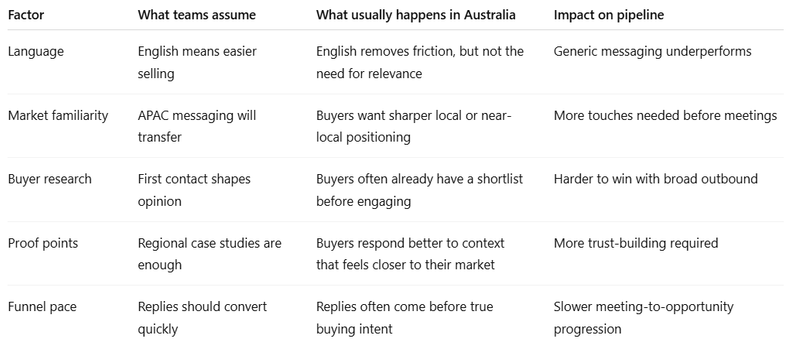
Description:
This table shows why Australia often looks easier to enter than it really is. While the language and market maturity reduce surface-level friction, real pipeline generation still depends on relevance, trust, and proof, which is why conversion usually takes longer than expected.
Real benchmarks: what “good” actually looks like
One of the most common mistakes in outbound is using the wrong benchmark.
If you treat Australia like a fast-conversion market, you may assume the motion is underperforming when the market is simply asking for more trust and sharper qualification.
SDR.sg’s APAC benchmark content for 2026 puts average cold outbound open rates at 20% to 30%, reply rates at 3% to 6%, and meetings booked at 1% to 2%. For top-performing, localized campaigns, those benchmarks rise to 35% to 45% open rates, 8% to 12% reply rates, and 4% to 6% meetings booked.
That framing is useful because it shifts the question from “Why is Australia slow?” to “Is our motion localized enough to earn trust?”
For most teams, the answer is not to increase send volume. It is to improve positioning, relevance, and follow-up quality.
Table 2: Practical outbound benchmarks for Australia within an APAC motion
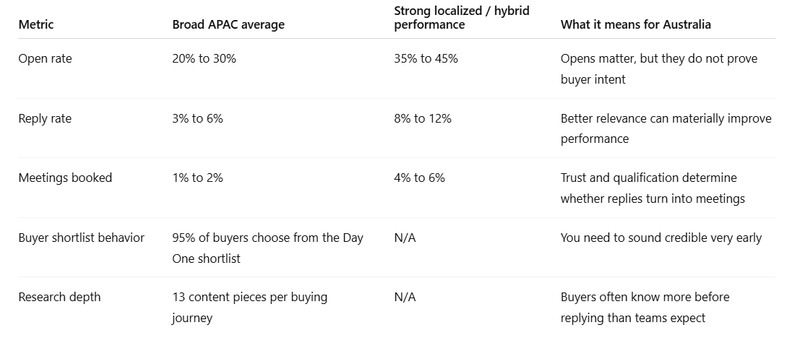
Description:
These benchmarks help set more realistic expectations for outbound performance in Australia within a broader APAC motion. The key takeaway is that stronger localized messaging and a hybrid AI plus human SDR approach can improve results, but success should still be measured by qualified meetings and pipeline quality, not just opens or replies.
Sources: SDR.sg APAC outbound benchmarks and 6sense Buyer Experience research.
What this looks like in real life
A common example looks like this.
A SaaS company decides to expand into Australia as part of its APAC growth plan. It launches outbound from Singapore using the same messaging it uses across the region. The copy is clean. The accounts look relevant. The first numbers seem acceptable. Open rates are decent. A few prospects reply.
But qualified meetings do not build consistently.
Usually, this happens for three reasons.
First, the value proposition is too broad. “We help B2B companies grow pipeline across APAC” sounds fine internally, but it is not specific enough to stand out in Australia.
Second, the proof is too far away. Regional results are useful, but if the buyer cannot quickly connect that proof to their own context, credibility is weaker.
Third, the motion lacks trust layers. One email sequence is rarely enough. Australia responds better when outreach is supported by visible thought leadership, strong lead qualification, and multi-channel touches that feel consistent rather than automated.
This is exactly where a hybrid sales team, AI and human, starts to outperform either extreme. AI-powered sales prospecting tools can improve account research, prioritization, and message preparation. Human SDRs are still essential for judgment, personalization, and objection handling. For Australia, that combination is usually stronger than pure automation or purely manual prospecting.

Why sharper positioning matters more in Australia
In some markets, broad positioning can still generate enough first meetings to create momentum.
In Australia, broad positioning usually slows you down.
Buyers want to know quickly:
- who you help
- what specific problem you solve
- why your model fits their market
- what proof you have
- why they should speak to you now
That matters for lead generation agency models, outsourced SDR services APAC, AI SDR offers, and sales development outsourcing for SaaS companies.
A weak version sounds like this:
We help B2B companies build pipeline in APAC.
A stronger version sounds like this:
We help B2B companies entering Australia build qualified pipeline through localized outbound, better lead qualification, and a hybrid AI plus human SDR model.
The second version is clearer, more specific, and far more credible for an Australian buyer.
Why Australia takes longer to convert
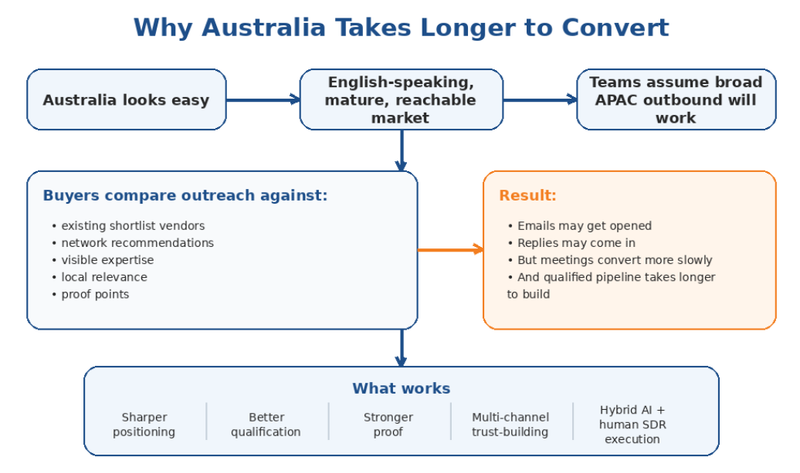
Description:
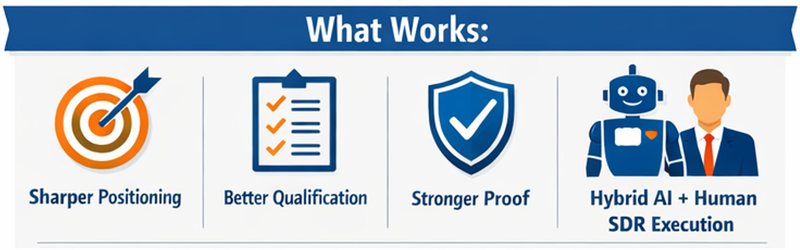
This infographic summarizes the core dynamic of the Australian market. It highlights why familiar market traits can create false confidence, while actual conversion depends on sharper positioning, stronger credibility, and a more trust-led outbound motion.
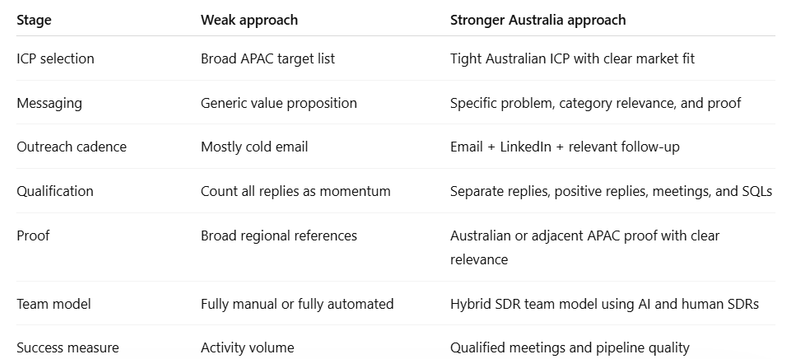
Table 3: Weak vs strong Australia playbook
Description:
This comparison shows the difference between a generic outbound approach and one that is better suited to Australia. The stronger model relies on tighter ICP selection, better localization, multi-channel outreach, and a clearer focus on qualified pipeline rather than activity volume.
What companies should do differently
If the goal is to book more sales meetings in APAC, generate higher-quality B2B leads, and build sales pipeline faster in Australia, the answer is not more volume.
The answer is a better motion.
1. Localize the positioning
Do not just say you serve APAC. Say why your offer is relevant to Australian buyers specifically.
2. Use proof that feels close
Australian buyers do not always need an Australia-only case study, but they do need proof they can map to their own reality.
3. Separate engagement from real intent
A reply is not the same as sales readiness. This is where lead qualification tips for B2B companies become critical.
4. Build trust across channels
Email marketing and SDR outreach strategies work better when backed by LinkedIn presence, relevant content, and visible expertise.
5. Use AI to improve precision, not to replace judgment
AI sales prospecting tools are strongest when they help SDRs research faster, prioritize better, and personalize more effectively. They are not a substitute for trust-building.

The strategic takeaway
Australia is not a bad outbound market.
It is a market that punishes lazy outbound.
For companies investing in B2B lead generation APAC, outsourced SDR services APAC, lead generation Singapore, or APAC go-to-market strategy, that is actually good news. It means the market is still highly winnable for teams willing to do the harder work.
The teams that succeed in Australia are usually not the ones sending the most emails.
They are the ones with the clearest positioning, the strongest proof, and the discipline to build trust before they push for conversion.
That is the real challenge in Australia. And it is also the opportunity.
FAQ – Common Questions
Q1. Why is Australia harder to break into than it looks?
Australia looks accessible because it is English-speaking and commercially mature, but buyers usually expect stronger relevance, proof, and credibility before they commit to a meeting.
Q2. Is Australia still a strong market for B2B lead generation?
Yes. Australia is still a strong market for B2B lead generation, but success usually comes from sharper positioning, better qualification, and more localized outbound execution.
Q3. Why does outbound take longer to convert in Australia?
Outbound often takes longer because buyers compare new outreach against existing vendors, peer recommendations, and visible market credibility before they engage seriously.
Q4. What should companies change in their Australia outbound strategy?
Companies should tighten ICP selection, localize messaging, use stronger proof points, and measure qualified meetings and pipeline quality rather than just opens or replies.
Q5. Does a positive reply mean the prospect is qualified?
Not always. In Australia, replies can signal interest, but stronger qualification is often needed before a prospect becomes a real sales opportunity.
Q6. Can AI improve SDR performance in Australia?
Yes, especially when AI is used for research, prioritization, and personalization support. The strongest results usually come from a hybrid AI and human SDR model.
Q7. Who benefits most from outsourced SDR support for Australia?
B2B companies expanding into Australia, entering APAC from Singapore, or struggling to build predictable pipeline usually benefit most from outsourced SDR support.

Conclusion
If your team is trying to generate B2B leads in APAC, expand into Australia, or improve outbound lead generation strategies, do not treat Australia like a simple extension of another region. Treat it like a mature market that expects sharper messaging, better trust signals, and more disciplined execution.
That is where outsourced sales development starts to work properly.
And that is where a hybrid model, combining AI-powered sales prospecting for B2B with experienced human SDR execution, gives teams a real edge.
Looking to build qualified pipeline in Australia faster?
SDR.sg helps B2B companies combine AI-assisted prospecting with human SDR execution to create better meetings, stronger qualification, and more predictable pipeline across APAC.
👉 Book a strategy session: HERE
👉 Explore services: HERE