Published on:
Estimated Reading Time: 12 minutes
Written by Jasmina C., Head of Marketing at SDR.sg
Discover why typical sales pitches don’t work in Japan and how to adapt your B2B lead generation in APAC. Learn local channels, trust-building tactics, and hybrid SDR strategies for successful market entry.
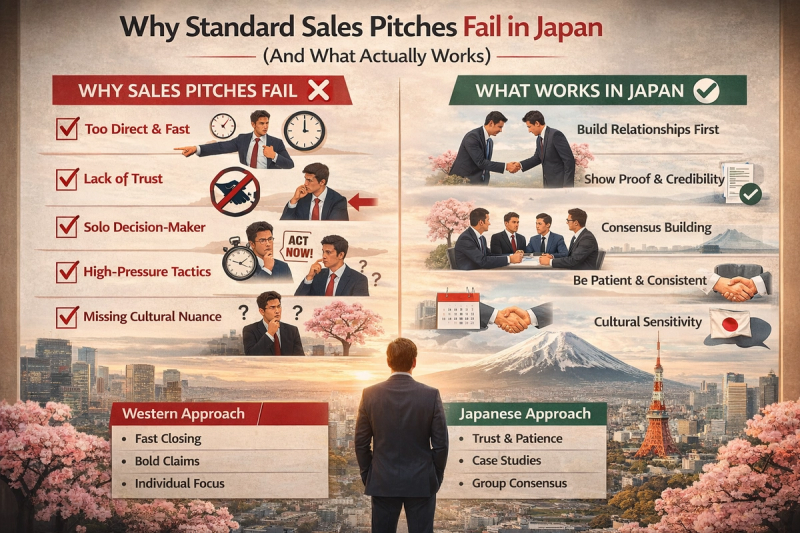
Expanding into Japan sounds straightforward: strong economy, global brands, high purchasing power.
In reality, most Western sales teams fail—not because of product or pricing, but because of approach.
This is where most APAC go-to-market strategies break: they assume proven Western playbooks will translate. Japan is the clearest example that they don’t.
The Core Problem: Misaligned Sales Philosophy
Western sales is built on speed, persuasion, and individual decision-making.
Japan operates differently:
- decisions are consensus-driven
- communication is indirect
- trust comes before business
Table 1: Western vs Japanese Sales Approach
Before adjusting tactics, you need to understand the structural differences.
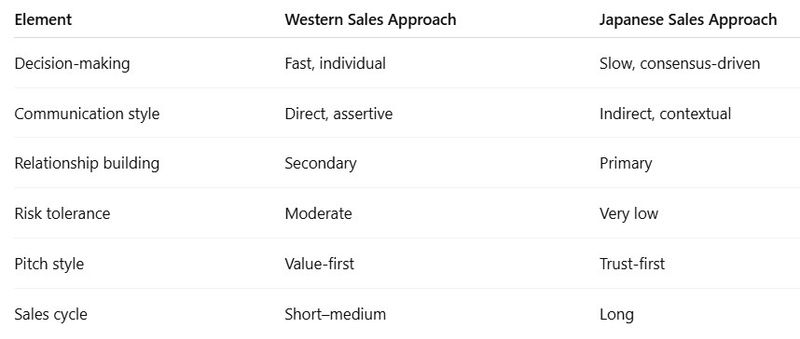
Explanation:
If your outbound lead generation is optimized for speed, you will consistently underperform in Japan—not because prospects aren’t interested, but because you’re moving too fast.
Where Western Playbooks Break Down
Most B2B lead generation in APAC relies on:
- cold email
- LinkedIn outreach
- quick qualification
- fast meeting booking

That creates three problems in Japan:
1. Trust Deficit
You’re asking for a meeting before establishing credibility.
2. Cultural Misalignment
Direct messaging can feel aggressive or premature.
3. Internal Friction
Even interested stakeholders need internal alignment before progressing.
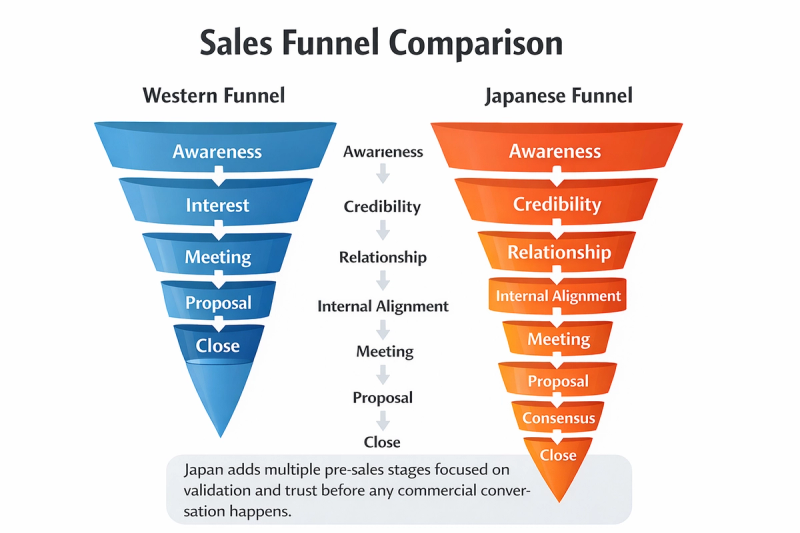
Sales Funnel Comparison
Western Funnel
Awareness → Interest → Meeting → Proposal → Close
Japanese Funnel
Awareness → Credibility → Relationship → Internal Alignment → Meeting → Proposal → Consensus → Close
Description:
Japan adds multiple pre-sales stages focused on validation and trust before any commercial conversation happens.
What the Data Actually Shows (2024–2026)
This isn’t theory—it’s measurable.
- Japan ranks among the lowest in sales productivity across developed markets (McKinsey)
- B2B buyers globally now use 10+ interaction channels during their journey (McKinsey B2B Pulse 2024)
- APAC buyers increasingly expect localized, personalized engagement
- Japan places significantly higher weight on long-term relationships in B2B decisions
Interpretation:
Lower speed ≠ lower performance. It means more interactions per deal and longer nurturing cycles.
👉 If you apply Western KPIs blindly, your sales pipeline building solutions will misfire.
Why Japan Requires More Touchpoints (Not Fewer)

Modern B2B buying is already complex. Japan amplifies that.
- multiple stakeholders require different context
- internal validation processes (ringi) slow decisions
- credibility must be reinforced repeatedly
👉 Single-channel outreach (email-only SDR) rarely works.
To succeed in B2B prospecting APAC markets, you need multi-touch, multi-channel engagement.
Japan-Specific Channels Most Teams Ignore
This is where most lead generation agency models fail: wrong channels.
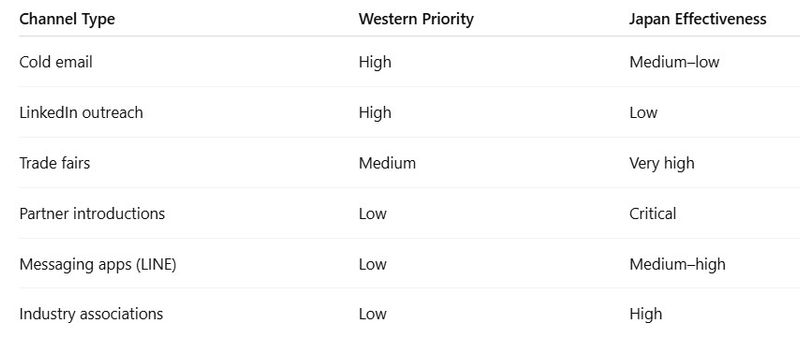
Table 2: Effective vs Ineffective Channels in Japan
Understanding channel effectiveness is critical before scaling outreach.
Explanation:
- Partner introductions (keiretsu-style networks) are often required before any engagement
- Trade fairs remain a strong channel for trust-building
- LINE / messaging apps are used for relationship maintenance, not initial outreach
👉 Ignoring these channels means your B2B lead generation strategies APAC will underperform in Japan.
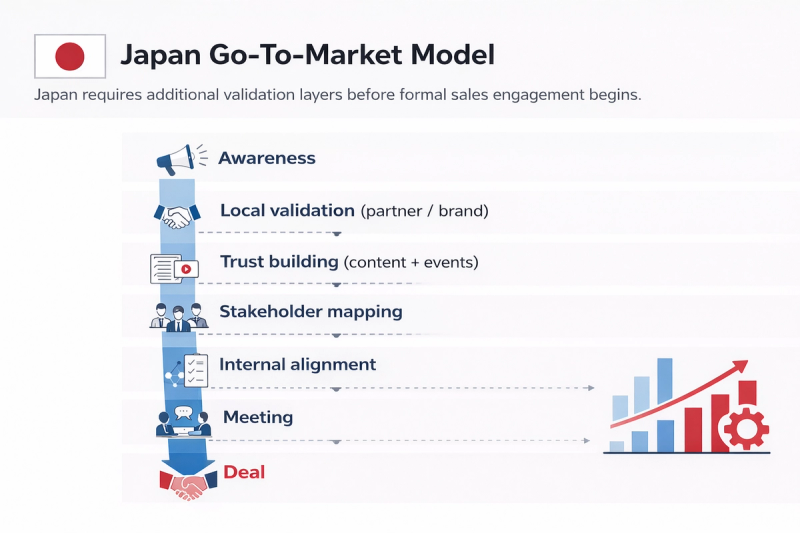
Awareness↓Local validation (partner/brand)↓Trust building (content + events)↓Stakeholder mapping↓Internal alignmen↓Meeting↓Consensus↓Deal
Description:
Japan requires additional validation layers before formal sales engagement begins.
What Actually Works in Japan
You don’t abandon outbound—you redesign it.
Table 3: Tactical Adjustments for Japan
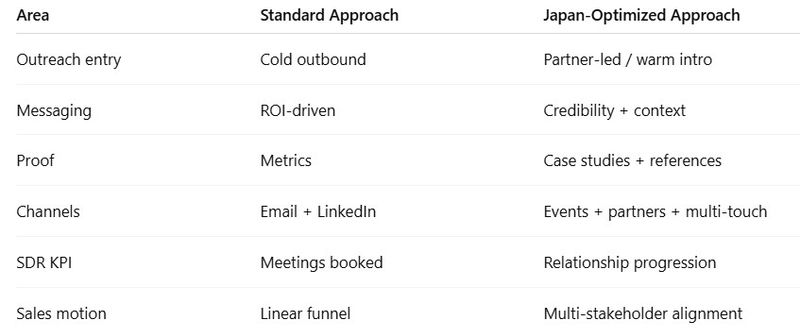
Interpretation:
Optimizing only for meetings booked is the wrong KPI. Real signal = progression of trust.
Real Example: What Fails vs What Converts
❌ Western pitch:
“We help companies increase pipeline by 30% in 90 days. Can we book 15 minutes this week?”
✅ Japan-adapted:
“We’ve worked with APAC companies aligning outbound strategies with local buyer expectations.
Happy to share insights if relevant.”
No urgency. No pressure. Just credibility.
Hybrid SDR Models in Japan
Japan is where hybrid sales teams: AI and human SDR shine:
- AI ensures consistent touchpoints
- Humans adapt tone and context
- Long cycles require structured nurturing
Pure automation fails. Pure manual doesn’t scale.
👉 This drives better results in AI-powered sales prospecting for B2B environments.
Benchmarks: Japan vs APAC
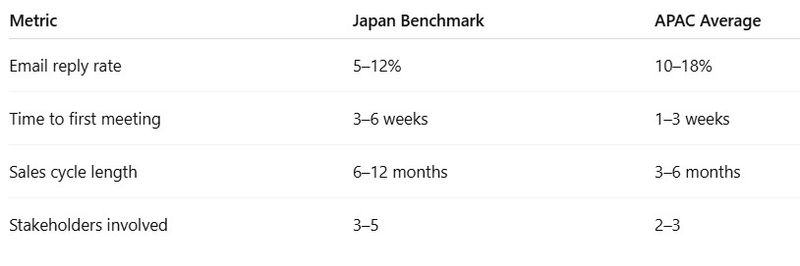
Explanation:
Lower response rates reflect different buying behavior, not failure.
From Outreach to Ecosystem Selling
In Japan, you don’t sell directly—you enter an ecosystem:
- Partners
- Distributors
- Industry networks
- Existing relationships
SDRs are no longer just meeting bookers—they coordinate multi-touch engagement and relationship building.
This is critical for outsourcing SDR teams for APAC expansion.
Internal Resources
- Outbound vs Inbound in APAC: What Actually Drives Pipeline
- How to Combine Inbound and Outbound Leads for Better Results
- Common Mistakes in B2B Lead Generation in Asia
- B2B Lead Generation in APAC: Insider Guide for Beijing, New Delhi & Tokyo SMEs (Part 2)
External Sources
- McKinsey – Why is Japan sales productivity so low?
- European Business magazine – Global B2B Pulse Survey 2024
- ECXO – Asia B2B CX Benchmark Report 2025
- 90 Degrees Asia – B2B Marketing Trends APAC 2025

FAQ – Common Questions
Q1: Why is Japan harder than other APAC markets?
A1: Strong emphasis on consensus, hierarchy, and trust.
Q2: Does cold outreach work in Japan?
A2: Yes, if adapted and supported by credibility.
Q3: Is LinkedIn effective in Japan?
A3: Less than in Western markets; other channels are stronger.
Q4: How long does it take to close deals?
A4: Typically 6–12 months for B2B.
Q5: Should SDRs be local?
A5: Strongly recommended for best results.
Q6: What channels work best?
A6: Partners, events, multi-touch outreach.
Q7: Can AI replace SDRs in Japan?
A7: No, it must be combined with human interaction.

Most companies fail in Japan not because there is no demand—but because they lack local distribution of trust.
If you're building B2B lead generation or scaling into Japan, standard playbooks won’t work.
At SDR.sg, we design APAC sales development services that combine:
- Localized outreach
- Hybrid sales teams: AI and human SDR
- Proven frameworks for appointment setting services APAC
👉 To increase sales meetings with outsourced SDR and build a predictable pipeline in Japan, the strategy—not the volume—is what needs to change.
Book a strategy session and get a market-specific plan tailored to Japan.