Published on:
Estimated Reading Time: 9 minutes
Written by Jasmina C., Head of Marketing at SDR.sg
Discover how our first APAC outreach campaign failed—and how we fixed it. Learn actionable lessons on B2B lead generation in Asia, precise ICP targeting, problem-focused messaging, and multi-channel outreach to book more sales meetings. Avoid common SDR mistakes and scale your pipeline faster.
Expanding into APAC markets is rarely as simple as sending a few emails.
Build a list.
Send sequences.
Book meetings.
For most companies, this approach underdelivers. Our first B2B lead generation in Asia campaign proved that.
We expected fast results. Instead, we faced:
- 1,500 emails sent
- 41 replies (~2.7% reply rate)
- 6 meetings booked
The lesson? Even in APAC, the failure is often predictable—and fixable.
The Reality of APAC B2B Outreach
APAC is diverse: Singapore, Australia, Japan, Southeast Asia—all have different buying behaviors.
- Decision cycles are longer
- Trust signals matter more
- Multi-channel outreach outperforms email-only
Many companies underestimate how much localization is required for successful outbound lead generation strategies.
The goal of our campaign: generate qualified meetings for a mid-market SaaS company expanding across APAC.
Problem 1: ICP Too Broad
Targeting “mid-size companies in APAC” sounds logical. But it was too vague.
Messaging attempted to cover multiple industries at once—connecting with no one.
We rebuilt our ICP, focusing on operational complexity instead of just industry.
Table 1 — Initial vs Optimized Targeting
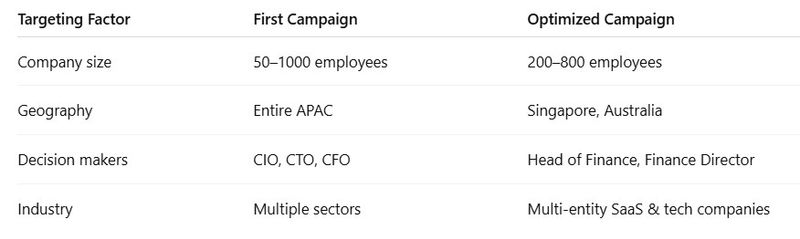
Explanation: Narrowing the ICP significantly increased relevance. According to HubSpot, targeted campaigns can generate 2–3× higher reply rates than broad outreach.
Why Outbound Campaigns Fail
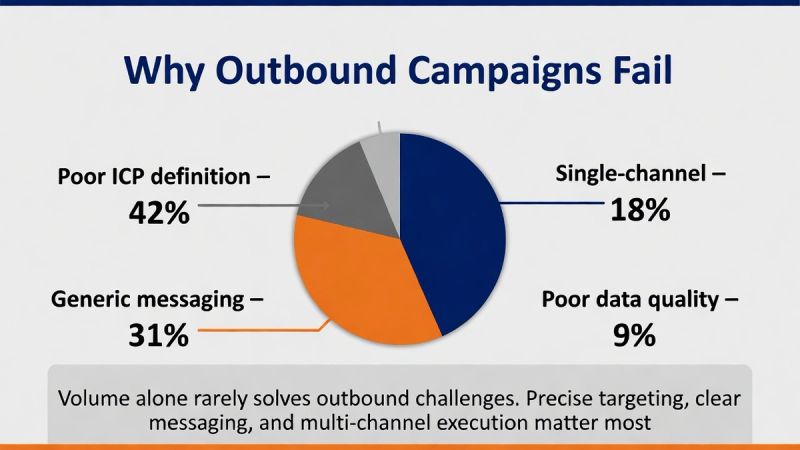
Most failures stem from:
- Poor ICP definition – 42%
- Generic messaging – 31%
- Single-channel outreach – 18%
- Poor data quality – 9%
Explanation: Volume alone rarely solves outbound challenges. Precise targeting, clear messaging, and multi-channel execution matter most.
Problem 2: Messaging Focused on the Product
Our first email read like a product brochure: integrations, platform capabilities, features.
Executives don’t respond to features—they respond to problems.
We rewrote the message around one pain point: manual consolidation across subsidiaries.
Table 2 — Messaging Before and After
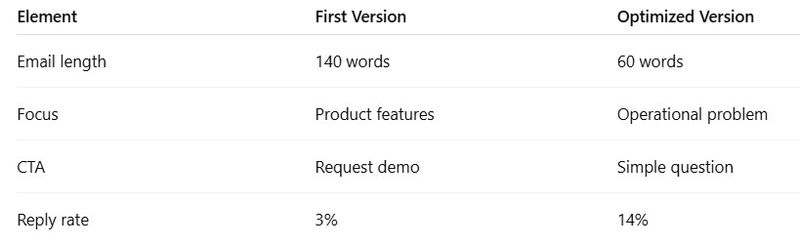
Explanation: Short, problem-focused emails drastically increased engagement. McKinsey & Company highlights that decision-makers prefer concise, problem-driven outreach.
Problem 3: Email Alone Is Not Enough
Email-only outreach underperformed. Multi-channel strategies are essential.
We added:
- LinkedIn connection requests
- Short LinkedIn messages
- Calls following the second email
Table 3 — Multi-Channel Performance
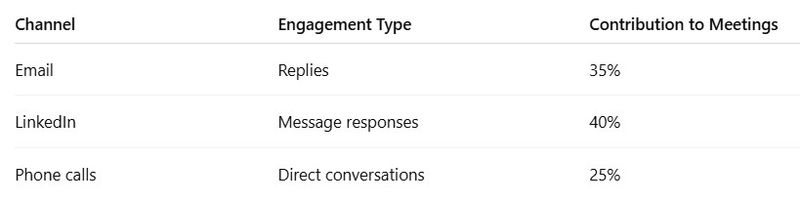
Explanation: Combining human SDRs with AI tools improves results. Hybrid workflows (AI-assisted prospect research + human outreach) are now standard for hybrid sales team: AI and human setups.
Modern SDR Stack
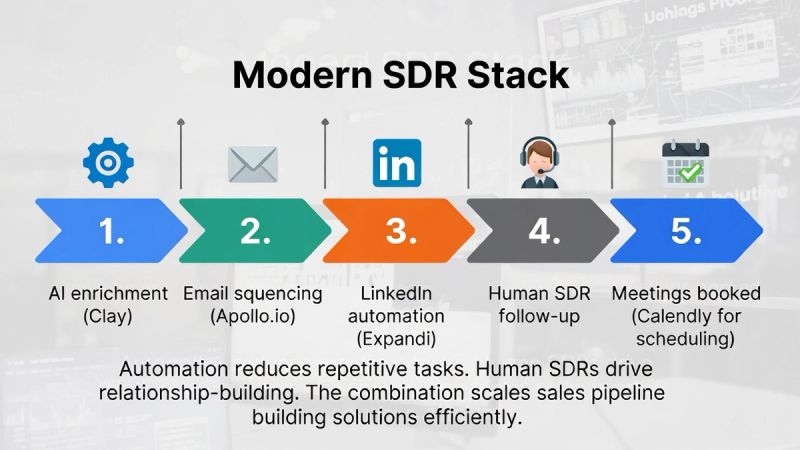
Workflow:
- AI enrichment (Clay)
- Email sequencing (Apollo.io)
- LinkedIn automation (Expandi)
- Human SDR follow-up
- Meetings booked (Calendly for scheduling)
Explanation: Automation reduces repetitive tasks. Human SDRs drive relationship-building. The combination scales sales pipeline building solutions efficiently.
The Turning Point
After refining ICP, messaging, and multi-channel outreach:
- 920 prospects targeted
- 134 replies (~14.6% reply rate)
- 51 conversations
- 34 qualified meetings booked
“Within three weeks we had more qualified meetings than in the previous quarter.” — VP Sales, APAC SaaS client
Results vary by industry, list quality, and outreach support channels—but precision and multi-channel are key.
Why Companies Outsource SDR in APAC
Building internal teams is slow:
- Hiring & training
- CRM setup
- Regional prospect research
Outsourcing provides:
- Faster market entry
- Regional expertise
- Immediate access to prospect data
- Predictable pipeline
Especially useful for APAC go-to-market strategies for startups and SaaS expansions.
Key Lessons From Our Campaign
- ICP precision beats volume
- Problem-focused messaging trumps product-focused
- Multi-channel outreach outperforms email-only

Consistency in these principles drives B2B lead generation in Asia success.
Internal Resources
- Is AI Disrupting the B2B Sales Stack?
- Beyond Automation: How Human‑Led Sales Will Define Success in 2026
- From Profile Views to Revenue: How SDR Builds Real B2B Conversations Across APAC
- Part 1: Singapore, Kuala Lumpur & Jakarta
- Part 2: Beijing, New Delhi & Tokyo
- Part 3: Manila, Bangkok & Seoul
- Part 4: Sydney, Melbourne & Auckland (ANZ)
FAQ — Common Questions About APAC Lead Generation
Q1: What is the biggest challenge in B2B lead generation?
A1: Poor ICP is the most common problem.
Q2: Why use outsourced SDR services in Singapore?
A2: Faster market entry, local expertise, and immediate access to data.
Q3: What are effective appointment-setting tips for APAC?
A3: Localize messaging, use multi-channel touchpoints, focus on relationship-building.
Q4: Can AI replace SDRs?
A4: No. AI supports research and enrichment; humans handle conversations.
Q5: Which industries benefit most from outsourced SDR?
A5: SaaS, tech, enterprise software, and fintech infrastructure.
Q6: How long to build a pipeline via outbound?
A6: Typically 4–8 weeks after optimizing ICP, messaging, and channels.
Q7: How to increase sales meetings in APAC?
A7: Strong prospect data + localized multi-channel outreach + hybrid AI-human SDR workflow.

If you are planning lead generation services or an APAC expansion, a structured SDR approach is essential.
Contact our team at SDR Outsourcing to:
- Build a predictable sales pipeline
- Scale SDR teams efficiently
- Implement hybrid AI + human workflows