Published on:
Estimated Reading Time: 11 minutes
Written by Jasmina C., Head of Marketing at SDR.sg
Discover why 7 out of 10 B2B deals in Malaysia see show-up rates below 50%. Learn cultural nuances, 48h pre-call strategies, and expert APAC lead generation tips to boost pipeline and conversions.

Introduction – The Critical 48-Hour Window
In the past 18 months, 7 out of 10 clients entering Malaysia for B2B expansion experienced a show-up rate below 50% in their first outreach campaigns. This occurred even with strong reply and booking metrics.
For companies leveraging B2B lead generation in APAC or scaling through outsourced SDR services Singapore, Malaysia consistently shows early-stage pipeline decay.
Many deals in Malaysia see early-stage pipeline decay due to cultural and scheduling nuances — understanding these is key to higher show-up rates.
Where the Funnel Actually Breaks
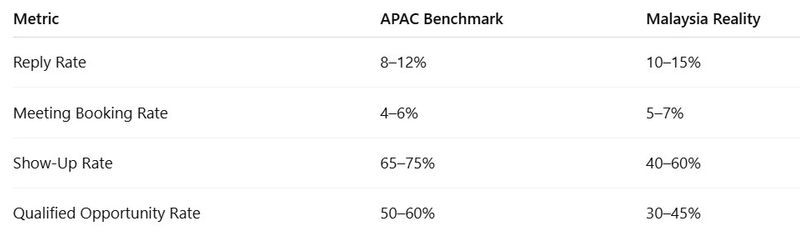
Top-of-funnel metrics often look promising, but pre-call decay is the real leak.
Table 1: Malaysia vs APAC SDR Benchmarks
Explanation:
Malaysia tends to overperform in outbound B2B lead generation Singapore models but underperforms in appointment setting services APAC. Early-stage enthusiasm often does not translate into actual meetings.
Politeness Creates False Positives
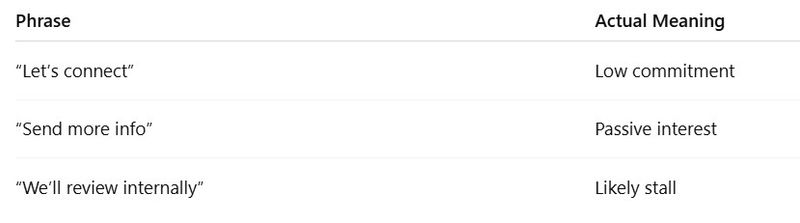
Malaysia operates on high-context communication (Cultural Atlas) — agreement is often social, not commercial.

Table 2: Polite Phrases vs Real Intent
Detailed Description:
In Malaysia, direct rejection is rare. These phrases may seem positive but are usually social niceties, not commitment:
- “Let’s connect” – polite acknowledgment, rarely a committed interest.
- “Send more info” – indicates passive attention, not active engagement.
- “We’ll review internally” – often signals deprioritization or stalled internal decision-making.
Implications for SDR teams:
- Re-anchor value in follow-up communication.
- Use 24h confirmations and micro-commitments to convert polite interest into real engagement.
- Track these phrases in CRM to optimize early-stage pipeline qualification.
The 48-Hour Pre-Call Window
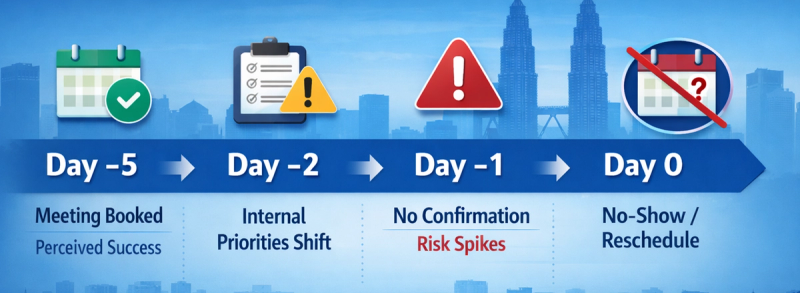
Meeting booking is not progress — the next 48 hours determine show-up.
Meeting Decay Timeline - Malaysia B2B SDR meeting decay timeline APAC lead generation
Detailed Description:
- Day -5: Meeting booked → perceived success
- Day -2: Internal priorities shift
- Day -1: No confirmation → risk spikes
- Day 0: No-show / reschedule
According to the ASEAN Business Outlook Survey, over 60% of business interactions in Southeast Asia shift due to internal priorities.
Best Practice:
24h confirmation + re-anchor value + micro-commitments increase show-up rates by 20–30%.
Silence = Disqualification
Silence in Malaysia is rarely neutral.

Table 3: Engagement vs Intent
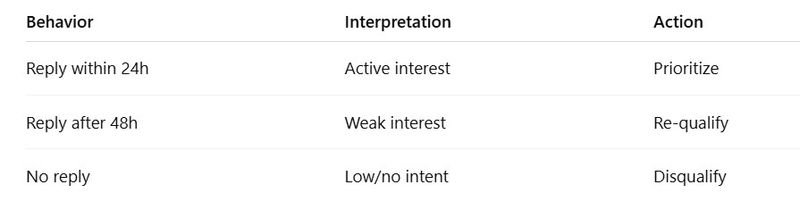
Detailed Description:
In Malaysia, the timing and frequency of responses provide stronger insight than the content alone.
- Reply within 24h – signals genuine engagement; prioritize these prospects for scheduling and follow-ups.
- Reply after 48h – indicates low urgency or competing priorities; SDRs should re-qualify these leads before committing internal resources.
- No reply – typically means low intent or deprioritization; continuing to invest time in these leads inflates the pipeline and reduces efficiency.
Implications for SDR teams:
- Use response timing as a pre-call qualification metric.
- Combine this table with polite-phrase insights (Table 2) to accurately score leads before booking.
- Helps optimize B2B lead generation in APAC by focusing on prospects with true intent, improving show-up rates and pipeline quality.
Trust-First Market Slows Transactional SDR Models
B2B decisions involve multiple stakeholders and informal validation (World Bank).
Key insight: 70% of deals require internal alignment before formal engagement.
Recommendation: Gradual, credibility-focused engagement works better than aggressive CTAs.
Internal Resource:
👉 Asia Outbound Playbook
Hierarchy Creates Hidden Risk
Most SDR conversations occur below decision level, inflating perceived pipeline.
Table 4: Stakeholder Influence
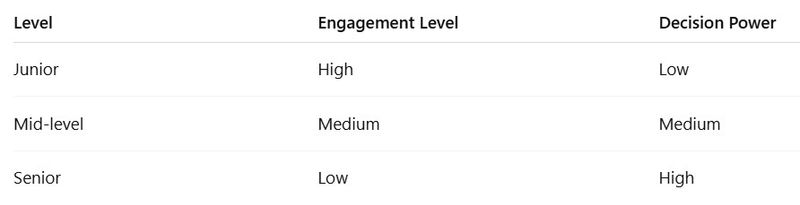
Practical Adjustment:
Confirm decision-maker involvement, internal alignment, and business relevance before scheduling.
Messaging Failure Is Invisible
Poor messaging does not trigger rejection — it triggers silence.
Messaging Failure Loop- Malaysia B2B SDR messaging failure loop outbound lead generation
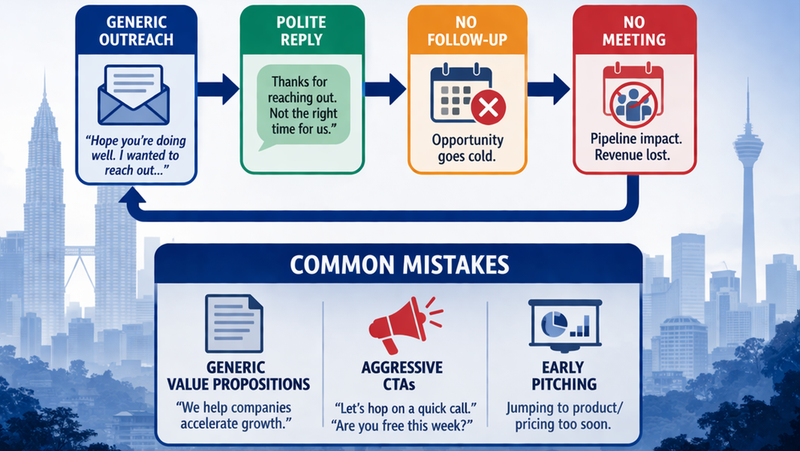
- Generic outreach → polite reply → no follow-up → no meeting
Common Mistakes:
- Generic value propositions
- Aggressive CTAs
- Early pitching
Internal Resource:
👉 B2B Outbound Frameworks
Pre-Call Qualification > Post-Call
Minimum criteria for Malaysian prospects:
- Confirmed within 24h
- Problem acknowledged
- Stakeholder identified
- Continued engagement
Use AI SDR, Tools for AI-assisted SDR prospecting, or Hybrid SDR teams to enforce this.
Real Case Study (APAC SaaS)
Scenario: Pre-call confirmation + structured agenda implemented.
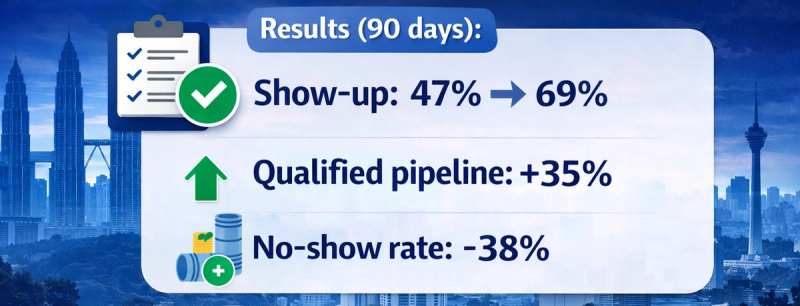
Results (90 days):
- Show-up: 47% → 69%
- Qualified pipeline: +35%
- No-show rate: -38%
Featured Snippet Section – How to Improve Show-Up Rate in Malaysia
- Send confirmation within 24h of booking
- Re-anchor meeting value clearly
- Validate multi-stakeholder alignment
- Add micro-commitments in emails
- Use hybrid SDR teams combining AI and human outreach
FAQ – Common Questions
Q1: Why do Malaysian prospects agree but not show up?
A1: Agreement is often polite acknowledgment rather than a commitment. Use 24–48h pre-call confirmations and micro-commitments to improve show-up.
Q2: What is a good show-up rate in Malaysia?
A2: For APAC SDR campaigns, 60–70% is considered strong when multi-stakeholder alignment is ensured.
Q3: Should I use AI SDR in Malaysia?
A3: Yes, but in a hybrid model, combining AI prospecting with human follow-ups to maintain cultural nuance.
Q4: How many follow-ups are optimal?
A4: Typically 3–5 touches; prioritize multi-channel (email + LinkedIn) within the 48h pre-call window.
Q5: Is email or LinkedIn better?
A5: Email drives volume; LinkedIn builds credibility and context for relationship-based markets.
Q6: What is the biggest mistake in early-stage pipeline?
A6: Treating polite engagement as intent; early-stage signals must be qualified.
Q7: How to improve show-up rate fast?
A7: Confirm meetings within 24h, re-anchor meeting value, validate stakeholders, and use micro-commitments.
Key Takeaways
- Malaysia inflates early-stage metrics; interpret signals carefully
- 48h pre-call window is critical for show-up
- Silence = disqualification
- Trust-building > transactional urgency

If you're:
- Expanding with APAC go-to-market strategies
- Scaling via SDR outsourcing Singapore / Malaysia
- Struggling with low show-up rates
You need a localized execution model.
👉 Book a strategy session: HERE
👉 Explore services: HERE
Immediate action: Review last 20 meetings: % confirmed within 24h and % with decision-makers involved.
Final Insight
Pipeline in Malaysia is signal-driven, not activity-driven. Misreading early signals means you never had the deal to begin with.