Published on:
Estimated Reading Time: 13 minutes
Written by Jasmina C., Head of Marketing at SDR.sg
Learn why B2B lead generation in South Korea often stalls after the first reply, and how to improve post-contact momentum, buyer trust, and meeting conversion.
Most teams do not lose momentum in South Korea because they targeted the wrong accounts.
They lose it because they misread what happens after the first reply.
That is a costly mistake for any company investing in B2B lead generation in APAC. South Korea is an attractive market, but it is also one where trust, hierarchy, relationship depth, and internal alignment shape how early buying conversations move forward. Business guidance for foreign companies highlights that Korean stakeholders often prefer to work with people they know, value introductions, and expect stronger relationship signals before moving a conversation forward ( Business Guides South Korea ).
A lot of global teams get trapped here. They assume the issue is copy, cadence, or channel mix. Sometimes it is. More often, the issue is that their go-to-market strategy for South Korea was never adapted to how Korean B2B buyers evaluate unfamiliar vendors.

The real problem is not reply rate, it is post-contact momentum
A lot of outbound teams celebrate too early.
They get a reply, a LinkedIn accept, or a polite email such as “we will review internally” and assume the deal is now moving. In South Korea, that is often the exact moment where the real work begins.
Korean business culture is strongly relationship focused and hierarchical. Asialink’s South Korea guide notes that building trust and rapport is essential, stakeholders prefer to work with people they know, introductions through local intermediaries help build confidence, and lower ranked executives may avoid openly contradicting superiors ( Business Guides South Korea ).
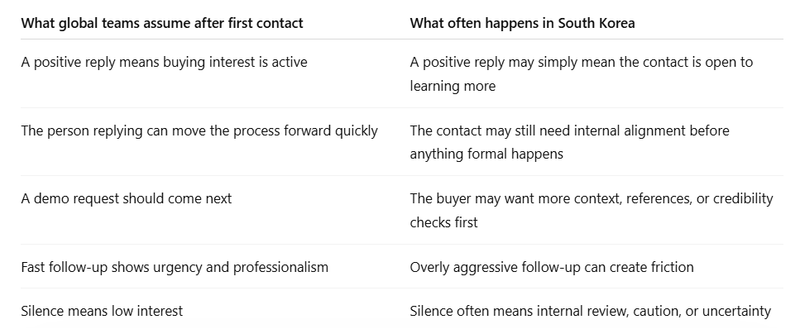
That has a very practical implication for outbound. A positive reply may signal openness, not commitment. It may also mean “not yet,” “I need to check internally,” or “I do not want to reject this directly.”
This is where local nuance matters. One useful concept here is nunchi, the idea of reading the room and sensing what is not being said directly. You do not need to build a whole sales playbook around that word, but you do need to understand the behavior behind it. If you only read the literal text of a reply, you can easily misread the actual buying signal. That is especially true in a market where indirect communication and group harmony matter more than blunt clarity ( Business Guides South Korea ).
A quick comparison makes the gap obvious.
Description:
The gap is usually not about market quality. It is about how sellers interpret early buyer signals.
That is why B2B lead generation in South Korea often looks healthy at the top of the funnel but underperforms in meeting conversion. Teams measure opens, replies, and first touches, but they do not design for internal hesitation. In practice, the first contact is rarely the breakthrough. It is the start of a credibility test.
Why South Korea stress-tests your APAC go-to-market strategy early
Foreign companies often underestimate how much local adaptation is required.
The U.S. Commercial Service guidance for Korea explicitly advises foreign companies to adapt products and procedures to Korean tastes and conditions. It also notes that after-sales service and customer support are demanding areas in Korea and that weak local support can hurt competitiveness ( Trade.gov ).
That same logic applies to outbound.
If your messaging, pacing, and meeting ask feel imported rather than market-aware, buyers notice fast.
Here is the simplified version of what happens in many Korean buying motions:
Before you pitch value, the buyer is evaluating fit.
Before they commit time, they are evaluating credibility.
Before they invite others, they are evaluating internal safety.
That is why a weak first-contact strategy causes hidden pipeline decay.
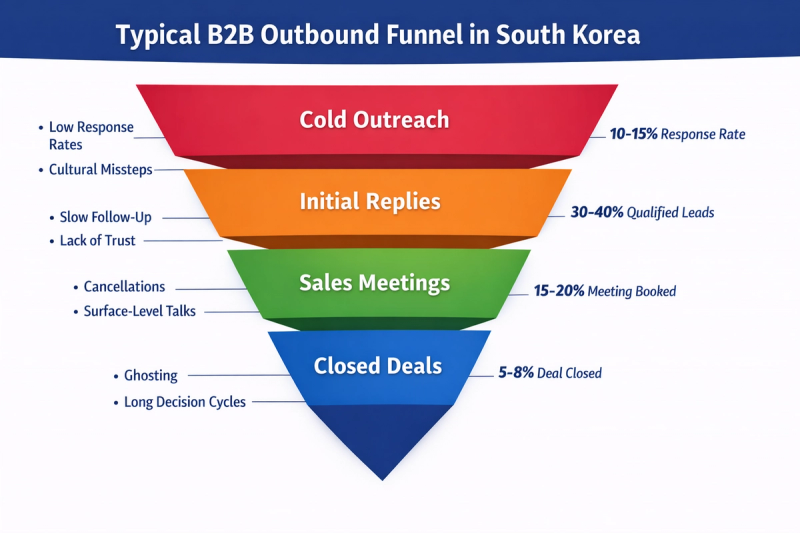
Infographic 1: Where first-contact momentum usually drops
Description:
The highest risk stage is often not top of funnel outreach. It is the period immediately after first contact, when buyer curiosity has not yet turned into internal confidence.
For teams asking how to generate B2B leads in APAC, this matters because South Korea punishes shallow signal reading. You can get enough engagement to believe the market is working, while the real conversion problem sits between contact and commitment.
How the buying process creates friction after first contact
One of the biggest mistakes foreign teams make is assuming that the person who replied now owns the buying motion.
In many Korean B2B environments, one person rarely carries the process alone just because they answered an email. Asialink’s guide emphasizes the importance of executive relationships, rank sensitivity, and local partnerships. It also notes that partnerships and intermediaries can help with introductions, procurement, contracting, and local credibility ( Business Guides South Korea ).
A simple SaaS example makes this clearer.
Imagine a foreign software company running sales prospecting in South Korea. A director replies to an outbound email and says the solution looks interesting. The SDR team immediately pushes for a full demo with multiple stakeholders later that week.
From the seller’s perspective, that is momentum.
From the buyer’s perspective, it can feel premature.

The contact may still be deciding three things:
- Is this vendor credible enough to bring up internally?
- Is the use case relevant enough for my team?
- Will I lose internal credibility if I introduce this too early?
That last point matters more than many foreign teams realize. The buyer is not only evaluating the solution. They are also evaluating the organizational risk of moving you forward.
This is where lead qualification tips for B2B companies need a local layer. In South Korea, qualification is not just about budget, authority, need, and timeline. It is also about internal sponsorship confidence.
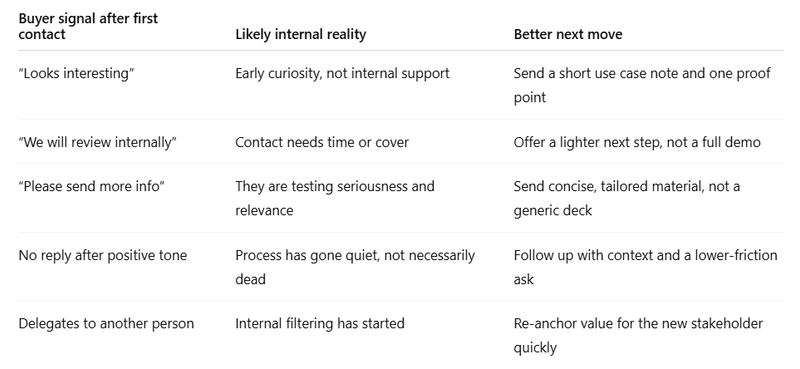
Description:
The right next step depends less on what the buyer said, and more on what they are trying to validate internally.
Trust is not built only in formal meetings
This is another place where global playbooks often miss the market.
In South Korea, trust does not always get built through a single formal call. It often develops through a sequence of smaller signals: a credible introduction, a thoughtful follow-up, a relevant case example, a polite LinkedIn interaction, a useful piece of content, or a recommendation from someone already known to the buyer.
That fits the broader guidance on Korea’s business culture. Asialink notes that maintaining relationships matters, sharing meals and informal time can strengthen business relationships, and local partners with strong networks can help foreign companies navigate the market more effectively ( Business Guides South Korea ).
That does not mean “network first, pipeline later.” It means your outbound sales strategy in South Korea should give buyers safe ways to keep engaging before they commit to a high-friction step.
In practice, that means:
- fewer generic deck drops
- more short, relevant follow-ups
- more proof points buyers can forward internally
- more respect for slower internal pacing
- more attention to context, not just literal responses

What stronger outbound sales strategy in South Korea looks like
The fix is not to become passive.
The fix is to become more precise.
If your goal is to book more sales meetings in APAC, especially in Korea, then your post-contact motion should do four things well.
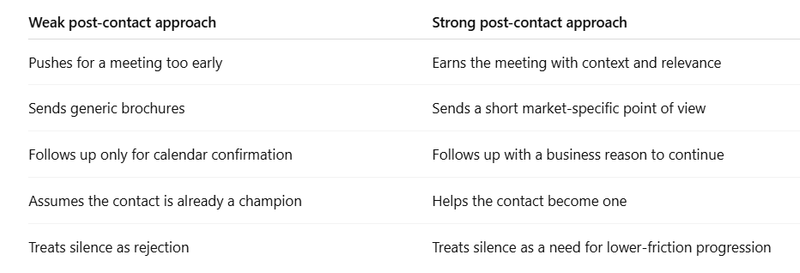
Description:
Better conversion comes from reducing buyer risk, not from increasing seller pressure.
That usually means:
- tightening your email outreach strategies for B2B
- using softer but clearer next steps
- showing you understand local context
- giving the contact something safe to forward internally
- sequencing channels carefully as part of best practices for multi-channel outbound sales
Infographic 2: Better post-contact sequence for South Korea
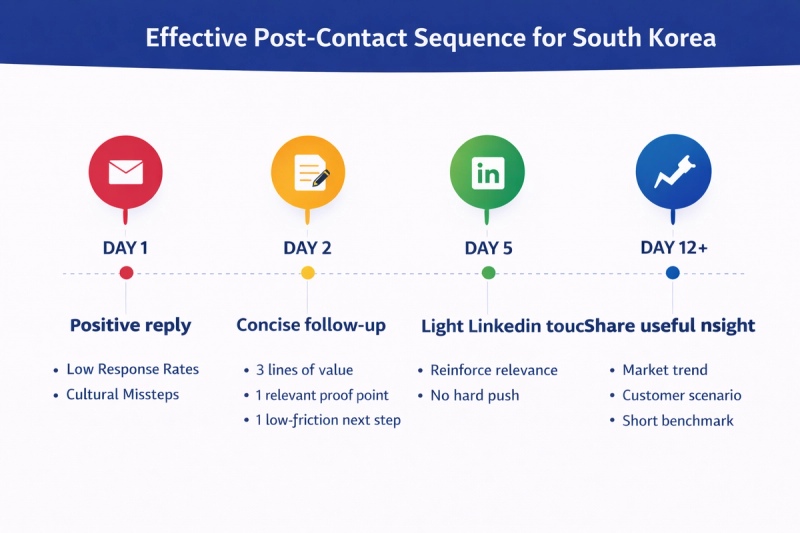
Description:
The goal is not speed at any cost. The goal is steady progression from curiosity to confidence.
The compliance layer most outbound teams treat too lightly
This part is often ignored until it becomes a problem.
If you are doing outbound into Korea, collecting prospect data, storing contact details outside Korea, or using offshore tools and workflows, privacy cannot be an afterthought. PIPC guidance states that PIPA can apply to overseas businesses in several circumstances, including when they provide goods or services to Korean data subjects, process personal information in Korea, or handle Korean data in ways that affect Korean individuals. The same guidance also explains that certain breaches must be reported to the PIPC within 72 hours and that affected data subjects may need to be notified ( PIPA ).
The regulatory backdrop is also getting stricter. South Korea amended PIPA on March 10, 2026, with most provisions taking effect on September 11, 2026. Legal and policy summaries report that the changes strengthen executive accountability, raise the cap for serious or repeated violations to as much as 10% of revenue in qualifying cases, expand governance and breach-related obligations, and introduce mandatory ISMS-P certification for covered organizations from July 1, 2027 ( IAPP ).
For outbound teams, that raises the bar on how prospect data is sourced, governed, transferred, and monitored.
A practical starting point:
- document where Korean prospect data is sourced from
- review whether your notices and consent practices fit the workflow you are using
- map where data is stored and transferred
- review vendor contracts for cross-border safeguards
- pressure-test your outbound stack with local counsel or a qualified privacy advisor before scaling volume
This is also why “just scrape more contacts” is a weak operating model in Korea. Cleaner sourcing, clearer governance, and tighter workflows reduce legal risk and improve commercial credibility at the same time.
What this means for SDR teams, founders, and expansion leaders
If you are planning B2B sales expansion APAC, South Korea is not a market where you should blindly scale outbound volume and hope conversion catches up later.
You need a sharper go-to-market strategy for South Korea.
That does not always mean opening a local entity first. But it does mean adapting your commercial motion before scale. Trade guidance points to the importance of local adaptation, credibility, support quality, and market-specific operating practices (TRADE.GOV ).
That usually means:
- local message testing before scale
- country-specific qualification logic
- carefully staged meeting asks
- better proof points after first contact
- cleaner compliance workflows
- more thoughtful channel sequencing
For some companies, that points toward outsourced execution. For others, it means tightening an internal playbook. Either way, the lesson is the same: if your pipeline stalls after first contact, it is usually a strategy problem before it becomes an activity problem.

Before you scale outbound in Korea, ask these 3 questions
- Does our current messaging feel localized, or just translated?
If it sounds like a global sequence with a country name inserted, that is not localization. - Are we treating early replies as interest, or as the start of trust-building?
If your next step is always “book the demo,” you are probably pushing too early. - Have we pressure-tested our data sourcing and cross-border prospecting workflow?
If the answer is no, fix that before volume goes up.
FAQ, Common Questions
Q1. Why does outbound stall so often in South Korea after an initial reply?
Because early buyer interest often comes before internal comfort, not after it.
Q2. Is South Korea a bad market for outbound sales?
No. It is a strong market, but it rewards relevance, trust, and patience more than brute-force activity.
Q3. Do we need a local entity before selling into South Korea?
Not always. Multiple entry structures are possible, but your sales motion still needs localization even if your legal setup is light.
Q4. What is the biggest mistake foreign SDR teams make in Korea?
They push for the meeting before they have earned internal confidence.
Q5. Should outbound into South Korea be written in Korean or English?
It depends on your audience, product, and level of local presence. English may work for some internationally exposed buyers, but Korean language messaging usually improves credibility and response quality earlier in the relationship.
Q6. Does compliance matter at the prospecting stage?
Yes. Prospecting, data handling, and cross-border workflows into Korea can raise PIPA considerations early.
Q7. What is the fastest way to improve meeting conversion in Korea?
Improve what happens after the reply, not just what happens before it.
Conclusion
The biggest misunderstanding in B2B lead generation in APAC is believing that interest and momentum are the same thing.
In South Korea, they are not.
A polite reply is not a green light to force a demo. It is an invitation to prove that your company is credible, relevant, and safe to move forward internally. The teams that understand this build better meeting quality, stronger conversion, and better long-term positioning in the market. The teams that ignore it usually see early engagement, then quiet pipeline decay.
If your B2B lead generation in South Korea looks active but meeting progression still feels weak, the issue may not be volume. It may be that your APAC go-to-market strategy has not been localized for how buyers in Korea actually move.
Ready to improve post-contact conversion in South Korea?
Better results in South Korea usually do not come from sending more messages.
They come from improving what happens after the first reply.
SDR.sg helps B2B teams build that post-contact motion through sharper outbound strategy and outsourced SDR execution.