Published on:
Estimated Reading Time: 13 minutes
Written by Jasmina C., Head of Marketing at SDR.sg
Discover how cold calling remains a key driver for B2B lead generation in APAC. Learn country-specific strategies, success rates, AI-assisted SDR workflows, and best practices to scale your sales pipeline across Asia.

The Reality of Outbound Sales in 2026
Sales technology has advanced dramatically in the last few years.
AI prospecting tools can identify buying signals.
Automation platforms can send thousands of emails.
Sales intelligence systems enrich prospect data instantly.
Yet despite all of this progress, the same pattern keeps appearing across high-performing teams.
The companies that consistently generate pipeline are not necessarily the ones sending the most automated emails.

They are the ones having the most conversations with potential buyers.
For organizations investing in B2B lead generation in APAC, particularly in competitive markets like Singapore, Australia, and India, conversations remain the moment when outreach turns into real pipeline.
And despite constant claims that cold calling is obsolete, it remains one of the fastest ways to start those conversations.
What the Data Actually Shows About Cold Calling
Recent industry reports analyzing hundreds of thousands of outbound interactions show that cold calling remains a meaningful channel in modern B2B sales.
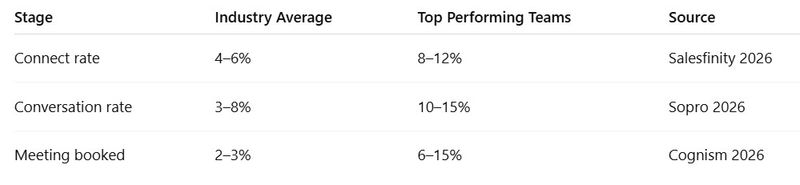
Table 1 – Cold Calling Funnel Benchmarks (2026)
Explanation
Most outbound teams convert roughly 2–3% of calls into meetings. However, top-performing teams that combine verified contact data, intent signals, and structured outreach often achieve 6–15% meeting conversion rates.
According to the Cognism Cold Calling Report (2026), which analyzed more than 200,000 outbound calls, the global average success rate for booking meetings from cold calls is 2.7%, while the best teams exceeded 11%.
The Modern Outbound Funnel
Below is a simplified view of how most outbound pipelines actually develop.
Typical B2B Outbound Funnel
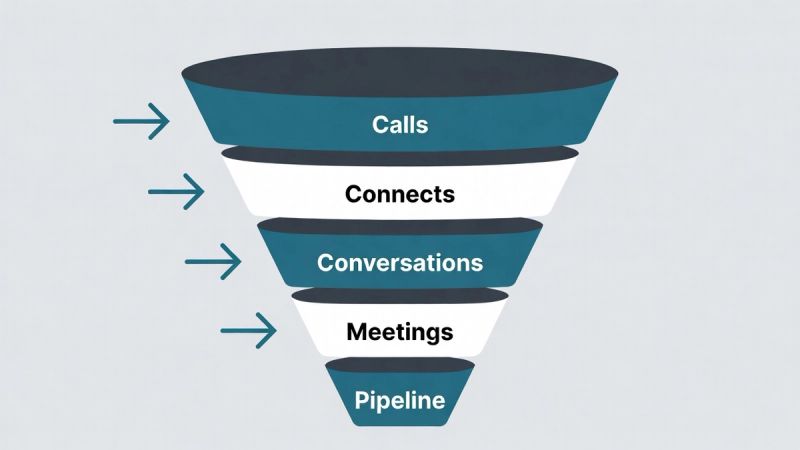
Calls → Connects → Conversations → Meetings → Pipeline
Explanation
The funnel illustrates an important reality: only a small percentage of outreach activity turns into real meetings. However, consistent activity compounds over time.
For companies implementing Outbound lead generation strategies, improving conversation volume is often the most reliable way to increase pipeline.
Why Activity Still Matters More Than Automation
Many organizations today spend weeks optimizing email automation workflows while overlooking the importance of activity levels.
Outbound success still follows a basic mathematical model.
According to Sopro’s Cold Outreach Report (2026):
- it takes 15–20 call attempts to reach a prospect
- prospects often require 8–18 touchpoints before engaging in a conversation
This means that pipeline growth rarely comes from a single message.
Instead, it comes from consistent outreach over time.
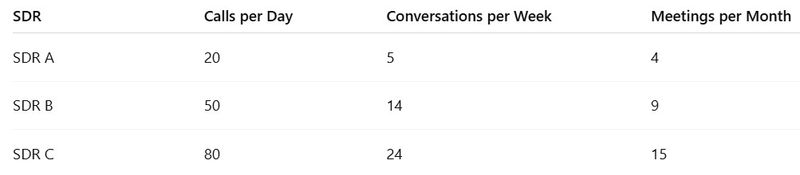
Table 2 – Example SDR Activity Comparison
Explanation
Even when conversion rates stay constant, higher activity levels naturally produce more conversations and therefore more meetings.
For organizations building Sales pipeline building for B2B companies, this activity-to-pipeline relationship remains one of the most important operational insights.
The Rise of Hybrid SDR Teams
Automation is transforming sales operations, but it is not replacing human conversations.
Instead, many companies are adopting Hybrid sales teams: AI and human SDR models.
In these systems:
AI tools help identify prospects and buying signals.
Human SDRs handle discovery conversations and relationship building.
Hybrid Outbound Workflow
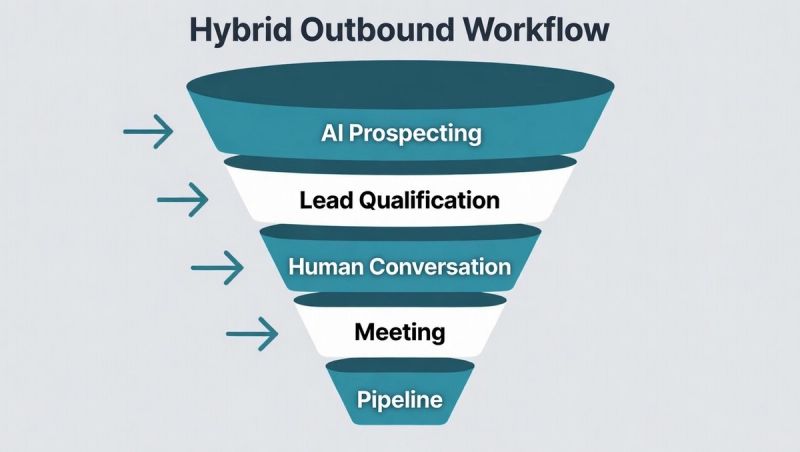
AI Prospecting → Lead Qualification → Human Conversation → Meeting → Pipeline
Explanation
AI tools accelerate research and prospect prioritization, but meaningful business conversations still require human interaction.
According to the Salesforce State of Sales Report (2026), 87% of sales organizations now use AI tools in some part of their sales workflow.
Want to Build Pipeline in APAC Faster?
Many companies entering Southeast Asia struggle to generate consistent outbound meetings.
Our team helps B2B companies build predictable pipelines through structured outreach programs.
Book a 15-minute outbound strategy call with SDR.SG.
The APAC Sales Challenge
Companies expanding into Asia often underestimate how different outbound sales can be across the region.
Several factors make the APAC market uniquely complex:
- multiple languages
- different communication styles
- fragmented markets
- varying regulatory frameworks
- complex buying committees
Strategies that work well in North America or Europe often require adjustment when applied in Asia.
That is why companies entering the region usually develop localized APAC go-to-market strategies.
How Cold Calling Varies Across APAC Markets (2026)

Outbound sales across Asia-Pacific is far from uniform.
Regulations, cultural expectations, and communication preferences vary significantly between markets. A cold call that works well in Australia may perform poorly in Japan without prior relationship building.
For companies focused on B2B lead generation in APAC, adapting outreach strategies to local conditions is essential.
Cold Calling Effectiveness by Market
Table 3 – Country-Level Cold Calling Overview
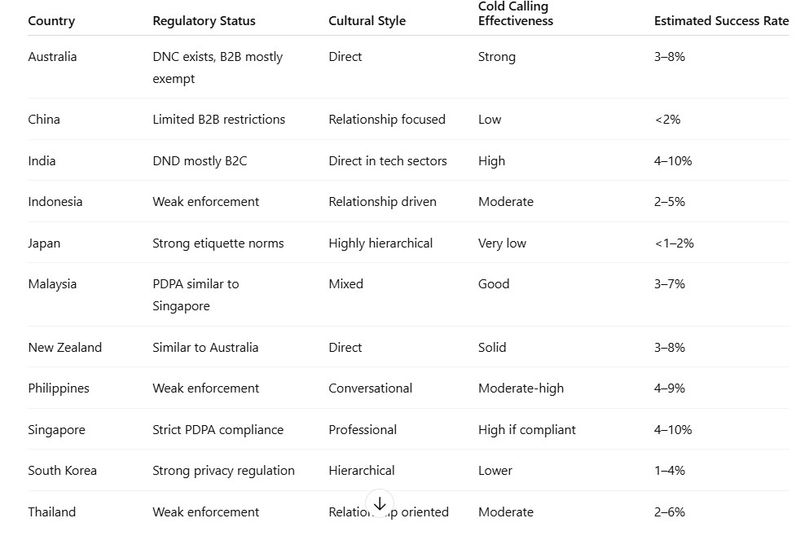
Explanation
Global benchmarks show that cold calling success averages around 2–3%, but performance varies significantly depending on local culture, regulation, and communication preferences.
Real Campaign Examples from APAC
Outbound campaigns across the region show consistent patterns once outreach becomes structured and data-driven.
Table 4 – Example Outbound Campaign Results
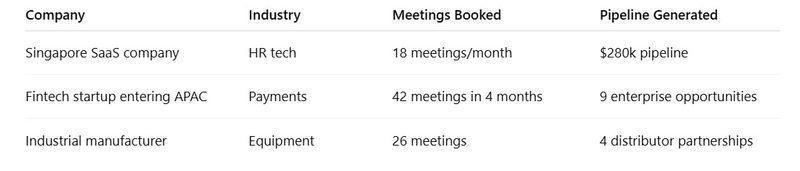
Explanation
Most outbound programs take 60–90 days before results stabilize. Once activity becomes consistent, pipeline generation becomes predictable.
This is one reason many companies entering Southeast Asia partner with Outsourced SDR services Singapore rather than building internal outbound teams immediately.
Cold Call Opening Examples That Work in APAC
The first few seconds of a cold call often determine whether a conversation continues.
Successful openings typically focus on context and relevance rather than a direct sales pitch.
SaaS Example
“Hi David, this is Mark calling from Singapore. We work with SaaS companies expanding into Southeast Asia and I noticed your team recently opened a regional office here.”
Finance Example
“Good afternoon, I’m reaching out because we’ve been helping financial services firms generate qualified meetings in Singapore and Hong Kong.”
Manufacturing Example
“Hello, I saw your company recently expanded distribution in Southeast Asia and wanted to quickly understand if finding regional partners is currently a priority.”
These approaches keep the opening concise while establishing relevance immediately.
Best Practices for Modern Outbound Teams
Based on both industry research and real campaign experience, the following practices consistently improve outbound results.
- Use intent signals before calling
- Verify contact data regularly
- Personalize the first 10 seconds of every call
- Keep opening statements under 15 seconds
- Follow up on LinkedIn after calls
- Combine inbound signals with outbound research
- Track conversation quality rather than just call volume
- Review call recordings weekly
- Experiment with different call times across time zones
- Integrate AI prospecting tools into SDR workflows
These practices help companies build scalable Outbound lead generation strategies across multiple APAC markets.

FAQ – 2026 Reader Questions
Q1: Is cold calling still effective in 2026?
A1: Yes. Despite automation tools, direct conversations remain one of the most effective ways to reach decision-makers in B2B sales.
Q2: What is the typical cold call success rate?
A2: Most teams convert around 2–3% of calls into meetings, while top-performing teams can achieve 6–15% conversion rates.
Q3: How many calls does it take to reach a prospect?
A3: Industry research suggests it typically takes 15–20 call attempts to connect with a prospect.
Q4: How is AI changing outbound sales?
A4: AI tools now assist with research, data enrichment, and identifying buying signals, allowing SDRs to focus more on conversations.
Q5: What are the best days for cold calling?
A5: Tuesday through Thursday generally show the highest connection rates.
Q6: What are the best times for cold calling in Singapore?
A6: Typically between 10:00–11:30 AM and 2:00–4:30 PM on business days.
Q7: Why do companies outsource SDR teams?
A7: Many organizations use Outsourcing to accelerate pipeline growth without the cost and complexity of building internal outbound teams.
Final Thoughts
Cold calling in 2026 looks very different from what it looked like a decade ago.
AI tools support prospect research.
Data platforms improve targeting.
Automation simplifies follow-up workflows.
But the core principle remains the same.
Pipeline begins with conversations.
And conversations often begin with a phone call.
For companies expanding across Asia, combining data-driven prospecting with human outreach remains one of the most reliable ways to generate predictable pipeline.
If your company is expanding into Asia and wants to Increase sales meetings with outsourced SDR, our team at SDR.SG helps companies build structured outbound pipelines across APAC.
Our programs combine AI-assisted prospecting, experienced SDR teams, and localized outreach strategies.
Schedule a strategy call with our team and start building a predictable outbound pipeline in Asia.
Research Note
Data referenced in this article includes insights from the State of Sales Report 2026 by Salesforce
Additional cold calling performance benchmarks come from the Cold Calling Report 2026 published by Cognism
Cold outreach benchmarks and email response statistics were referenced from research published by Sopro
Additional industry insights referenced throughout this article include research and analysis from:
- HubSpot – Sales statistics and outbound sales benchmarks
- Gartner – B2B sales transformation and the future of sales organizations
- McKinsey & Company – B2B growth strategies and global sales research
- Gong – Sales conversation intelligence and outbound call analysis
The analysis is further supported by first-party outbound campaign performance data from SDR.SG, based on B2B lead generation and sales development campaigns executed across multiple APAC markets, including Singapore, Australia, and India.