Published on:
Estimated Reading Time: 9 minutes
Written by Jasmina C., Head of Marketing at SDR.sg
👉 Book a strategy session: HERE
👉 Explore services: HERE
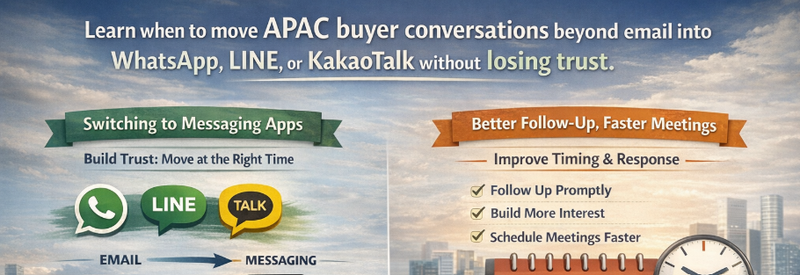
Learn when to move APAC buyer conversations beyond email into WhatsApp, LINE, or KakaoTalk without losing trust. See how stronger follow-up timing turns early interest into faster meetings.
In our first article, we explored where APAC buyer conversations move after the first touch. In the second, we looked at how to keep those conversations visible and moving across channels without losing context. This third article focuses on the most tactical question in the series: when should a seller take the conversation off email at all?
That question matters because buyers increasingly expect flexibility in how they engage. McKinsey’s B2B Pulse research found that market leaders continue to invest in omnichannel sales, while Forrester predicted that more than half of large B2B purchases worth $1 million or more would be processed through digital self-serve channels in 2025. In other words, buyers want more control over how and when conversations progress.
The first reply is not the finish line in multi-channel outbound sales APAC. In many cases, it is the most fragile moment in the whole motion. A buyer shows mild interest, asks a quick question, or replies politely, and the team assumes the hard part is over. But that is often where momentum is either built or lost.
In APAC, buyer conversations do not always stay in the inbox after the first credible touch. Once relevance is established, the next useful signal may show up in a faster, lighter, or more familiar channel. That does not mean every buyer wants to move to chat. It means strong teams know when a channel shift reduces friction and when it creates it. SDR.sg made a related point earlier in its article on LinkedIn, email, and WhatsApp in APAC outbound sales. The real win comes from assigning each channel a role instead of forcing every step into the same place.
That matters because buyers are already doing more of the journey before a seller gets meaningful access. 6sense reported that 94% of buying groups rank vendors before first contact. It also later reported that the buying journey shifted from a 70/30 split toward a 60/40 split between independent research and seller engagement. Green Hat and 6sense also found that APAC buying groups average about 10.9 people and often engage sellers only around 60% into the journey. By the time a buyer replies, there is often more context behind that response than the seller can see.
This is why the real question is not “which channel works best?” SDR.sg and other APAC-focused content already cover that territory. The more practical question is this: when should a seller take the conversation off email, and when should they not? That is the tactical decision that often determines whether early interest turns into a real meeting or quietly stalls.
Why the first reply is the most dangerous moment
Many teams misread the first reply. They treat any response as permission to accelerate. Then they push for a meeting too fast, switch channels too early, or send a follow-up that feels more invasive than helpful. The result is not just a lost reply. It is a broken trust curve.

That risk matters even more because buyers want relevance before pressure. Gartner reported in March 2026 that 67% of B2B buyers prefer a rep-free experience. That does not mean they refuse seller interaction. It means they want control before escalation. A channel shift can help if it reduces effort. It can hurt if it feels like a shortcut to pressure.
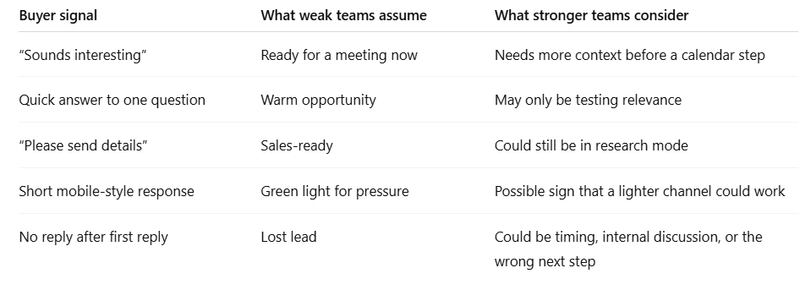
Before the first table, here is the practical rule: a first reply is not a green light to speed up blindly. It is a signal to decide whether the conversation should deepen in the current channel or move into a better one.
Table 1. What a first reply usually means, and what it does not mean
Description:
This table shows why the first positive signal should be interpreted carefully. In outbound sales in APAC markets, the job is not to force acceleration. The job is to choose the next step that creates the least friction and the most clarity. That becomes even more important when buyers prefer lower-friction and more self-directed engagement.
One of the biggest mistakes global teams make is assuming email should remain the default channel all the way to meeting booking. Sometimes it should. But sometimes the inbox becomes the slowest possible place to continue a conversation that has already become warmer. SDR.sg’s published APAC channel content and sequence case studies point in the same direction: channel mix matters most when it matches stage, buyer behavior, and market context.
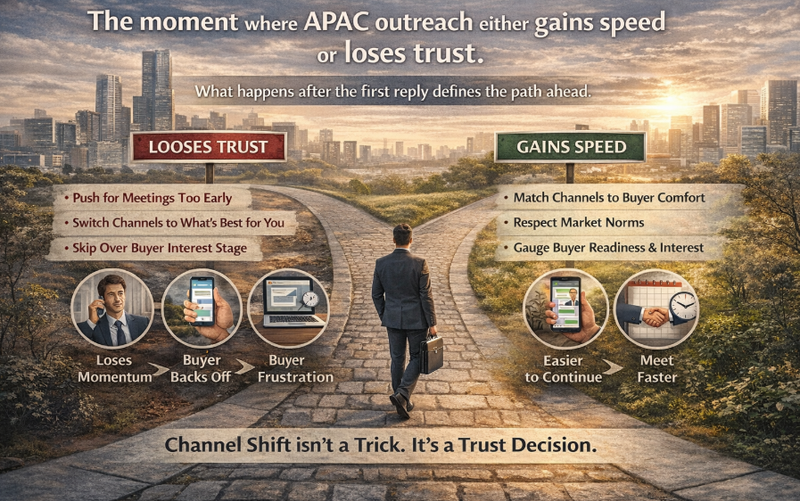
Infographic 1. The moment where APAC outreach either gains speed or loses trust
Description:
This infographic should show a fork after the first reply. One path pushes too hard, asks for a meeting too soon, or shifts channels without enough relevance and loses momentum. The other matches the next channel to buyer comfort, market norms, and stage of interest, making the conversation easier to continue. The point is that a channel shift is not a trick. It is a trust decision.
When WhatsApp helps, and when it hurts
WhatsApp works best when the buyer already knows who you are, the message can be brief, and the next step genuinely benefits from speed. That is why it tends to work better as a continuation channel than as a cold opening channel in many B2B situations. SDR.sg’s APAC content points to stronger results when WhatsApp follows initial relevance built elsewhere, rather than trying to create relevance from scratch. In one published example focused on APAC markets including Manila, SDR.sg noted that WhatsApp follow-up after LinkedIn or email improved response rates by 25 to 30%, helped book meetings within 48 hours, and contributed to a 2.5x lift in actionable replies over three months. In another structured Singapore and Indonesia sequence, SDR.sg documented 94 booked meetings in 90 days.

Why does that happen? Because WhatsApp reduces lag when the buyer is already comfortable continuing there. We Are Social reported that about four in five people in Singapore use WhatsApp monthly, and SDR.sg’s own APAC market content has repeatedly pointed to WhatsApp’s strong role in mobile-first communication in markets such as Singapore and Indonesia. That does not create permission by itself, but it does shape comfort once the buyer already sees you as relevant.
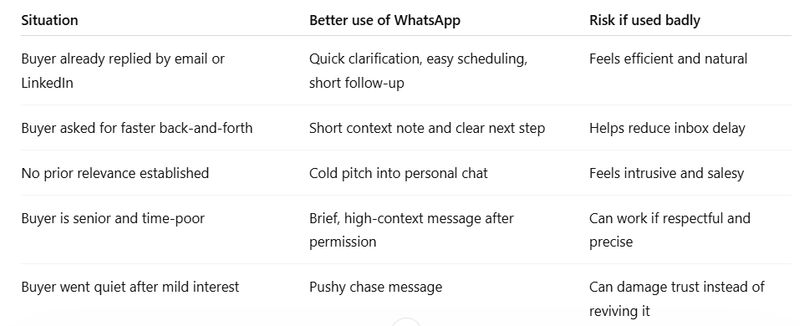
Before the second table, the key distinction is simple: WhatsApp is usually strongest when it shortens a warm next step, not when it tries to create warmth from scratch.
Table 2. When WhatsApp speeds the motion up, and when it backfires
Description:
This table shows why WhatsApp is a continuation tool, not a universal default. In stronger multi-channel outbound sales APAC motions, the question is not “Can we message here?” but “Has the buyer earned a lower-friction channel and will it make the next step easier?” SDR.sg’s own APAC case material supports that distinction.
How LINE changes the pace in Japan and Thailand
LINE is not just another chat app in Japan and Thailand. It is part of the communication rhythm. DataReportal reported that LINE had 97.0 million monthly active users in Japan in early 2025, equal to 89.1% of internet users. In Thailand, DataReportal reported roughly 56 million LINE users, equal to 85.7% of internet users. That kind of penetration matters because it shapes what people see as socially normal, low-pressure, and easy to continue.
But LINE changes more than speed. It changes tone. In Japan especially, a softer, less forceful continuation often works better than a quick meeting push. The buyer may prefer gradual exchange, more context, and less pressure. In Thailand, warmth and responsiveness still matter, but the rhythm can be more fluid. The lesson is not that one country likes chat and another does not. The lesson is that the same channel can still require a different style by market. SDR.sg’s broader APAC guidance has been consistent on this point: local fit matters as much as channel choice.
A weak team sees LINE and thinks “faster replies.” A stronger team sees LINE and asks “what pace, what tone, and what type of next step feels natural here?”
Why KakaoTalk is often about keeping warmth, not creating pressure
In South Korea, KakaoTalk is not an edge case. DataReportal reported that South Korea had 50.4 million internet users at the start of 2025, while the country also had 48.9 million social media user identities, showing just how deeply digital and messaging-led communication is embedded. SDR.sg’s South Korea content has used that same reality to argue that what matters most is often not getting the first response, but keeping momentum alive afterward.
What matters most here is not just the app. It is the trust curve. In many Korean B2B situations, the real challenge is not getting the first response. It is keeping momentum alive without making the buyer feel pushed before internal alignment is ready. A short, timely KakaoTalk follow-up can help maintain warmth between interest and meeting. But a heavy-handed push can do the opposite. That logic fits closely with SDR.sg’s recent South Korea content on how momentum often dies after first contact when teams mistake early warmth for immediate meeting readiness.
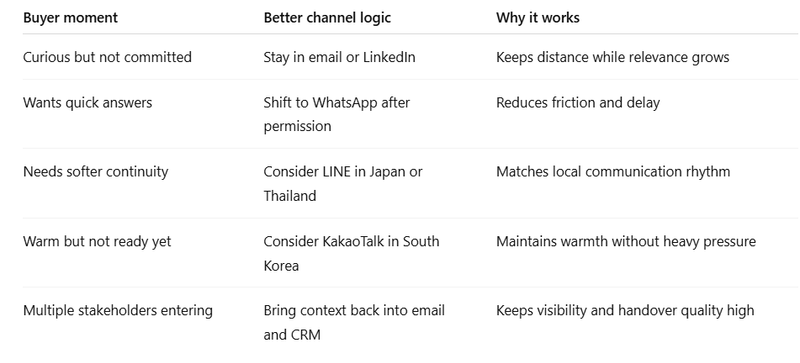
Before the third table, this is the simplest way to think about KakaoTalk in B2B: it is often more useful for maintaining trust than for escalating pressure.
Table 3. Which channel move fits which buyer moment
Description:
This table summarizes the main principle behind stronger best practices for multi-channel outbound sales. Channel shift should follow buyer need and market fit, not rep impatience. The strongest teams do not ask which app is best. They ask which move makes the next step easiest for this buyer now. That is also consistent with SDR.sg’s existing APAC outbound guidance.
What to send first after a channel shift
The first message after a shift matters more than most teams realise. If it is too long, too generic, or too sales-heavy, it makes the new channel feel invasive. If it is short, relevant, and clearly connected to the prior conversation, it lowers friction.
That usually means one of four things works best:
a short context reminder,
a concise answer to the question they already raised,
a simple timing prompt,
or a clear calendar option when meeting readiness is already obvious.
What usually works worst is pretending the channel shift itself is the achievement. It is not. It is only a change of environment. The message still has to feel earned. That is one reason structured multi-channel sequences outperform loose channel hopping. SDR.sg’s published 21-day cadence case is a good example. The result was strong not just because it used multiple channels, but because timing, role, and purpose were tightly controlled across each touchpoint.
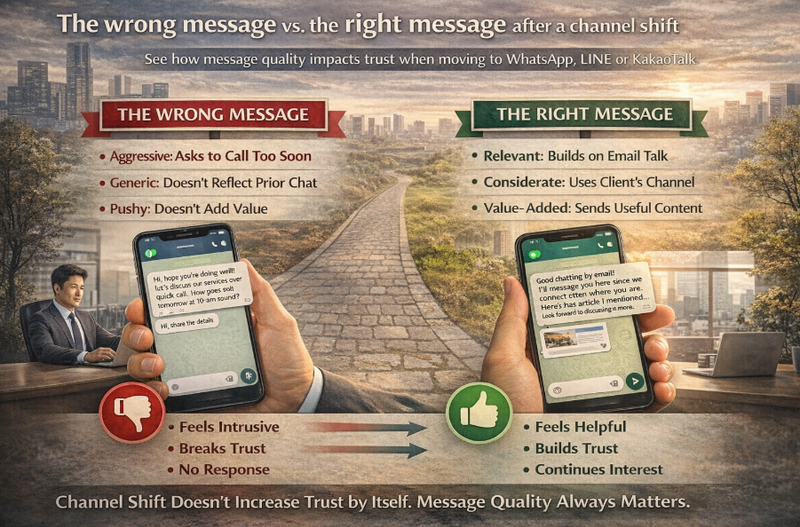
Infographic 2. The wrong message vs the right message after a channel shift
Description:
This infographic should compare two post-shift messages. One is generic, pushy, and disconnected from the earlier interaction. The other is short, contextual, and clearly tied to the buyer’s prior signal. The point is that a channel shift does not increase trust by itself. Message quality still decides whether the new channel feels useful or intrusive.
How to decide whether the shift is worth it
A simple way to decide is to ask four questions.
Has the buyer shown credible interest?
Is there a real benefit to faster or lighter communication?
Does the market make that channel feel natural after relevance is established?
Will the interaction still be captured clearly in CRM?
If the answer to those questions is yes, the shift can help. If the answer is no, staying in email may be smarter.
This is where the first two blogs in the series connect directly to this one. In the first, we explored where buyer conversations move after the first touch. In the second, we looked at how to keep APAC buyer conversations moving across every channel. This third article is narrower and more tactical: deciding when the shift should happen at all.
FAQ, common reader questions
Q1. Should WhatsApp be part of every APAC outbound motion?
No. It is strongest when relevance already exists and the buyer benefits from faster, lighter follow-up. It is not a universal cold outreach channel. That lines up with SDR.sg’s earlier APAC channel analysis.
Q2. Is LINE mainly relevant in Japan?
It is very important in Japan, but it also has strong penetration in Thailand. The key issue is not only the app but the communication rhythm it creates.
Q3. Why is KakaoTalk different from WhatsApp in B2B use?
In many Korean contexts, KakaoTalk often helps preserve warmth and continuity rather than force fast escalation. Its role is often trust maintenance, not pressure. That is why the timing of the follow-up matters as much as the channel itself.
Q4. When does a channel shift feel intrusive?
When it happens before enough relevance or permission exists, or when the first message in the new channel is too sales-heavy. That is especially risky when buyers prefer a lower-friction or self-directed buying experience.
Q5. What is the safest first message after switching channels?
A short message that references the prior interaction, adds one useful piece of context, and makes the next step easier.
Q6. Should every side-channel conversation be logged in CRM?
Every commercially meaningful one should. Otherwise the account story breaks and handover quality suffers. SDR.sg has already reinforced this logic in its reporting and multi-channel workflow content.
Q7. What is the biggest mistake global teams make here?
Treating channel shift as a tactic for speed instead of a decision about trust, timing, and buyer comfort. That is exactly where many APAC motions lose momentum after the first reply.
Final takeaway
The best teams do not take APAC buyer conversations off email because those apps are popular. They do it only when the shift makes the next step easier, warmer, and more natural for the buyer. That is the real logic behind stronger multi-channel outbound sales APAC. Not more channels for the sake of it. Better continuity at the moment when momentum is easiest to lose.
If the first reply is the most fragile moment in the motion, then the next channel choice is one of the most important decisions. Make it too early and you create friction. Make it well and you turn mild interest into a faster, cleaner path to a real meeting. That is the difference between activity and progress.

If your team is getting first replies in APAC but struggling to convert them into qualified meetings, the problem may not be messaging volume. It may be what happens next.
SDR.sg helps B2B teams build multi-channel outbound sales APAC systems that know when to stay in email, when to shift channels, and how to keep every buyer interaction visible across the workflow. A practical next step is to review your current post-reply motion: what your reps send next, how they decide to shift channels, and where momentum usually drops between interest and meeting.