Published on:
Estimated Reading Time: 13 minutes
Written by Jasmina C., Head of Marketing at SDR.sg
Discover what actually works in Australia outbound. Real lessons on ICP, messaging, and multichannel strategy for B2B lead generation in APAC.

This is the third and final article in our Australia outbound series. In the first piece, Why the Australian B2B Market Takes Longer to Break Into Than Most Teams Expect, we looked at why Australia often converts more slowly than teams expect. In the second, How to Structure Outbound for Australia So It Generates Meetings, Not Just Replies, we focused on the operating model behind stronger outbound execution. This final piece is about what the work itself taught us: what improved pipeline quality, what stalled it, how the messaging evolved, and which outreach approaches were actually effective in the Australian market.
Australia is still one of the most attractive B2B markets in APAC. The Australian Bureau of Statistics reported 2,729,648 actively trading businesses as of 30 June 2025, including 994,178 employing businesses. But as the first article in this series made clear, market size alone does not make outbound easy. 6sense’s 2025 Buyer Experience Report found that B2B buyers evaluate an average of 4.5 vendors, shortlist about 3.4 vendors on day one, and in 95% of cases buy from that initial shortlist.
The practical lesson from execution was simple: Australia responded best when targeting became tighter, messaging became narrower, and outreach became more disciplined.
Lesson 1: Pipeline quality improved only after ICP quality improved
The earliest issue was not cadence or tooling. It was targeting.
The first version of the motion was too broad. It covered too many accounts with partial fit, too many personas without clear problem ownership, and too much assumption that regional relevance alone would carry the outreach. It generated activity, but not enough qualified movement.
That changed when the ICP became narrower. The strongest accounts were the ones with more visible operational complexity, clearer commercial triggers, and stakeholders who could recognize the problem quickly. Once those conditions were present, the rest of the outbound system started working better.
This was one of the clearest links between all three articles in the series. The first showed that Australia punishes vague positioning. The second showed that better structure improves meeting outcomes. In practice, both start with better account selection.
This is where most B2B lead generation efforts in APAC start to break down, long before messaging or sequencing becomes the issue.
Before moving to messaging, it helps to look at what changed once the ICP became sharper.
Table 1: What changed when we narrowed the Australia ICP
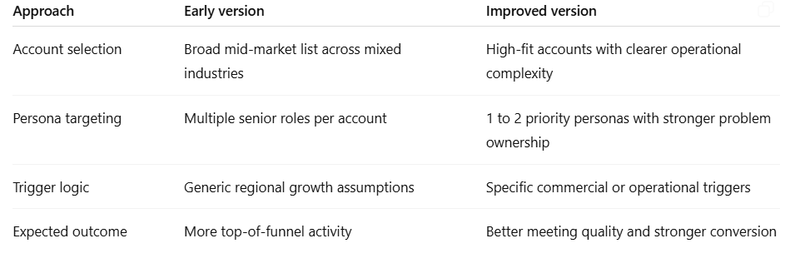
Description:
This table shows the first major lesson from Australia outbound. Narrowing the ICP reduced wasted activity and improved the odds that replies would turn into qualified conversations.
Lesson 2: Generic messaging created replies, but targeted messaging created meetings
Once the ICP improved, the next problem became easier to see.
The early messaging was polished, but too broad. It explained the offer well, but it still asked the buyer to do too much work. They had to decide for themselves whether the message was relevant, what problem it referred to, and why it justified a meeting now.
In most outbound prospecting workflows, this is where conversion starts to diverge between generic campaigns and targeted outbound.
That changed when the messaging became more specific, calmer, and more commercially direct.
Instead of trying to sound broadly impressive, the outreach started sounding more immediately useful. It focused on one problem, one angle, and one reason to talk. That shift made the message easier to place, easier to trust, and easier to respond to seriously. That matters even more because outbound messages are rarely judged in isolation. LinkedIn reported that audiences increasingly rely on their networks, not just brand-owned channels, to vet vendors, which makes visible credibility and trust signals more important in markets like Australia.
Table 2: Messaging evolution in Australia outbound
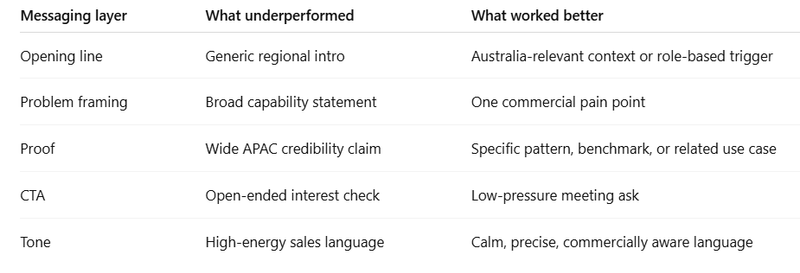
Description:
This table shows how messaging evolved from polished but broad to narrow and meeting-focused. In Australia, that shift often mattered more than increasing send volume.
That pattern also lines up with SDR.sg’s benchmark content. In APAC Cold Email Open Rates 2026: How to Hit 40%+, average outbound performance is framed at 20% to 30% open rates, 3% to 6% reply rates, and 1% to 2% meetings booked, while stronger localized campaigns can reach 35% to 45% opens, 8% to 12% replies, and 4% to 6% meetings booked. The important takeaway is not just that better messaging improves replies. It is that tighter relevance improves meeting conversion.
Related reading: APAC Cold Email Open Rates 2026: How to Hit 40%+ (Guide + Benchmarks)
Lesson 3: Email alone was not enough
This was one of the clearest execution lessons.
The first version of the motion leaned too heavily on email. The copy was reasonable, but the channel mix was incomplete. In Australia, where buyers often want more familiarity before engaging seriously, email alone left too much trust-building undone.
Once the outreach became properly multi-channel, the quality of engagement improved.
Infographic 1: How the Australia outbound motion evolved
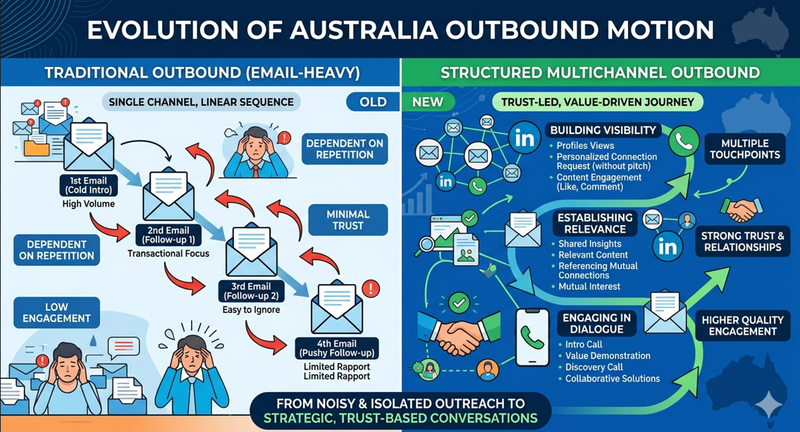
Description:
This infographic should show the shift from an email-heavy first version to a structured multichannel motion using email, LinkedIn, and phone. It should visually map how the outreach became more trust-led and less dependent on a single touchpoint.
The most effective channel mix looked like this:
- Email created context
- LinkedIn built familiarity
- Phone tested timing and seriousness
- Fast follow-up protected momentum
This is why multichannel outbound consistently outperforms single-channel approaches in more mature markets like Australia.
This lesson also aligns with SDR.sg’s earlier tactical content. The strongest-performing sequences were not louder. They were more coordinated.
Related reading: LinkedIn + Email + Cold Call: The Exact Sequence That Delivered 94 Booked Meetings in 90 Days for a SaaS Client
Lesson 4: Replies were easy to overestimate
One of the most important lessons from Australia was how easy it was to misread engagement.
A reply can mean curiosity. It can mean politeness. It can mean wrong timing, internal delegation, or real buying intent. Those are very different signals, but they can look similar on a dashboard.
That is why the distinction between reply activity and pipeline movement mattered so much. A clean-looking campaign could still underperform commercially if qualification was weak.
Without a clear qualification layer, even strong sales pipeline generation efforts can stall at the reply stage.
Infographic 2: Reply activity versus pipeline movement in Australia
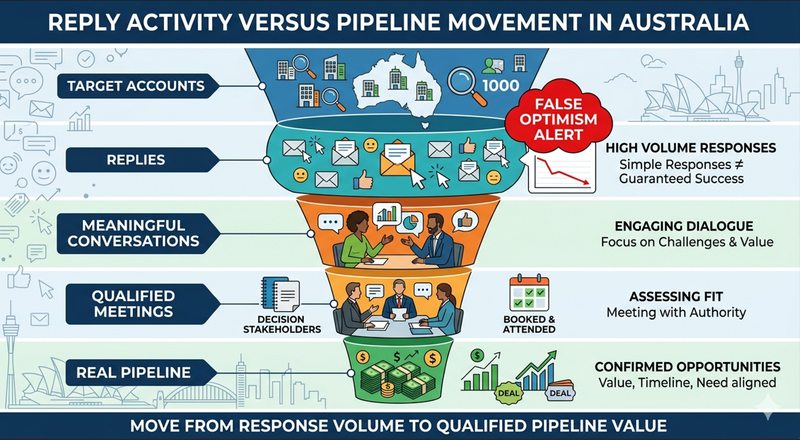
Description:
This infographic should show a funnel from target accounts to replies, then to meaningful conversations, qualified meetings, and real pipeline. The point is to show where false optimism appears when reply rate is treated as success.
Speed mattered here too. SDR.sg’s time-zone and follow-up benchmark content says that first response within 30 minutes can increase meetings booked by 35%, while delayed follow-up can reduce conversions significantly across APAC motions. In Australia, that speed mattered most when the follow-up itself clarified the problem, the stakeholder, and the timing.
Related reading: Stop Losing APAC Deals: Selling Across Time Zones Without Killing Your SDR Team
Lesson 5: Follow-up quality mattered more than first-touch creativity
A lot of outbound advice focuses on the opening line.
In practice, follow-up quality mattered more.
In most outbound sequencing models, this is where deals are either qualified properly or quietly lost.
Once a prospect replied, the next step needed to do one of four things:
- clarify the problem
- confirm the stakeholder
- identify timing
- create a low-friction next step
The mistake was assuming that a positive reply should immediately be pushed into a meeting. Broader sales data supports that pattern too. HubSpot reports that 80% of successful sales require five or more follow-up calls, while 44% of salespeople give up after a single follow-up attempt. The better approach was to tighten the thread first, then move the prospect forward.
This is where the second article in the series becomes especially useful again. Strong sequence design is not just about how outreach starts. It is about how each touch reduces uncertainty and earns the next step.
Before summarizing the broader outcome, it helps to look at the workflow that performed best.
Table 3: What the strongest Australia outbound workflow looked like
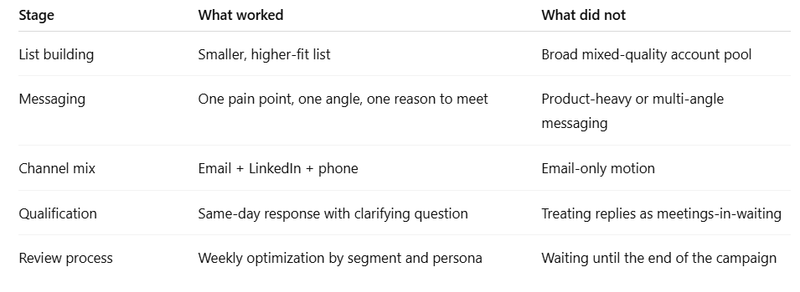
Description:
This table shows the workflow lessons that produced better pipeline in Australia. The common theme is simple: less randomness, more operational discipline.
What the numbers actually taught us
This is where the difference between activity and actual pipeline generation in B2B outbound becomes visible
The strongest lesson was not theoretical. It was operational.
In SDR.sg’s earlier APAC outreach example, a campaign sent 1,500 emails, generated 41 replies, roughly 2.7%, and booked only 6 meetings. That campaign was an early-stage regional motion with a broader ICP, weaker message-market fit, and less structured sequencing. It created activity, but not enough conversion quality to build real momentum.
Related reading: Why Our First Outreach Campaign Failed

By contrast, SDR.sg’s multichannel sequence case study delivered 94 booked meetings in 90 days using a tightly coordinated 21-day sequence repeated across 412 account-contact combinations. The context matters here. That campaign used a narrower ICP, clearer role-based messaging, and a fully coordinated channel mix. It was not just “better copy.” It was a stronger operating model.
Related reading: LinkedIn + Email + Cold Call: The Exact Sequence That Delivered 94 Booked Meetings in 90 Days for a SaaS Client
Another useful benchmark comes from SDR.sg’s broader 2026 case material, where an outsourced SDR setup for a SaaS HR tool targeting Australia produced 180 SQLs in the first 90 days, reduced CAC by 35%, and generated 2x more meetings booked than in-house projections. That example is useful not because every team should expect the same outcome, but because it reinforces the same pattern: targeted structure outperforms generic effort.
Related reading: How Outsourced SDR Services Drive B2B Lead Generation in APAC: 2026 Real Cases and Benchmarks
For teams building outbound into Australia, the practical benchmark is not whether outreach gets attention. It is whether the motion can move from the 1% to 2% meetings booked range toward the 4% to 6% range seen in stronger localized campaigns.
The final takeaway
What worked in Australia was not one clever tactic.
It was a combination of better account selection, narrower messaging, multi-channel sequencing, faster qualification, and more disciplined review.
What did not work was broad targeting, product-heavy positioning, email-only outreach, and treating replies as success too early.
That is the clearest conclusion from this three-part Australia series.
The first blog showed why the market is harder than it looks.
The second showed how to structure outbound correctly.
This third one shows what the market teaches you once you actually execute.
In mature markets, the teams that win are usually not the teams doing the most. They are the teams doing the right things in the right order.
FAQ – Common Questions
Q1. How is this third article different from the first two?
The first article focused on why Australia is harder than it looks. The second explained how to structure outbound properly. This third article focuses on practical lessons learned from execution.
Q2. What was the biggest mistake in early Australia outbound?
The biggest mistake was broad targeting. Once the ICP became narrower and more problem-led, meeting quality improved.
Q3. Did email-only outbound work in Australia?
Not well enough. The stronger motion used email, LinkedIn, and phone together.
Q4. What changed the messaging most?
The shift from broad capability language to one clear commercial pain point made the biggest difference.
Q5. Why were replies easy to misread?
Because many replies reflected curiosity or politeness rather than real commercial intent.
Q6. How long does it usually take to see results in Australia?
Usually longer than teams expect. Early engagement can appear within the first few weeks, but consistent qualified meetings often depend on several weeks of structured follow-up, sharper qualification, and message refinement.
Q7. What mattered more than first-touch creativity?
Follow-up quality. The best results came from faster, more qualifying follow-up rather than clever opening lines alone.

Conclusion
If your team is trying to build pipeline in Australia, the goal is not to generate more noise.
It is to create more qualified movement.
Australia is absolutely winnable. But it tends to reward precision more than pressure. That means stronger ICP work, sharper messaging, better sequencing, clearer follow-up, and a more realistic view of what engagement really means.
That is where targeted outbound starts to produce meetings.
That is where meetings start to compound into pipeline.
Looking to build more predictable pipeline in Australia? SDR.sg helps B2B companies combine AI-assisted prospecting with experienced human SDR execution to create better meetings, stronger qualification, and more consistent pipeline across APAC.
👉 Book a strategy session: HERE
👉 Explore services: HERE