Published on:
Estimated Reading Time: 13 minutes
Written by Jasmina C., Head of Marketing at SDR.sg
👉 Book a strategy session: HERE
👉 Explore services: HERE
AI generated outbound emails can speed up sales outreach, but without human review they can scale broken placeholders, weak personalisation and buyer trust issues. See how SDR.sg protects outbound quality.
AI generated outbound emails are now part of modern sales development.
That is not a problem.
AI can help teams research accounts faster, identify patterns, draft first versions of messages, summarise signals, and support more structured outbound execution. Salesforce notes that AI for sales can support lead scoring, forecasting, personalised outreach and call coaching, while HubSpot reported that AI adoption among salespeople rose from 24% in 2023 to 43% in 2024.
The problem starts when AI-written emails are treated as ready to send without enough human review.
Because buyers do not see the workflow behind the email.
They only see the message.
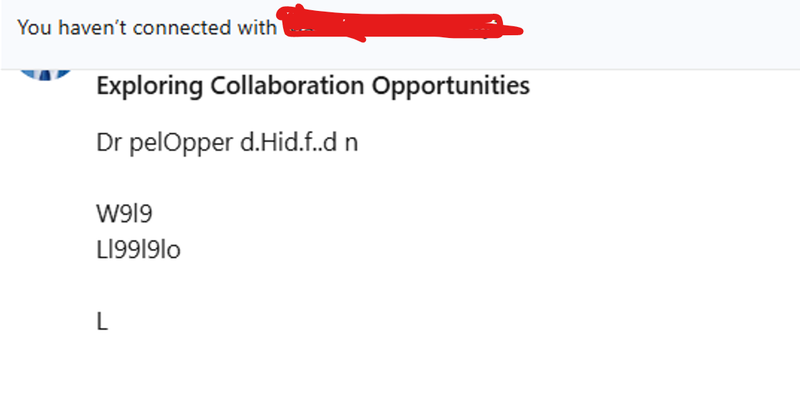
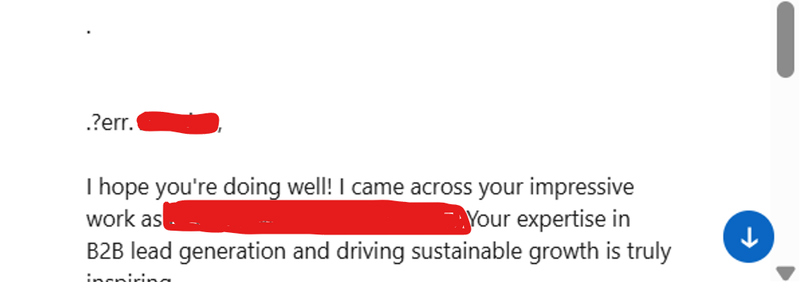
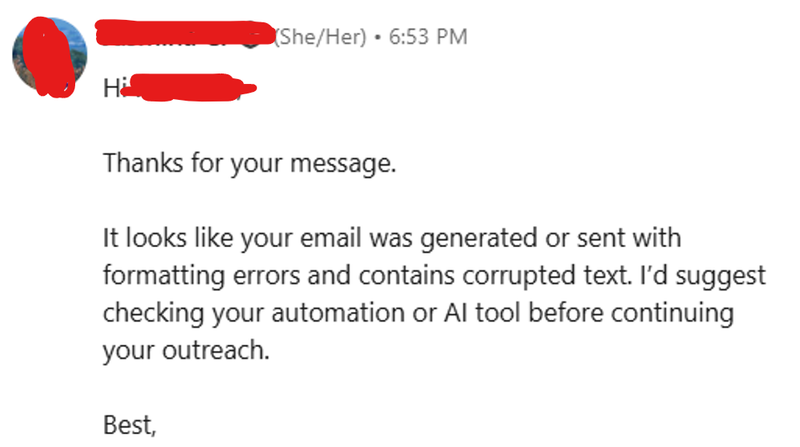
And when that message includes a broken placeholder like:
Hi [First Name],
or worse:
Hi (),
the buyer immediately knows something was not checked.
The same happens when the email references the wrong company, uses an insight that has nothing to do with the buyer, or connects a personalisation point to an offer that makes no commercial sense.
That is not just a copy issue.
It is a trust issue.
At SDR.sg, we use AI because it is useful. But we do not believe professional outbound should be left to automation alone. AI can create speed and structure. Human review protects accuracy, relevance and credibility before a message reaches the market.
That distinction matters even more in APAC, where buyer expectations, communication norms and channel preferences can vary significantly across Singapore, Australia, Indonesia, Malaysia, Japan, India and other markets. SDR.sg has already written about why outbound in APAC requires context-aware execution, not copy-paste messaging across channels.
The issue is not AI. The issue is unsupervised AI.
AI is not the enemy of good outbound.
Used properly, AI-powered sales prospecting tools can improve research speed, surface account signals, help SDRs draft relevant first messages and reduce repetitive manual work. Stanford’s 2025 AI Index reported that 78% of organisations used AI in 2024, up from 55% the year before, showing that AI has moved from experimentation into mainstream business use.
The risk is not that AI exists in the outbound process.
The risk is when there is no serious quality control between the AI output and the buyer’s inbox.
A human SDR can make a mistake. But that mistake usually happens more slowly.
An AI-assisted system can repeat the same mistake across hundreds of contacts before anyone notices.
One bad merge field can affect an entire segment.
One weak persona assumption can shape a full sequence.
One irrelevant insight can be reused across an APAC campaign.
That is where automation becomes risky.
Not because it is fast.
Because it is fast without supervision.
SDR.sg has covered the value of hybrid execution before, especially in the context of AI and human SDR collaboration. The new issue here is more specific: what happens at email level when quality control is missing.
Table 1: Common AI email mistakes buyers notice immediately
Before looking at frameworks, it helps to name the mistakes clearly. These are the errors that make a buyer question the sender before they even consider the offer.
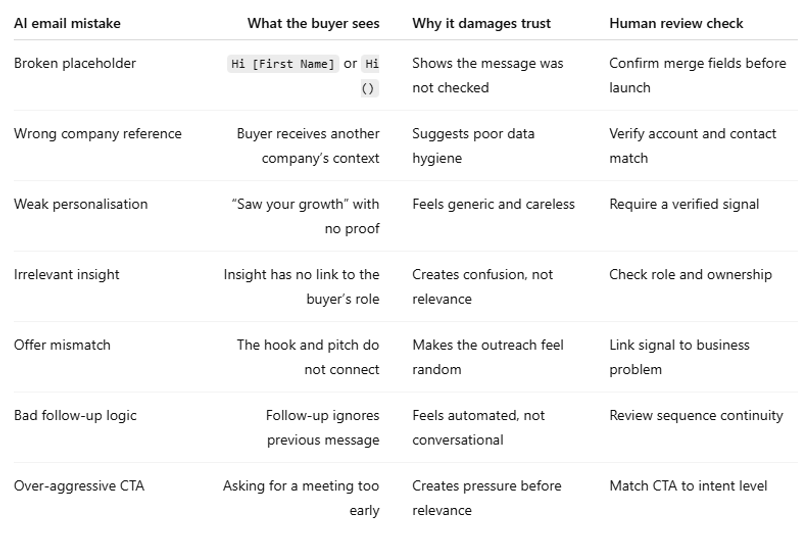
Table explanation:
These errors are not simply formatting problems. They are buyer-facing trust signals. In a strong hybrid SDR team model, AI supports speed, but humans check whether the message is safe, relevant and credible enough to send.
Bad personalisation can be worse than no personalisation
A generic email is easy to ignore.
A badly personalised email is harder to forgive.
Why?
Because bad personalisation pretends to understand the buyer.
When an email references a person’s company, market or role, it creates an expectation that the sender has done some thinking.
If the insight is wrong, weak or disconnected from the offer, the message does the opposite of what it was supposed to do.
It does not create relevance.
It creates doubt.
Gartner research reported by the Journal of Sales Transformation found that 73% of B2B buyers actively avoid suppliers who send irrelevant outreach. The same research found that 61% of B2B buyers prefer an overall rep-free buying experience, which means sellers have less room to waste attention with weak or careless outreach.
For B2B lead generation in APAC, this is especially important. Buyers are often evaluating multiple vendors, comparing information across channels, and involving several stakeholders before agreeing to a conversation. A poor first message can quietly disqualify a seller before a meeting ever happens.
Strong personalisation is not about proving you found a fact.
It is about proving you understand why that fact matters.
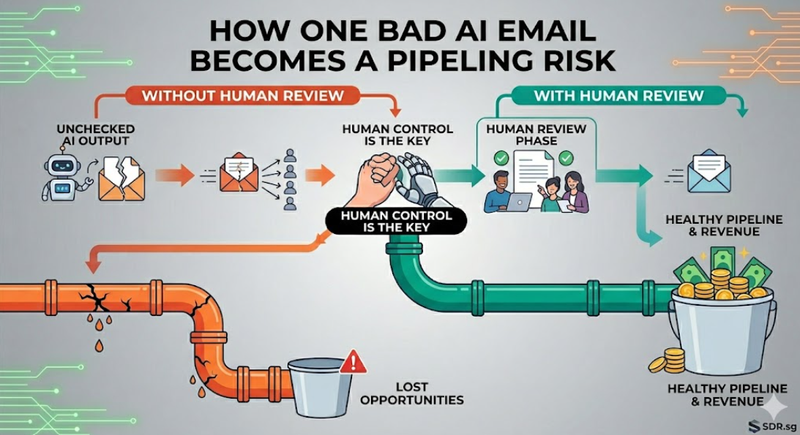
Infographic 1: How one bad AI email becomes a pipeline risk
The risk of AI-generated email mistakes is not only the single bad message. The risk is the path from one unchecked output to broader pipeline damage.
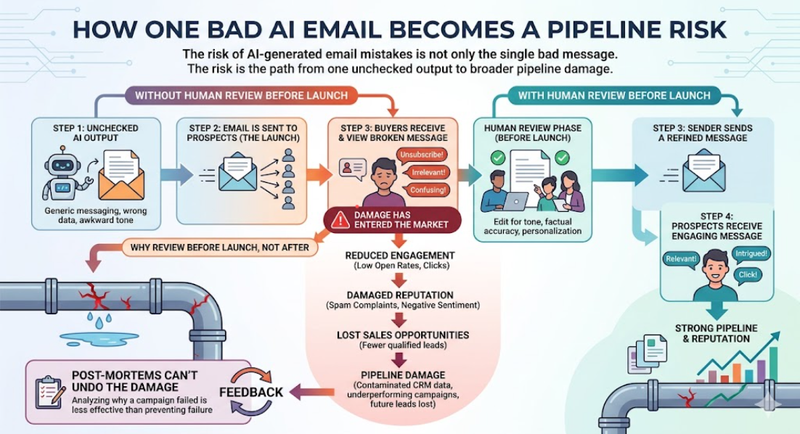
Infographic description:
This workflow shows why human review should happen before launch, not after the campaign underperforms. Once buyers have seen a broken or irrelevant message, the damage has already entered the market.
AI can make weak assumptions sound polished
One reason AI generated outbound emails are risky without review is that AI can make weak logic sound confident.
For example, AI may assume that:
- A company is expanding because it saw hiring activity
- A CFO owns a problem that actually sits with operations
- A regional leader should receive the same message as a local manager
- A company announcement is relevant to the product being sold
- A reply like “send details” is automatically a qualified buying signal
Some assumptions may be right.
Some may be completely wrong.
The problem is that the email can still sound smooth.
McKinsey’s 2025 State of AI research shows that organisations are continuing to focus on capturing AI value, while its earlier research highlighted the need to mitigate inaccuracy as adoption accelerates.
That is exactly why human review matters in outbound.
AI can draft the message.
A person still needs to decide whether the message should be sent.
Table 2: Before and after human review
A useful way to understand SDR.sg’s approach is to compare what happens when AI output is sent too quickly versus when it goes through human review.
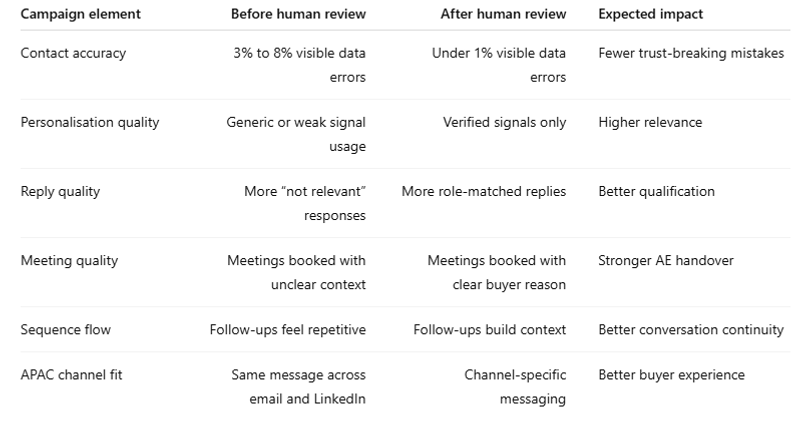
Table explanation:
These are practical quality-control benchmarks for an AI-assisted outbound workflow. The exact numbers vary by industry and campaign, but the direction is consistent: human review reduces visible errors and improves commercial relevance before outreach reaches buyers.
Human review is not copy editing
This is where many teams misunderstand the role of humans in AI-assisted SDR prospecting.
Human review is not only checking grammar.
It is not only making the email sound warmer.
It is not only replacing one sentence with a better sentence.
Real review checks the commercial logic behind the email.
Before SDR.sg sends outreach, the question is not simply:
“Does this email read well?”
The better questions are:
- Is this the right contact?
- Is this company a good fit?
- Is the role relevant to the problem?
- Is the insight accurate and safe to reference?
- Does the insight connect to the offer?
- Does the CTA fit the level of buyer intent?
- Does the tone fit the market and channel?
- Does the follow-up make sense based on the previous touchpoint?
This is the difference between basic automation and professional outbound.
Basic automation sends more.
Professional outbound sends better.
Table 3: SDR.sg quality control framework for AI-assisted outbound
The best way to use AI is not to remove humans from outbound. It is to give humans better leverage while keeping them in control of decisions that affect buyer trust.
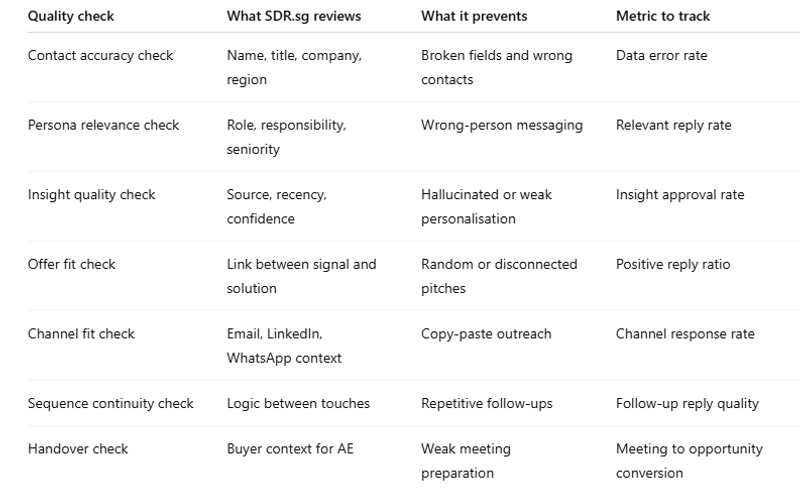
Table explanation:
This framework turns human review into an operating system, not a vague principle. It supports stronger outbound lead generation strategies because every email is checked for accuracy, context and commercial relevance before it represents the brand.
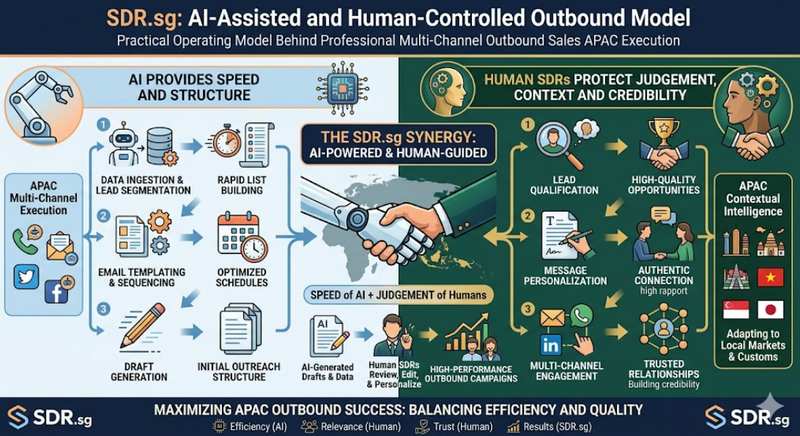
Infographic 2: The SDR.sg AI and human outbound model
SDR.sg’s model is not anti-AI. It is AI-assisted and human-controlled.
Infographic description:
AI improves speed and structure. Human SDRs protect judgement, context and credibility. This is the practical operating model behind professional multi-channel outbound sales APAC execution.
Real example: when speed creates noise, and review creates relevance
Consider a software company expanding into Singapore and Australia.
The team wants to reach 800 target accounts across two markets. AI helps generate account summaries and first-touch email drafts. The output looks efficient. Hundreds of emails can be prepared quickly.
But during review, several issues appear:
- 6% of contact records have outdated titles
- 4% of company references are too generic to use
- 18% of AI-generated insights are accurate but commercially irrelevant
- 22% of CTAs are too direct for first-touch outreach
- Several follow-ups repeat the same ask without adding new context
If sent as-is, the campaign would look active on the dashboard. Emails would go out. Opens might come in. Replies might even appear.
But the quality risk would be high.
After review, the campaign is adjusted:
- Low-confidence insights are removed
- Senior buyers receive shorter, sharper messages
- First-touch CTAs are softened
- Follow-ups are rewritten to build context
- APAC market differences are reflected in tone and channel use
This is where SDR.sg adds value.
Not by slowing the process down for the sake of it.
By making sure speed does not come at the expense of credibility.
SDR.sg’s own APAC benchmark content shows that cold outbound averages around 20% to 30% open rates, while top-performing teams reach 35% to 45%; reply rates average 3% to 6%, while stronger campaigns reach 8% to 12%; and meetings booked average 1% to 2%, with top teams reaching 4% to 6%.
The difference is rarely just volume.
It is targeting, relevance, timing, message quality and human judgement.
How this connects to existing SDR.sg thinking
This article does not replace SDR.sg’s existing guidance on AI, workflow and APAC outbound. It narrows the focus to one important execution layer: email quality before send.
For broader context, read SDR.sg’s guide on how AI is changing outbound sales and where human SDRs still win.
For signal-based targeting, read the 2026-proof guide to digital signals and lead qualification in APAC.
For workflow issues that stop pipeline from scaling, read the SDR.sg article on hidden SDR workflow problems in APAC and Singapore.
Together, these pieces support one operating principle:
AI helps outbound teams move faster.
Human oversight makes sure they are moving in the right direction.
FAQ: AI generated outbound emails and human review
Q1. Are AI generated outbound emails bad for B2B sales?
No. AI generated outbound emails are not bad by default. They become risky when companies send them without checking accuracy, relevance and buyer context.
Q2. Why do AI-written sales emails often sound wrong?
They often sound wrong because AI can write fluent copy without fully understanding the buyer’s role, market, pain point or decision context.
Q3. What are the most common AI email mistakes?
The most common mistakes include broken placeholders, wrong company references, weak personalisation, irrelevant insights, wrong persona messaging and follow-ups that ignore previous context.
Q4. How does SDR.sg use AI in outbound?
SDR.sg uses AI to support research, drafting, signal summaries and structure. Human SDRs then review the message for accuracy, relevance, tone, timing and commercial logic.
Q5. Why is human review important in APAC outbound?
APAC markets differ by culture, language, channel behaviour, seniority expectations and buying process. Human review helps adapt outreach so it does not feel copied, careless or out of place.
Q6. What is the best way to measure outbound email quality?
Look beyond open rates. Track relevant reply rate, meeting quality, data error rate, handover quality, positive reply ratio and meeting to opportunity conversion.
Q7. Can AI replace SDRs?
AI can replace some repetitive tasks. It should not replace human judgement in buyer-facing outreach. The strongest model is usually AI-assisted and human-reviewed.
Final thought
AI can make outbound faster.
That is useful.
But speed is not the same as quality.
If an outbound system sends broken placeholders, irrelevant insights or mismatched messages, it is not simply moving quickly. It is scaling mistakes.
That is why AI generated outbound emails still need human review.
At SDR.sg, AI supports speed, structure and research. Human SDRs protect relevance, credibility and buyer trust.
That is the difference between automated outreach and professional outbound execution.
If your outbound engine is moving faster but not producing better conversations, it may be time to review what is happening before messages reach buyers.
SDR.sg can help you assess your current outreach workflow, identify where AI-generated messaging may be creating risk, and build a more controlled AI and human outbound process for APAC.
Book a strategy session with SDR.sg to review your outbound quality control process and identify where human oversight can improve reply quality, meeting quality and pipeline conversion.