Published on:
Estimated Reading Time: 10 minutes
Written by Jasmina C., Head of Marketing at SDR.sg
👉 Book a strategy session: HERE
👉 Explore services: HERE
B2B lead generation in APAC is no longer just about email opens and replies. Learn where buyer conversations move after the first touch, from WhatsApp and LINE to KakaoTalk and WeChat, and how smarter teams track real buying signals.
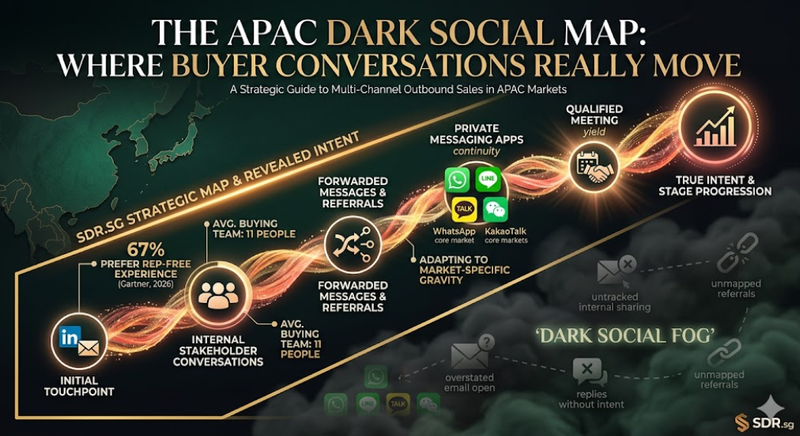
If your team still measures B2B lead generation in APAC mainly through email opens, reply rates, and send volume, you are probably seeing only the most visible layer of buyer activity. In APAC, real commercial movement often starts in the inbox but does not stay there. The first touch may be email or LinkedIn, but the next meaningful signal can shift into warmer, more private environments, including internal stakeholder conversations, forwarded messages, messaging apps, and referral-based follow-up.
That shift matters because buyers are already doing more on their own before a seller ever enters the picture. 6sense’s 2025 Buyer Experience Report found that 94% of buying groups rank vendors before first contact, while a later 6sense update said the buyer journey had moved from a 70/30 split to a 60/40 split between independent research and seller engagement. In APAC specifically, Green Hat and 6sense reported that buyers now reach out at around 60% of the journey, with an average buying cycle of 11 months and buying teams of about 11 people.
At the same time, inbox metrics have become less reliable. Apple says Mail Privacy Protection prevents senders from seeing whether a recipient opened an email and downloads remote content in the background by default. So if your outbound reporting still treats opens as a strong proxy for interest, it is likely overstating what is actually happening.

This is the core argument of this article: the real problem in how to generate B2B leads in APAC is not that email stopped working. The problem is that too many teams still treat visible inbox activity as the whole buying signal, when much of the real progress has already moved elsewhere. That is exactly why a stronger APAC go-to-market strategy needs to track movement, not just activity.
As we explored in Selling in APAC: The SDR Reality No One Talks About, the region punishes copy-paste global playbooks. This article goes one level deeper and asks a more important question: where does the buyer conversation move after the first credible touch?
Why B2B lead generation in APAC breaks when teams track the wrong signals
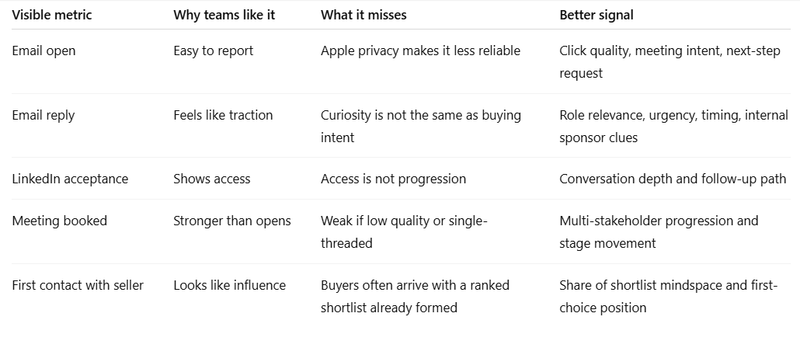
The easiest metrics to report are usually the weakest indicators of buying progress. Opens are easy. Replies are easy. Even meeting counts can be misleading if the meetings are low-intent, poorly qualified, or single-threaded. Stronger sales pipeline building for B2B companies depends less on activity volume and more on progression quality. That is a big reason many teams feel busy without actually moving enough revenue.
Before the first table, here is the key lens: if your dashboard is built around what is easiest to count, it will often miss what is most commercially important.
Table 1. What teams see vs what actually matters
Description:
This table shows the gap between visible outreach activity and commercially meaningful buying signals. The point is not that opens and replies are useless, but that they are much weaker indicators than stakeholder expansion, next-step intent, and stage progression.
A related issue is buyer preference. Gartner reported in March 2026 that 67% of B2B buyers prefer a rep-free experience. That does not mean sellers no longer matter. It means buyers want to engage later, with more control, and on their own terms. So when a global team interprets silence as rejection, it often misreads what is actually happening. The buyer may still be researching, validating internally, or waiting for the conversation to continue in a more natural channel.
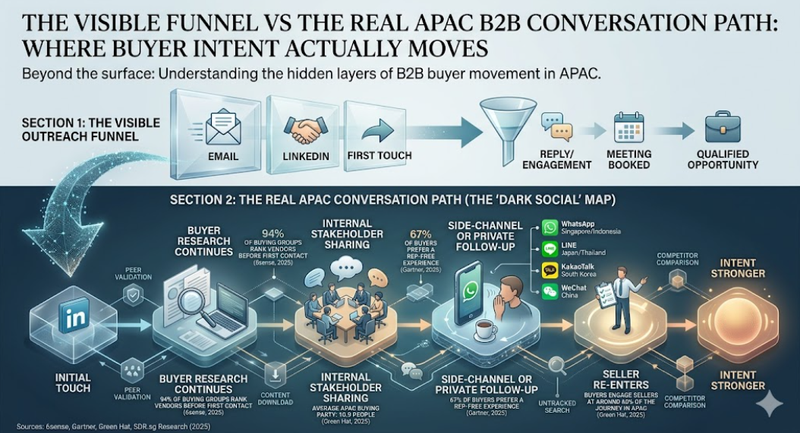
Infographic 1. The visible funnel vs the real APAC conversation path
Description:
This infographic should show the difference between visible outreach and hidden buyer movement after first touch: email or LinkedIn outreach, then internal stakeholder sharing, private validation, side-channel follow-up, and only later a clearer seller-facing signal. The point is simple. In APAC, the buyer journey is often more private, more nonlinear, and harder to read if you only trust inbox metrics.
Where buyer conversations actually move in multi-channel outbound sales APAC
Platform penetration is not the same thing as B2B permission. That distinction matters. Just because a market uses a platform heavily does not mean cold outreach should start there. But once relevance is established, platform familiarity strongly influences what feels natural, fast, and low-friction next. That is where best practices for multi-channel outbound sales become a real advantage. As SDR.sg discussed in its earlier piece on LinkedIn, email, and WhatsApp, the real win comes from assigning each channel a job instead of forcing everything into one sequence.
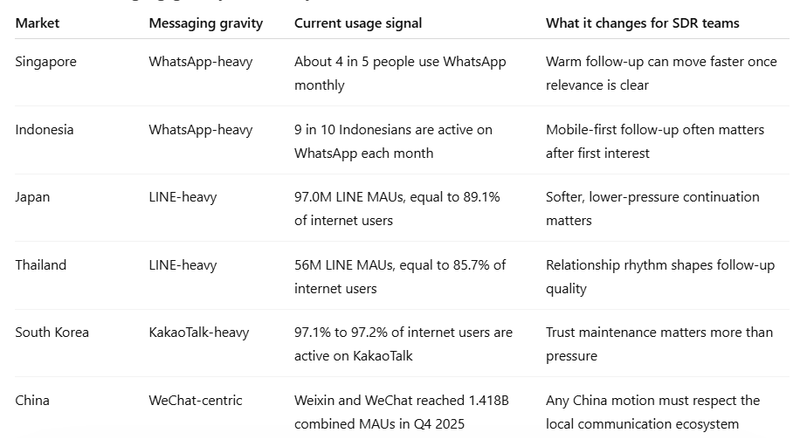
Before the second table, the practical takeaway is simple: the right first channel and the right next channel are often not the same.
Table 2. Messaging gravity across key APAC markets
Description:
This table is not a permission slip to blast buyers on chat apps. It is a market map. Better outbound sales in APAC markets adapt to the communication gravity of each country instead of forcing one global cadence everywhere. What feels natural in Singapore or Indonesia is not the same as what feels natural in Japan, Thailand, South Korea, or China.
This is also where global teams make one of their most expensive mistakes. They run one polished sequence, monitor one polished dashboard, and assume the market is not interested when replies stay low. In reality, the buyer may simply prefer slower trust-building in Japan, warmer continuity in South Korea, or faster mobile follow-up in Singapore and Indonesia once initial relevance has been established. That is not randomness. It is channel fit.
SDR.sg’s own case material points in the same direction. In one published multichannel sequence for Singapore and Indonesia, 412 first touches produced 169 positive replies, 94 SQL meetings, 31 opportunities, and 6 deals in 90 days. In another SDR.sg example, an earlier APAC campaign sent 1,500 emails, generated only 41 replies, and booked just 6 meetings. That contrast does not prove one app is magic. It proves that stronger sequencing, better market fit, and better progression logic change commercial output.
What strong APAC go-to-market strategy teams measure instead
The most effective APAC sales development services start by redefining success. The question is no longer “How many people opened?” It is “Which accounts moved?” Better teams track progression events such as stakeholder expansion, referrals, response quality, timing cues, meeting readiness, and whether a conversation becomes easier to continue over time. That is the difference between activity reporting and real buying-signal tracking.
Before the third table, here is the contrast that matters most: healthy-looking activity can still hide a weak pipeline motion.
Table 3. Average outbound vs localized channel-aware motion
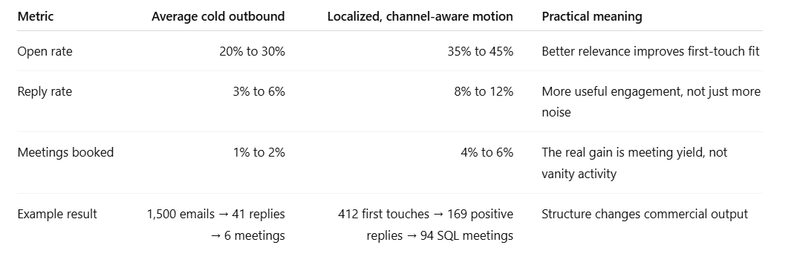
Description:
These ranges come from SDR.sg’s published benchmark and case-study content. The point is not that every campaign should hit the same numbers. The point is that better localization, better sequencing, and stronger signal handling materially improve the part of the funnel that actually matters.
That is why the term “dark social” matters here. In this article, it does not mean mysterious traffic sources. It means the part of the buying journey that remains commercially relevant but poorly captured if your team only trusts inbox analytics. When a buyer forwards your email internally, checks your credibility with a colleague, goes quiet while still evaluating, or continues in a warmer side channel later, your motion should not automatically treat that account as dead. It should look for the next real signal.
Infographic 2. Email-visible motion vs channel-aware APAC motion
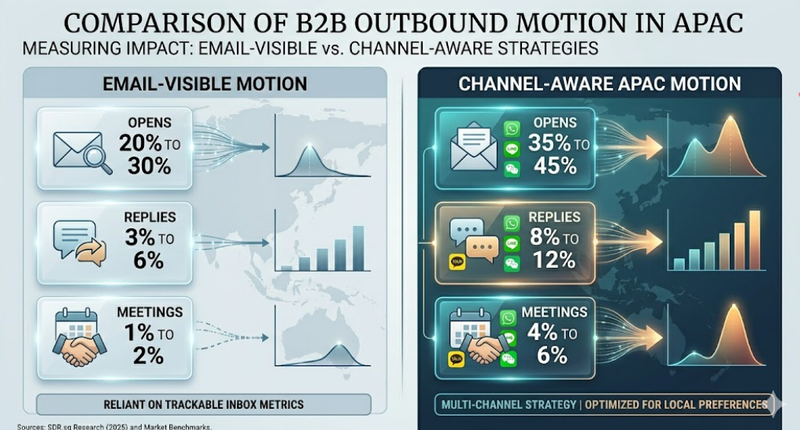
Description:
This infographic should contrast a standard email-visible motion with a localized channel-aware APAC motion. On one side, moderate opens, low replies, and weak meeting yield. On the other, better relevance, stronger progression, and materially better conversion into qualified meetings. The point is that improved channel fit does not just create more activity. It creates more movement.
How to build a channel-aware APAC SDR motion
A stronger outsourced SDR services APAC model does not force every buyer into a chat app. It does four simpler things well.
First, it defines progression events clearly. A good reply, a referral, a request for timing, or a second stakeholder entering the thread all matter more than inflated open data.
Second, it allows channel shifts only after a credible signal. If relevance has not been established, moving too early into WhatsApp, LINE, or KakaoTalk can feel intrusive. If relevance has been established, staying trapped in slow email back-and-forth can kill momentum. SDR.sg’s earlier content on APAC channel mix makes that exact point: channels work best when each is assigned a role.
Third, it records every meaningful interaction in CRM. A WhatsApp message, a LINE exchange, or a referral note should not remain tribal knowledge inside one rep’s phone. It should become stage context, next-step clarity, and better handover. That is how sales pipeline building for B2B companies becomes more reliable across multiple APAC markets. As SDR.sg argued in Invisible Sales Cycle Drags: How to Shorten Deals in APAC, many regional pipeline problems are visibility problems long before they become volume problems.
Fourth, it responds quickly once a real signal appears. Persistence still matters, but only after relevance is established. HubSpot’s sales statistics roundup notes that many successful sales require five or more follow-ups, while many sellers give up far earlier. More pressure on the wrong account is still just noise. Better follow-up only works when it follows fit.
FAQ - common reader questions
Q1. What does “dark social” mean in this APAC B2B context?
It means buyer movement that happens outside the neat, visible layer of standard email dashboards, including internal sharing, warmer side-channel follow-up, and private message continuity.
Q2. Does this mean email no longer works?
No. Email still matters. But in B2B lead generation in APAC, email is often the opening layer, not the full conversation path.
Q3. Which apps matter most across APAC?
WhatsApp is especially strong in Singapore and Indonesia, LINE is dominant in Japan and Thailand, KakaoTalk is deeply embedded in South Korea, and WeChat remains central in China’s communication ecosystem.
Q4. Why are open rates weaker as a signal than they used to be?
Apple Mail Privacy Protection prevents senders from seeing whether a recipient opened an email and downloads remote content in the background by default.
Q5. What should teams measure instead?
Track progression quality: stakeholder expansion, referrals, response depth, meeting intent, stage movement, and whether the account is becoming easier to advance.
Q6. Is this only relevant for enterprise sales?
No. It is most obvious in complex deals, but the same pattern appears across many forms of outbound sales in APAC markets because buyers increasingly self-educate before engaging sellers.
Q7. How should an outsourced SDR team handle this?
By choosing channels by market, shifting channels only after buyer permission is earned, documenting every meaningful interaction, and turning side-channel movement into CRM-visible context.
Final takeaway
The real lesson is simple. B2B lead generation in APAC is no longer just an inbox game. Buyers shortlist earlier, research more independently, and continue conversations in ways that standard dashboards do not fully capture. If your team still treats opens and replies as the core truth, it is probably mistaking visibility for progress.
The stronger model is channel-aware, market-aware, and progression-aware. It uses email well, but it does not confuse email with the whole journey. It respects local communication gravity without assuming every buyer wants to move to chat. And it builds a cleaner reporting system for B2B lead generation in APAC, one that measures movement, not just activity.

If your current motion is producing sends, opens, and occasional replies but still not enough qualified meetings, the issue may not be volume. It may be that your buyer conversations are moving somewhere your reporting does not capture.
SDR.sg helps B2B teams build multi-channel outbound sales APAC systems with localized sequencing, cleaner signal tracking, and stronger conversion from first touch to qualified meeting.
A practical next step is a short audit of your current outbound motion: where buyers first engage, where the conversation actually continues, and where signal is being lost between channels.
That is the fastest way to see whether your market coverage is active, or actually effective.