Published on:
Estimated Reading Time: 12 minutes
Written by Jasmina C., Head of Marketing at SDR.sg
Explore the hidden challenges of selling in APAC and the realities SDRs face. Learn practical B2B lead generation strategies, hybrid AI-human workflows, and actionable insights to book more meetings across diverse APAC markets.

Expanding into APAC offers significant growth potential for B2B companies, but selling in APAC is not like selling in Western markets.
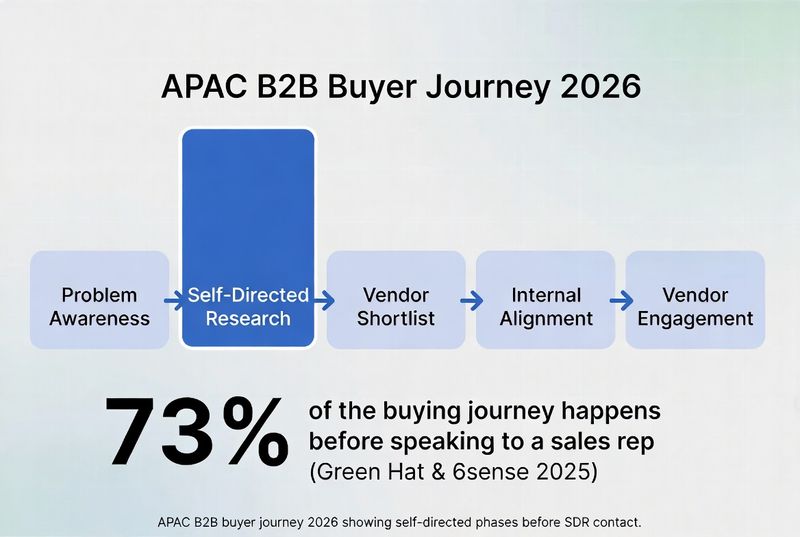
While 67% of B2B buyers prefer rep-free experiences (Gartner March 2026), early multi-channel engagement remains essential to reach prospects during the 60–73% self-directed research phase (Green Hat & 6sense 2025).
APAC B2B buyer journey 2026 showing self-directed phases before SDR contact
Description:
Shows APAC buyers’ journey phases from Awareness → Research → Evaluation → Decision, highlighting the self-directed portion of the process (Green Hat & 6sense 2025).
Successful APAC SDR strategies balance signal-based AI insights, localized messaging, and human SDR engagement, particularly given 10–13 stakeholders per deal on average, and up to 20+ in complex enterprise accounts.
Key Takeaways
- APAC markets are highly heterogeneous — culture, language, and regulations differ.
- Enterprise deals often involve multi-stakeholder committees, requiring account-based outreach.
- Localization and personalization significantly improve reply rates.
- Hybrid AI + human SDR strategies outperform automation alone.
- Singapore, Australia, and New Zealand are ideal starting points for new campaigns.
Market Complexity Across APAC
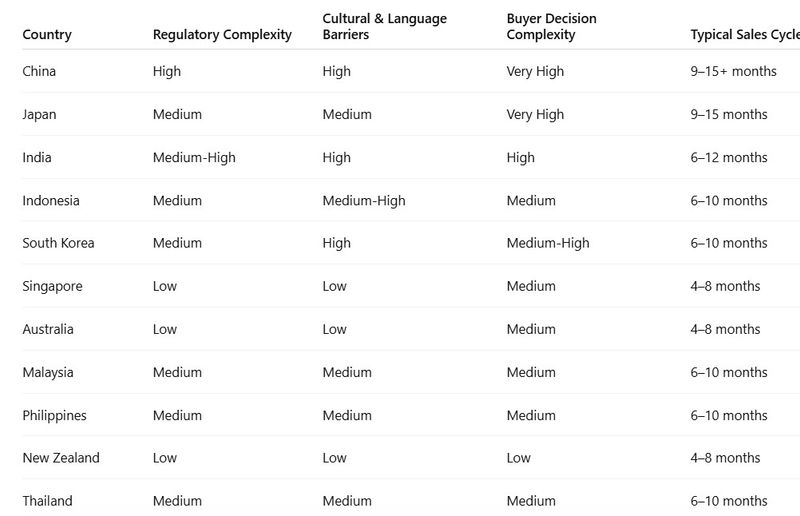
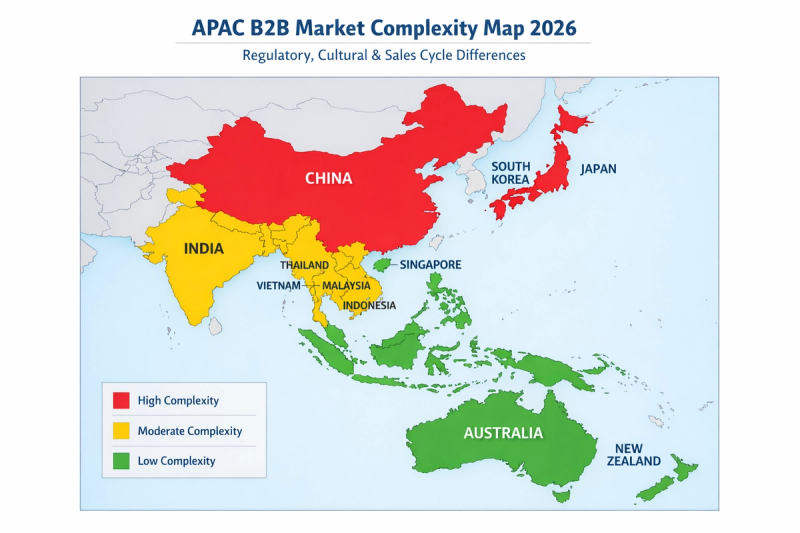
Before we dive into the numbers, it’s important to understand that APAC markets vary significantly in regulatory, cultural, and decision-making complexity. SDR teams need to adapt their approach to each market’s unique characteristics.
Table 1 – Market Complexity Scorecard for APAC SDR Outreach
Description:
This table illustrates the relative complexity of APAC markets for SDR outreach, factoring in regulation, culture/language barriers, and decision-making structure. It highlights why certain markets (China, Japan) require more sophisticated multi-stakeholder and localized strategies, while others (Singapore, Australia, New Zealand) allow faster entry and simpler outreach.
Description:
Color-coded APAC map showing regulatory, cultural, and decision-making complexity by market: red = high complexity (China/Japan), yellow = medium (India/SEA), green = low (SG/AU/NZ).
Why SDR Teams Struggle in APAC
Common missteps include:
- Targeting single contacts rather than multi-stakeholder committees.
- Using generic, non-localized messaging.
- Ignoring regional platforms like WeChat, LINE, Kakao.
- Over-relying on cold email without multi-channel follow-up.
Modern APAC strategies require account-based targeting, hyper-personalization, and signal-driven outreach.
Updated Engagement Benchmarks
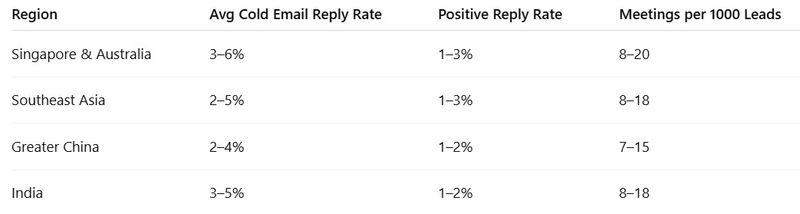
Before looking at campaign metrics, note that APAC cold outreach is more challenging than global averages. Response rates are lower, especially for cold emails without personalization, but well-executed hybrid campaigns can achieve strong results.
Table 2 – Realistic APAC SDR Outreach Benchmarks (2025–2026)
Description:
This table provides practical benchmarks for APAC outbound campaigns. “Avg Cold Email Reply Rate” reflects typical performance, while “Positive Reply Rate” shows the subset of replies that indicate genuine interest. Meetings per 1000 leads demonstrate achievable pipeline outcomes when hybrid AI + human SDR workflows are applied.
Global/APAC cold avg: 3.4–4.1% (Instantly Cold Email Benchmark Report 2026); top hybrid/localized campaigns: 8–12%+ (SDR.sg 2025–2026 campaigns + Prospeo/Outreaches.ai).
Case Studies

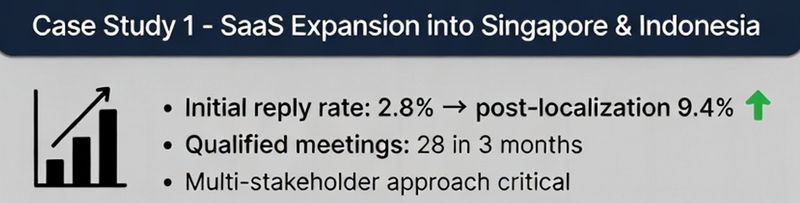
Case Study 1 – SaaS Expansion into Singapore & Indonesia
- Initial reply rate: 2.8% → post-localization 9.4%
- Qualified meetings: 28 in 3 months
- Multi-stakeholder approach critical
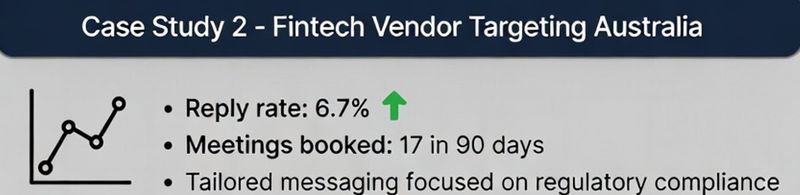
Case Study 2 – Fintech Vendor Targeting Australia
- Reply rate: 6.7%
- Meetings booked: 17 in 90 days
- Tailored messaging focused on regulatory compliance
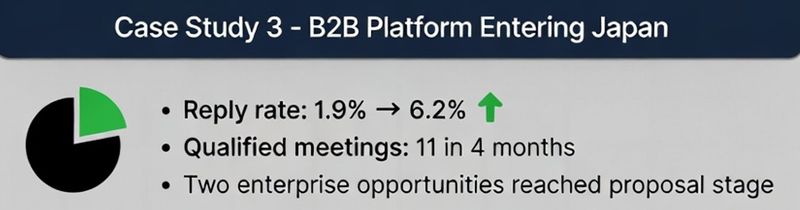
Case Study 3 – B2B Platform Entering Japan
- Reply rate: 1.9% → 6.2%
- Qualified meetings: 11 in 4 months
- Two enterprise opportunities reached proposal stage
Hybrid SDR + AI Model

- AI: Lead scoring, prospect research, prioritization
- Human SDRs: Multi-stakeholder engagement, relationship building, qualification
- Outcome: Hybrid approach consistently outperforms AI-only sequences in APAC
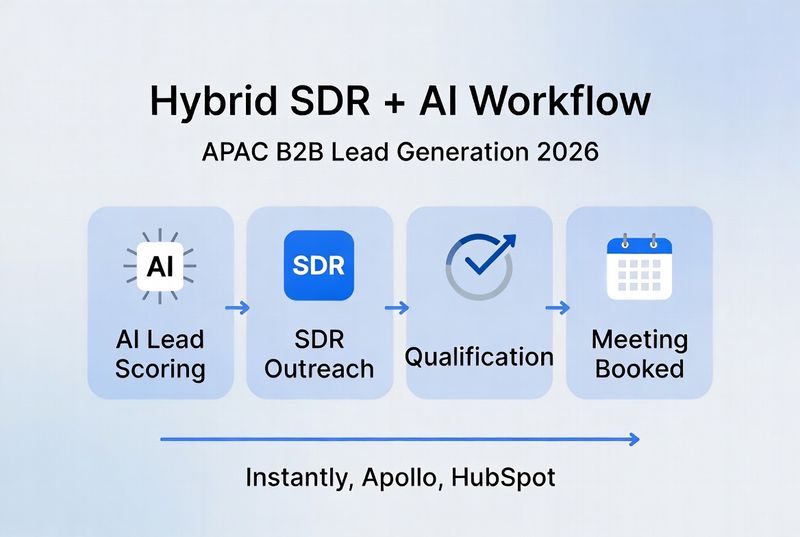
Description:
Demonstrates how AI-assisted lead scoring and human SDR engagement combine to maximize qualified meetings across APAC.
Core Market Entry Barriers
Before entering APAC, SDR teams must anticipate key barriers that can slow pipeline progress. This table summarizes common obstacles and recommended strategies.
Table 3 – Key Barriers for APAC SDR Expansion
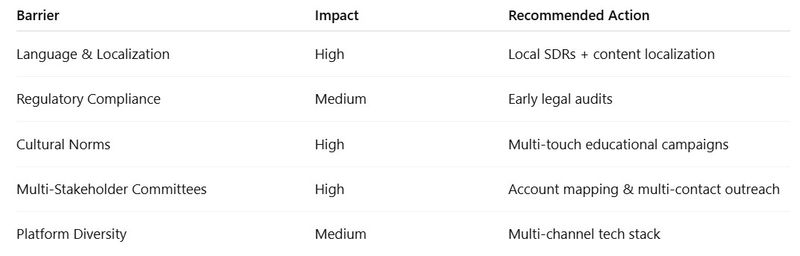
Description:
Understanding these barriers helps SDR teams allocate resources effectively, choose the right markets to start in, and implement strategies (e.g., multi-channel and localized outreach) that maximize engagement and conversion.
Strategic Insights
- Start with accessible markets: Singapore, Australia, New Zealand
- Localize before scaling
- Focus on account-based multi-contact outreach
- Leverage hybrid AI + human SDR models
Internal resources:
- AI Sales Prospecting Guide
- Outbound Prospecting Strategies
- B2B Lead Generation Strategy
- Part 1: Singapore, Kuala Lumpur & Jakarta
- Part 2: Beijing, New Delhi & Tokyo
- Part 3: Manila, Bangkok & Seoul
- Part 4: Sydney, Melbourne & Auckland (ANZ)
What Doesn’t Work in APAC 2026
- Spray-and-pray cold email campaigns
- Ignoring regional platforms (WeChat, LINE, Kakao)
- Generic, non-localized messaging
- Single-contact targeting only
- Over-relying on email alone (70%+ interactions in China/Japan occur on local platforms)
FAQ: Common Questions
Q1: What makes APAC different from Western markets?
A1: Multi-stakeholder decisions, longer cycles, and cultural nuances.
Q2: How long does pipeline building take?
A2: 8–12 weeks for initial engagement; enterprise deals can exceed 12 months.
Q3: Are outsourced SDR teams effective?
A3: Yes, integrated with hybrid AI workflows.
Q4: Which APAC markets are easiest to start with?
A4: Singapore, Australia, New Zealand.
Q5: Which channels work best?
A5: LinkedIn (SG/AU), WeChat (China), LINE (Japan/SEA), KakaoTalk (Korea).
Q6: How much does outsourced SDR cost in APAC 2026?
A6: $3k–$10k+/month typical; pay-for-performance models reduce risk.
Q7: How is AI changing outbound in APAC?
A7: Improves research, scoring, prioritization; human SDRs still essential.
Q8: How to maximize meetings in hybrid campaigns?
A8: Use multi-channel outreach, account mapping, and signal-based targeting.
Q9: What is a realistic reply rate for APAC cold outreach?
A9: 2–5% avg; 8–12% achievable with hyper-personalization and localization.

If your company plans APAC expansion:
- Book a 15-min APAC Strategy Call to discuss pipeline design.
- Implement hybrid AI + human SDR workflows for scalable B2B lead generation.
Focus on localization, multi-stakeholder outreach, and signal-driven targeting for measurable pipeline growth.