Published on:
Estimated Reading Time: 11 minutes
Written by Jasmina C., Head of Marketing at SDR.sg
👉 Book a strategy session: HERE
👉 Explore services: HERE
Sales may be a team sport, but not every role carries the same burden. Modern B2B lead generation in APAC depends on more than closers. See which roles carry the most weight across pipeline, trust, qualification, revenue and growth.

Sales is a team sport. Everyone says it. Most people agree with it. But in modern B2B lead generation in APAC, the more useful truth is this: not everyone carries the same weight at the same stage.
Some people carry the weight of creating demand. Some carry the first conversation. Some qualify whether the opportunity is real. Some build the business case. Some close. Some retain. Some make the data visible enough for leadership to see where the funnel is leaking.
The problem starts when one person, or one team, is expected to carry the whole revenue number.
That is what happens when founders are pulled into every sales conversation, AEs are expected to prospect, qualify and close, SDRs are forced to compensate for weak positioning, and marketing celebrates MQLs that sales cannot convert.
This matters because buyers are forming opinions earlier than many sales teams realize. 6sense’s 2025 B2B Buyer Experience Report found that buyers shortlist roughly four out of five vendors on day one of the buying journey, and that the winning vendor came from the day-one shortlist 95 percent of the time. Typical buying groups also involve more than 10 people.
The sales call is not where the game starts. It is where a lot of earlier work gets tested.
Sales used to look simpler
Sales used to look easier on paper.
Marketing generated leads. Sales closed deals. Customer success handled renewals. Leadership reviewed the forecast.
That model no longer matches how buyers behave.
LinkedIn’s B2B Institute explains the 95-5 rule: most potential B2B buyers are not in-market today, but may become active in the future. That means companies cannot only focus on buyers who are ready now. They need to build trust before the buying window opens.
This changes the role of every revenue function.
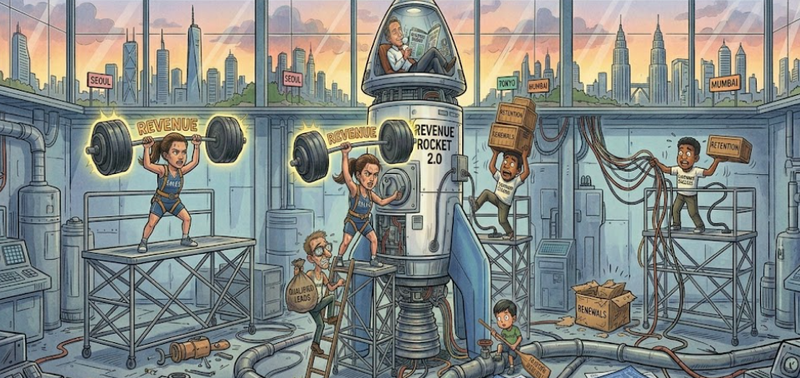
Marketing cannot just produce awareness. It has to create trust. SDRs cannot just send messages. They have to create relevance. AEs cannot just run discovery. They have to guide consensus. RevOps cannot just clean CRM fields. It has to show where pipeline is leaking.
That is why sales pipeline building for B2B companies has to be treated as a system, not a heroic individual effort.
Pipeline starts before the sales call
Pipeline does not begin when an AE joins a discovery call.
It begins much earlier:
- Positioning
- ICP definition
- Account selection
- Market research
- Persona mapping
- Messaging
- First touch
- Qualification
- Handoff quality
This is where many companies lose momentum.
They hire AEs and expect pipeline to appear. They ask founders to open doors forever. They send SDRs into the market with generic messaging. Then they blame the sales team when prospects do not respond.
For companies exploring outsourced SDR services APAC, the real value is not simply more meetings. The value is turning the early pipeline motion from guesswork into a structured system. SDR.sg describes this as moving outbound from random activity into a structured pipeline engine through account selection, decision-maker outreach, qualification and meeting generation.
Before we break down the roles, here is the clean visual view of the revenue burden.
Infographic 1: The revenue burden map
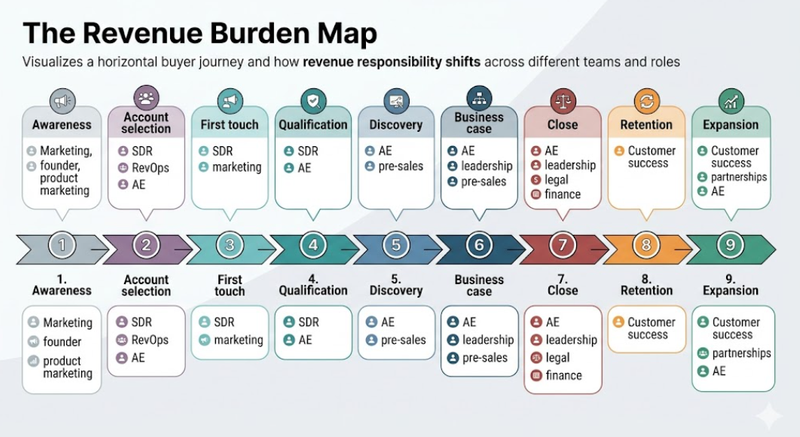
Infographic description:
This infographic shows that pipeline does not start with the AE. Trust, relevance and buyer confidence are built across multiple roles before the first sales conversation happens.
Who carries what weight?
A strong revenue system does not ask every role to do everything.
It defines who carries which part of the buyer journey. This is especially important for companies building APAC sales development services, because each market adds its own layer of buyer behavior, seniority, hierarchy and trust-building.
The table below breaks down the practical weight each role carries.
Table 1: Who carries what weight in modern B2B sales
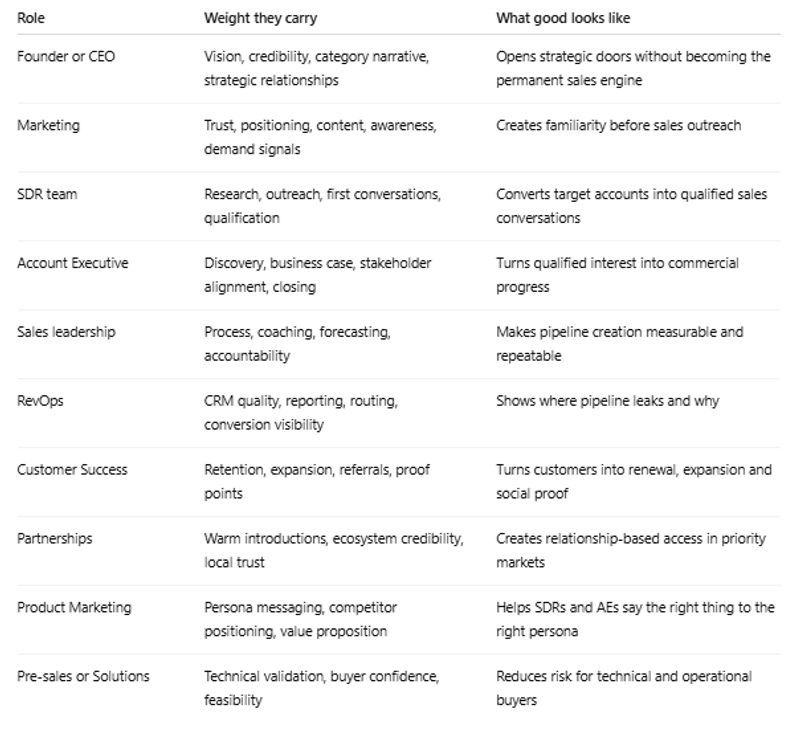
Table description:
This table separates revenue ownership from revenue contribution. The AE may own the commercial outcome, but the AE does not own every activity that creates buyer trust, urgency and readiness.
The problem starts when one role carries too much
A sales system becomes fragile when one role carries weight that should be distributed.
Salesforce reports that sales reps spend 60 percent of their time on non-selling tasks, including searching for materials, entering CRM notes and chasing internal approvals.
That is not just an efficiency issue. It is a revenue issue.
If your best closers are spending too much time building lists, cleaning data, writing first-touch messages, researching accounts and qualifying weak leads, they have less time for discovery, stakeholder alignment and closing.
The same pattern appears across the whole revenue team.
Table 2: What breaks when one role carries too much
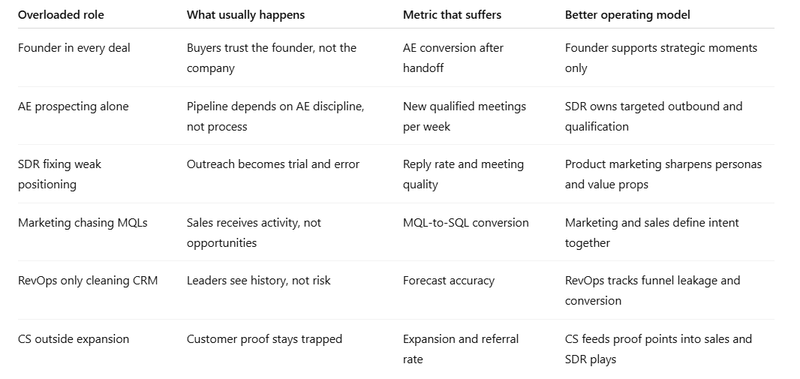
Table description:
This table shows why many pipeline issues are not caused by poor effort. They are caused by poor role design. When the wrong person carries the wrong burden, the funnel slows down.
When sales still fails even with good people
Even strong teams fail when the system is badly designed.
A good AE cannot fix poor account selection.
A good SDR cannot fix weak positioning.
A good founder cannot scale personal credibility forever.
A good marketing team cannot create pipeline if sales rejects every lead without shared qualification criteria.
A good RevOps function cannot forecast accurately if funnel definitions are political instead of operational.
This is why pipeline problems are rarely just people problems.
More often, they are design problems.

A founder-led motion may work for the first 10 customers. It may not work for regional expansion. A senior AE may be able to prospect strategically. That does not mean they should carry all account research, first-touch messaging and qualification.
The SDR motion is where strategy either becomes pipeline, or stays trapped in a slide deck.
What this means for companies entering new markets
The burden becomes heavier when companies expand into Singapore, Australia, India, Japan, Korea, China, New Zealand and Southeast Asia.
A message that works in one country may fail in another. A strong ICP in Singapore may not translate directly into Indonesia. A cold email sequence that works in Australia may need a different trust mechanism in Japan. A founder-led relationship approach may help early in Southeast Asia, but slow scale if every opportunity depends on senior access.
That is why an APAC go-to-market strategy needs to happen before outbound volume.
SDR.sg’s guide on APAC outbound differences notes that strategies that work in the US or Europe often do not perform the same way in APAC because of differences in culture, decision-making hierarchy and digital maturity.
For B2B sales expansion APAC, the early questions matter.
Table 3: Market entry questions that affect pipeline quality
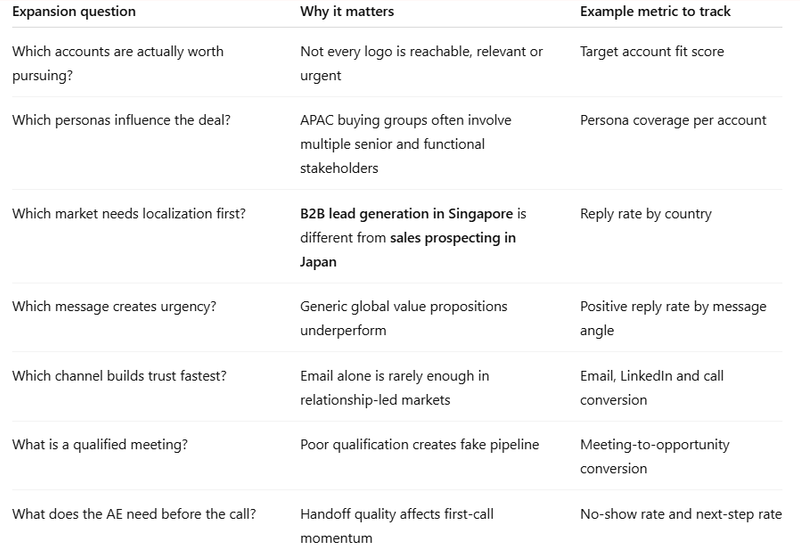
Table description:
This table connects market entry strategy to measurable execution. A strong market entry strategy for Australia, Singapore, Japan or Southeast Asia should define accounts, personas, messaging, channels and qualification before activity begins.
A common APAC expansion example
A SaaS company enters Singapore with two AEs and no local SDR support.
The AEs are asked to build lists, research accounts, write outbound messages, qualify prospects and close deals.
For the first few months, activity looks healthy. Emails are going out. Meetings are happening. CRM is moving.
But the pipeline does not convert.
The issue is not that the AEs are weak. The issue is that they are carrying too much of the process. Account selection is unclear, messaging is not localized, qualification is inconsistent and the AE handoff does not exist because the AE is doing everything.
This is where structured sales development changes the model.
It does not replace the AE. It protects the AE’s time for the work only the AE can do.
Infographic 2: Random outbound vs structured SDR motion
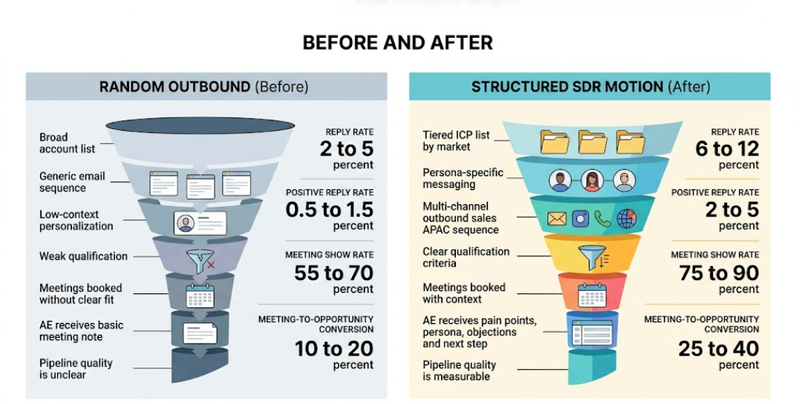
Infographic description:
This infographic shows that structured SDR work does not only create more meetings. It improves the quality of the early funnel, gives AEs better context and gives leadership better visibility into what is working.
Real benchmarks from APAC sales development
The strongest case for structured APAC sales development services is not theory. It is funnel improvement.
In SDR.sg’s 2026 benchmark article comparing in-house, outsourced and hybrid SDR models, a single in-house SDR in Singapore is shown with a cost per meeting of 1,100 to 1,500 SGD and a three to six month ramp period. The same article places outsourced SDR services in APAC at a cost per meeting of 700 to 900 SGD, with time to first meetings of two to four weeks.
That does not mean outsourcing is always the answer. It means the operating model matters.
The better question is not “who should own pipeline?”
The better question is: “Which role should carry which part of pipeline creation, and where do we need support?”
Where SDR.sg fits
SDR.sg should not be positioned as a replacement for the sales team.
A better way to think about it is this:
SDR.sg helps B2B companies carry the early pipeline burden more effectively, from account research and localized messaging to outreach, qualification and meeting generation.
That matters because AEs should not spend most of their time doing work that belongs earlier in the funnel. Founders should not remain the only source of credibility. Marketing should not be measured only on MQL volume. RevOps should not only clean up the mess after the quarter is already at risk.
A strong SDR motion creates the bridge between strategy and sales execution.
It supports:
- Cleaner account selection
- Better persona mapping
- Localized messaging
- More disciplined multi-channel outbound sales APAC
- Better first conversations
- Stronger qualification
- Cleaner AE handoff
- More reliable pipeline visibility
This is also where appointment setting services APAC need to be judged properly. The goal is not just to book meetings. The goal is to book meetings that sales can actually progress.
Why B2B lead generation in APAC needs a team-based revenue system
The best sales teams do not pretend every role carries the same weight.
They define the weight clearly.
Marketing builds familiarity before buyers enter the market. SDRs create first conversations with the right accounts. AEs convert qualified interest into business cases. Pre-sales validates the solution. RevOps shows where the system leaks. Customer success turns delivery into retention, proof and expansion. Leadership keeps the whole motion honest.
This is also where lead qualification tips for B2B companies become more than a checklist. Qualification only works when the whole system agrees on what a good opportunity looks like.
Edelman’s 2025 Hidden Buyer research found that 71 percent of hidden buyers have little or no interaction with sales teams, while 95 percent say strong thought leadership makes them more receptive to sales and marketing outreach.
That is the real point.
Buyers are not waiting for your sales team to educate them from zero. They are already forming opinions before they speak to you.
The companies that win are not the companies that ask one great closer to carry everything.
They are the companies that build a system around the buyer before the buyer is ready to speak.
FAQ: common questions from revenue leaders
Q1. What is the main reason B2B pipeline breaks?
B2B pipeline usually breaks because the revenue system is fragmented. Marketing, SDR, AE, RevOps and customer success often work from different definitions of quality, urgency and qualification.
Q2. Should AEs do their own prospecting?
AEs should understand prospecting and may still do strategic outreach, but they should not be the only pipeline creation engine. When AEs carry all prospecting, qualification and closing, selling time drops and forecast risk increases.
Q3. When should a company consider outsourced SDR services APAC?
A company should consider outsourced SDR services APAC when it is entering new markets, testing ICPs, lacking local SDR leadership, or asking founders and AEs to carry too much early pipeline work.
Q4. Is B2B lead generation in APAC different from the US or Europe?
Yes. APAC requires more attention to market-by-market nuance, seniority, channel preference, local trust and relationship-building. Singapore, Japan, Australia, India and Southeast Asia cannot be treated as one identical outbound motion.
Q5. What metrics should sales leaders track?
Track reply rate, positive reply rate, connect rate, meeting booked rate, show rate, meeting-to-opportunity conversion, opportunity value, sales cycle length and closed-won conversion by source.
Q6. Are appointment setting services APAC enough?
Only if they include qualification, context and handoff discipline. Meetings without fit create fake pipeline. Qualified meetings with clear context help AEs progress real opportunities.
Q7. Where does SDR.sg add the most value?
SDR.sg adds the most value before the AE conversation: account research, localized messaging, outbound execution, first conversations, qualification and meeting generation. The goal is not to replace the sales team. The goal is to help the sales team spend more time on the conversations that matter.
CTA: find out who is carrying too much of your pipeline burden
If your founders are still opening every door, your AEs are prospecting more than selling, or your SDRs are booking meetings that do not convert, the issue may not be effort.
It may be role design.
SDR.sg helps B2B companies build structured B2B lead generation in APAC motions around their existing sales teams, so founders, AEs and revenue leaders are not carrying the wrong parts of the pipeline alone.
Book a conversation with SDR.sg to review where your pipeline burden sits today, where the funnel is leaking and what a more structured SDR motion could look like across your target APAC markets.