Published on:
Estimated Reading Time: 12 minutes
Written by Jasmina C., Head of Marketing at SDR.sg
Learn how to structure outbound for Australia with better messaging, sequencing, follow-up, and channel mix to improve B2B lead generation in APAC and generate qualified meetings, not just replies.

This article builds directly on our earlier piece, Why the Australian B2B Market Takes Longer to Break Into Than Most Teams Expect, and answers the next practical question: if Australia takes longer to convert, how should you structure outbound so it creates qualified meetings instead of inbox activity alone?
That question matters for any team investing in APAC sales expansion services, B2B lead generation in APAC, Outsourced SDR services, and Sales pipeline building solutions.
Australia is often treated like a simple market to enter. It is English-speaking, commercially mature, and easy to include in regional plans from Singapore. But that first impression is exactly why so many teams get the motion wrong. They assume a few replies mean traction. They assume broad messaging will work. They assume activity will turn into pipeline if they keep sending enough outreach. In reality, Australia usually rewards structure more than volume. The Australian Bureau of Statistics reported 2,729,648 actively trading businesses as of 30 June 2025, including 994,178 employing businesses, which makes the market large and attractive, but not automatically easy to convert.
The teams that generate meetings consistently are usually not the teams sending the most emails. They are the teams making better decisions about account selection, messaging, sequencing, follow-up rhythm, and channel mix. That is especially true for companies relying on AI-powered sales prospecting tools, AI SDR, and Hybrid sales teams: AI and human SDR to scale faster without losing quality.
Buyer behavior explains why. 6sense’s 2025 Buyer Experience Report found that buyers evaluate an average of 4.5 vendors, shortlist about 3.4 vendors on day one, and in 95% of cases end up buying from that day-one shortlist. That means your outbound is not being judged in isolation. It is being compared against existing category knowledge, competitor familiarity, peer recommendations, and your visible market credibility long before a meeting happens.
So if your outbound is generating replies but not meetings, the problem is usually not effort. The problem is structure.
Start with the right objective

The first mistake many teams make is optimizing for the wrong outcome.
Replies are useful. Opens are useful. Clicks can be useful. But none of those are the real goal.
The real goal is qualified meetings with accounts that fit your ICP and can move into real sales conversations.
That sounds obvious, but it changes the entire motion. If you optimize for reply rate, broad messaging can look healthy. If you optimize for meetings, broad messaging often collapses very quickly.
That distinction matters because the gap between visible engagement and real pipeline is often wider than teams expect. In SDR.sg’s own APAC benchmark content for 2026, average cold outbound campaigns typically land at 20% to 30% open rates, 3% to 6% reply rates, and only 1% to 2% meetings booked. In top-performing localized campaigns, those ranges improve to 35% to 45% opens, 8% to 12% replies, and 4% to 6% meetings booked. The lesson is simple: activity can look healthy long before pipeline actually is.
For Australia, that distinction matters even more because buyers are often polite enough to reply without being commercially ready. A response can mean curiosity, timing mismatch, mild interest, internal referral, or actual buying intent. Those are not the same thing.
That is why strong B2B lead generation strategies APAC should define success early around meeting quality, not activity volume.
Before writing a single email, teams should be clear on four things:
- Which accounts are worth pursuing now
- Which personas are most likely to engage first
- Which problem is strong enough to justify a meeting
- What signal counts as genuine intent
For a stronger targeting foundation, readers can refer to How to Define ICP for Effective Outbound Sales in the APAC Region, which reinforces how precise ICP work improves targeting and conversion in regional outbound.
Australia is rarely a market where a giant list saves weak strategy. It is usually the opposite.
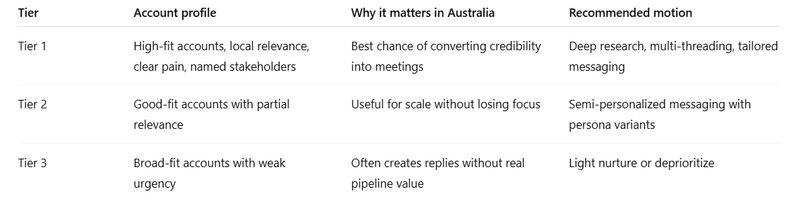
Before you even begin sequence design, it helps to structure the account base properly.
Table 1: Australia outbound account selection model
Description:
This table shows how to segment Australian accounts before launching outbound. The goal is not to maximize list size. It is to focus effort where trust, relevance, and timing are strongest.
Messaging should sound narrower, not louder
One of the biggest mistakes in Outbound lead generation is trying to sound impressive instead of useful.
Australian buyers usually respond better to messaging that feels commercially aware, specific, and calm. Over-claiming weakens trust. Generic regional language weakens trust. The fastest way to sound irrelevant is to say you help everyone everywhere.
Weak version:
We help B2B companies scale faster across APAC with AI-driven outbound.
Stronger version:
We help SaaS teams entering Australia build qualified pipeline through localized outbound, sharper targeting, and a Hybrid sales team AI and human model.
The second version is better because it narrows the problem and makes the motion easier to understand. Buyers do not have to work hard to figure out where you fit.
This matters because outbound is now evaluated alongside broader trust signals. LinkedIn reported in August 2025 that posts on the platform were up 41% over three years, and 77% of B2B marketing leaders said audiences rely on their networks, not just brand-owned channels, to vet companies. In other words, your email is rarely judged on its own.
In Australia, messaging should do five things quickly:
- establish relevance
- narrow the problem
- show proof without overselling
- make the meeting feel low friction
- avoid sounding automated
A good outbound message often follows this structure:
- first line with local context or role relevance
- second line naming a specific commercial problem
- third line with proof, pattern, or observed benchmark
- fourth line with a simple meeting ask
That is also why this post should internally connect to Why Cold Calling Still Builds the Strongest Sales Pipeline and LinkedIn + Email + Cold Call: The Exact Sequence That Delivered 94 Booked Meetings in 90 Days for a SaaS Client. SDR.sg’s own content shows that structured multichannel outreach consistently outperforms single-channel activity, and its cold-calling piece notes that global cold-calling success averages around 2% to 3%, with local performance varying significantly by market.
Before changing message volume, teams should fix message design.
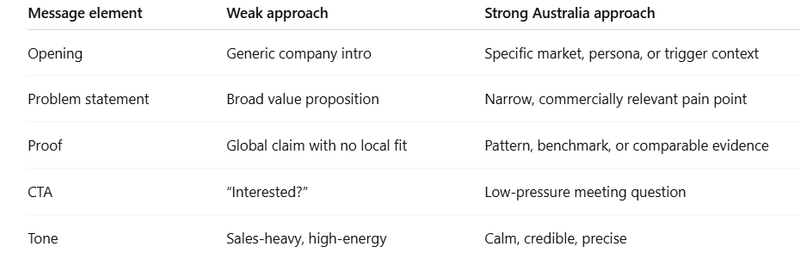
Table 2: Message structure that creates meetings, not just replies
Description:
This comparison shows why Australian buyers often ignore messaging that looks polished but feels vague. The stronger version reduces uncertainty and makes the meeting request feel more grounded.
Sequence design matters more than most teams think

Once account selection and messaging are in place, the next issue is cadence.
A lot of teams either under-follow up or over-automate. Both are expensive mistakes.
Australia usually responds better to structured persistence than constant pressure. If the first email does not convert immediately, that does not mean the account is lost. It usually means trust has not been built yet.
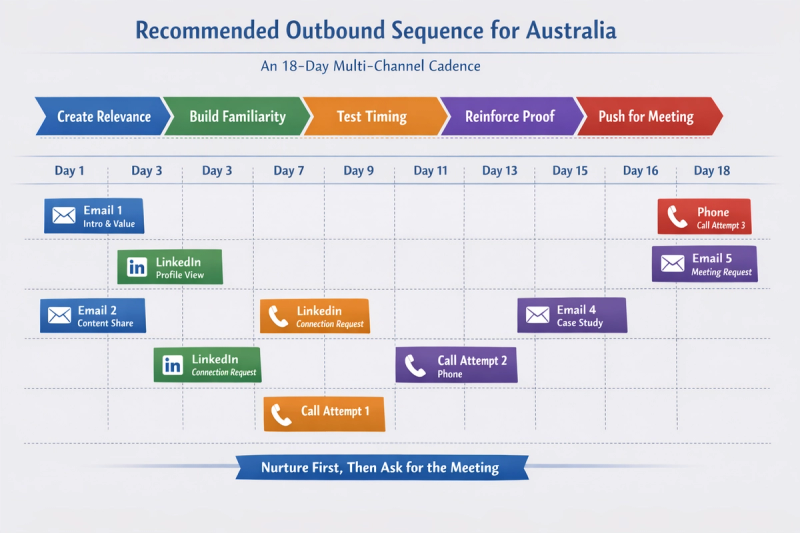
Before teams start changing volume, it helps to visualize what a practical outbound cadence for Australia should actually look like across channels. A structured sequence reduces randomness, improves timing, and creates more chances to qualify real interest before asking for a meeting.
Infographic 1: Recommended outbound sequence for Australia
Description:
This infographic should visualize an 18-day outbound cadence across email, LinkedIn, and phone. It should show how each touch has a different role: create relevance, build familiarity, test timing, reinforce proof, and only then push for a meeting.
A practical structure for Australia often looks like this:
Day 1
Email with localized problem framing
Day 3
LinkedIn profile visit and connection request
Day 5
Second email with a different angle or stronger proof point
Day 7
Cold call with a short context-led opener
Day 10
LinkedIn follow-up or comment engagement
Day 12
Third email focused on a more specific commercial question
Day 15
Second call attempt
Day 18
Permission-based close or break-up note
This sequence works because each touch has a job. The SDR is not repeating the same ask eight times. They are gradually reducing uncertainty.
It also matches broader follow-up evidence. HubSpot’s February 2026 sales statistics roundup reports that 80% of successful sales take five or more follow-up calls, while 44% of salespeople give up after a single follow-up attempt. That gap alone explains why many campaigns stall before they have a fair chance to convert.
That is where Best practices for multi-channel outbound sales, Appointment setting tips APAC, and Email marketing and SDR outreach strategies become more than theory. In a mature market like Australia, channel coordination improves credibility.
Channel mix should build familiarity before conversion
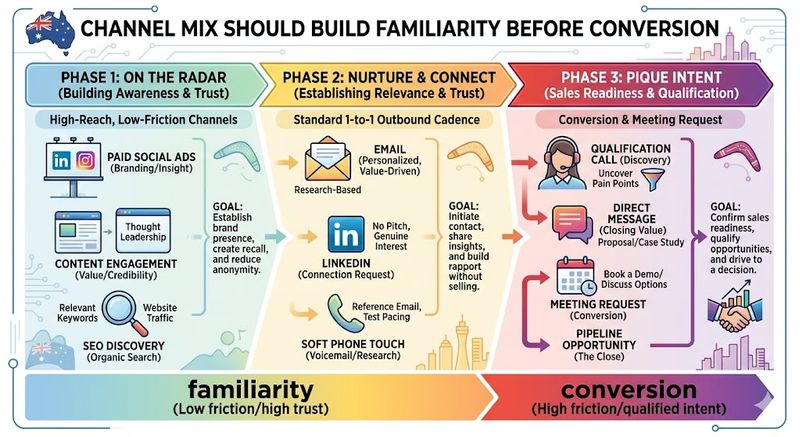
One reason so many teams struggle with Email marketing and outbound in Australia is that they expect one good email to do the work of a full trust-building process.
Usually, it does not.
Australia often performs better when each channel has a distinct role:
- Email creates context
- LinkedIn builds familiarity
- Phone tests seriousness and timing
- Thought leadership reinforces credibility
- Fast follow-up protects momentum
This is where AI-powered sales prospecting for B2B becomes useful, but only when used properly. AI can support research, prioritization, segmentation, and first-draft messaging. Human SDRs are still essential for judgment, nuance, objection handling, and qualification.
That is why Hybrid sales teams: AI and human SDR tend to outperform either extreme. SDR.sg’s own content on unstructured outreach says structured multi-channel sequences can increase reply rates and booked meetings 2 to 4 times, and frames hybrid AI plus human execution as a core reason those systems perform better.
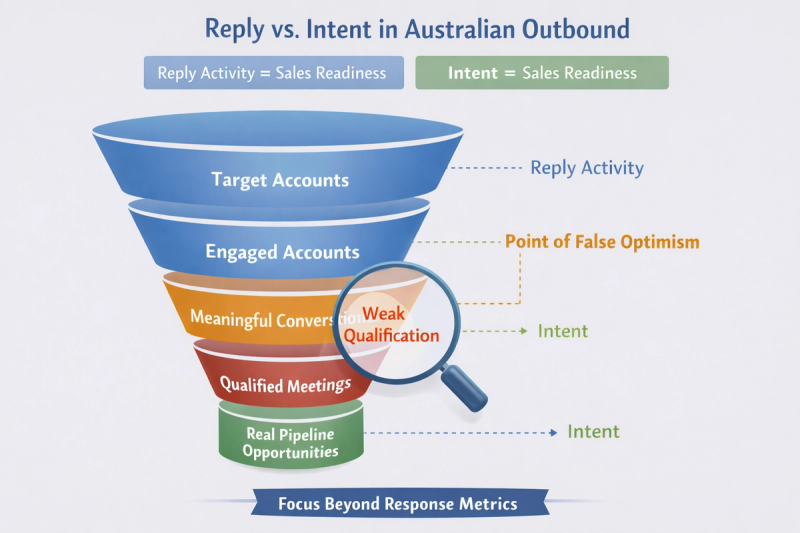
The second problem is that many teams misread engagement. A reply can look positive without creating any real pipeline movement. That is why Australian outbound needs a simple way to separate surface-level engagement from actual sales readiness.
Infographic 2: Reply versus intent in Australian outbound
Description:
This infographic should show the difference between reply activity and sales readiness. A funnel can map the journey from target accounts to engaged accounts, meaningful conversations, qualified meetings, and real pipeline opportunities. The goal is to highlight where weak qualification creates false optimism.
This distinction matters because many teams celebrate positive signals too early.
A reply is not a meeting.
A meeting is not qualified pipeline.
A polite prospect is not always a ready prospect.
For teams focused on Increase sales meetings with outsourced SDR, Appointment setting services APAC, and Sales pipeline building for B2B companies, the handoff logic matters just as much as the top-of-funnel logic.
Follow-up rhythm is where pipeline is won or lost
In Australia, the hardest part is often not getting the first response. It is managing what happens next.
A good follow-up should clarify four things quickly:
- Is there a relevant problem now?
- Is this the right stakeholder?
- Is there a project or timing window?
- Is a meeting the natural next step?
If the answer is unclear, the SDR should not force a meeting. They should tighten the thread.
Speed also matters more than many teams assume. SDR.sg’s internal 2025 to 2026 benchmark content says that first response within 30 minutes increases meetings booked by 35%, while delayed follow-ups can reduce conversions by up to 50% across APAC motions. In Australia, where many replies are exploratory rather than meeting-ready, that speed matters most when paired with strong qualification.
A simple follow-up rhythm often works better than long back-and-forth emails. For example:
First reply comes in
Respond same day with one clarifying question
Prospect answers vaguely
Offer two short pathways: quick call or send one-page summary
Prospect asks to reconnect later
Set a precise follow-up window instead of a vague future reminder
Prospect delegates internally
Treat the referral as a new thread with fresh context, not a recycled sequence
This is where Lead qualification tips for B2B companies become essential. Without strong qualification, teams end up measuring noise.
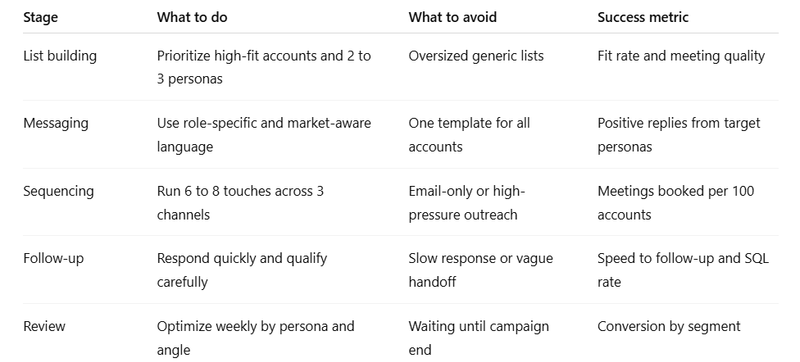
Before implementing the full motion, it helps to view outbound as one operating workflow rather than separate tasks.
Table 3: Practical Australia outbound workflow
Description:
This workflow shows how to turn Australian outbound into a repeatable system. The strongest teams treat targeting, messaging, sequencing, and qualification as one connected operating model.
What this looks like in practice
A common Australia outbound motion for a B2B SaaS team might look like this:
100 Tier 1 accounts
2 core personas per account
3 messaging variants by pain point
7 touches over 18 business days
email + LinkedIn + phone
same-day review of every positive reply
That kind of structure usually outperforms sending 1,500 generic emails into a mixed list.
The contrast is clearer when you compare real campaign outcomes. In SDR.sg’s “Why Our First Outreach Campaign Failed” an early APAC campaign sent 1,500 emails, generated 41 replies, about 2.7% reply rate, and booked only 6 meetings. By contrast, SDR.sg’s multichannel sequence case study booked 94 meetings in 90 days with a tightly structured 21-day motion, while its 2026 benchmark content puts stronger localized cold-email motions in the 4% to 6% meetings booked range. That does not mean every Australia campaign will perform the same way. It does show that better account selection, clearer messaging, stronger follow-up, and tighter qualification materially improve the odds of converting interest into meetings.
It also aligns well with Sales development outsourcing for SaaS companies, Outsourced sales development for SMBs, Lead generation agency models, and companies asking How to outsource SDR in Singapore while still needing market-specific quality.
The most useful benchmark is not whether the campaign gets noticed. It is whether the structure moves you from the market average of 1% to 2% meetings booked toward the 4% to 6% range seen in stronger localized campaigns. That is the difference between outreach that creates activity and outreach that creates pipeline.
The strategic takeaway
If you want to Book more sales meetings APAC, improve B2B prospecting APAC markets, and make outsourcing SDR teams for APAC expansion actually work, Australia needs a more disciplined outbound structure than most teams expect.
The winning model is usually built on:
- tighter account selection
- narrower messaging
- multi-channel sequencing
- faster qualification
- a strong Hybrid SDR team model
- weekly review of meeting quality, not just reply volume
That is how teams turn Australian outbound into pipeline instead of activity.
FAQ – Common Questions
Q1. Why do Australian outbound campaigns get replies but not meetings?
Because replies often reflect curiosity or politeness, not true buying intent. Stronger qualification is needed before counting traction as pipeline.
Q2. How many touches should an Australia outbound sequence have?
A practical starting point is 6 to 8 touches across 14 to 18 business days, spread across email, LinkedIn, and phone.
Q3. Should outbound for Australia be email-only?
No. Email works better when supported by LinkedIn, phone outreach, and visible trust signals.
Q4. What is the best CTA for Australian prospects?
A low-pressure meeting ask works best. Avoid heavy sales language and make the next step easy to accept.
Q5. Can AI improve outbound performance in Australia?
Yes. Tools for AI-assisted SDR prospecting can improve research, prioritization, and drafting. The strongest results usually come when AI supports human SDR judgment rather than replacing it.
Q6. What should teams personalize first?
Start with business problem, role relevance, and local context. Cosmetic personalization is less useful than commercial relevance.
Q7. Who benefits most from this outbound structure?
B2B SaaS companies, regional growth teams, firms entering Australia from Singapore, and businesses using Outsourced SDR services APAC or SDR outsourcing Singapore usually benefit most.
Conclusion
Australia does not usually reward the team that sends the most outreach.
It rewards the team that builds the best structure.
If your outbound motion is built around the right accounts, clear positioning, disciplined sequencing, better follow-up, and a smarter balance between automation and human judgment, Australia becomes much easier to convert.
Not fast. But predictable.
And in a mature B2B market, predictable is what builds pipeline.
Looking to improve B2B lead generation APAC, strengthen your APAC go-to-market strategy, and build a better outbound motion for Australia?
SDR.sg helps B2B companies combine AI sales prospecting tools with experienced human SDR execution to create stronger qualification, better meetings, and more predictable pipeline across APAC.
👉 Book a strategy session: HERE
👉 Explore services: HERE