Published on:
Estimated Reading Time: 12 minutes
Written by Jasmina C., Head of Marketing at SDR.sg
Learn how to build trust with Korean decision-makers through smarter outbound outreach, better follow-up, and lower-friction next steps that improve conversion.
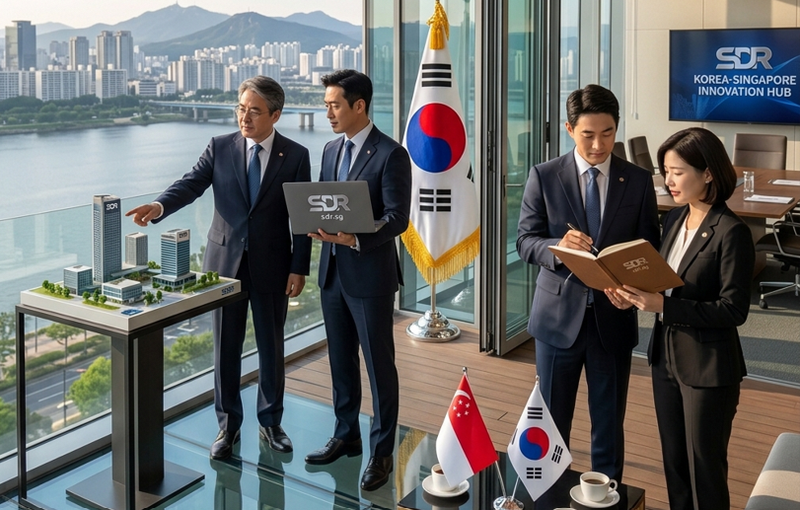
In the first article in this series, Why Momentum in South Korea Dies After First Contact and How to Fix It, we looked at why momentum often dies in South Korea after first contact. This second piece starts one step earlier. Before a Korean buyer agrees to a meaningful next step, they usually need to feel that the vendor is credible, relevant, and safe to engage. That is not a soft cultural detail. It is a core part of how early buying motion works in the market. Guidance on doing business in South Korea consistently points to the importance of relationships, hierarchy, and local credibility in getting commercial conversations to move.

That is why strong outbound lead generation strategies matter so much in South Korea. If your outreach is built around “book the demo fast,” Korea exposes the weakness quickly. A polite reply is not a green light. A warm conversation is not yet buying intent. And a contact who seems interested may still be deciding whether introducing you internally is smart, safe, and worth the reputational risk. Trade guidance for Korea also emphasizes local adaptation and strong support expectations, which is a good reminder that trust is built through how you show up, not just what you sell.
This also connects naturally with SDR.sg’s earlier pieces on:
- Why Global SDR Playbooks Fail in the APAC Region and How to Fix Them
- Go-to-Market Strategies for APAC: What You Need to Know in 2025
- Why Traditional Outbound Approaches Do Not Work in APAC and How to Adapt Them.
The Korea lesson is a sharper version of the same principle: generic outreach may create attention, but trust-building outreach creates movement.
Why the usual “book a demo” approach breaks down in Korea
A lot of global SDR teams are trained to move from first reply to calendar link as quickly as possible.
That works in some markets. In South Korea, it often creates friction too early. Business guides on Korea consistently describe a market where relationships matter, hierarchy shapes behavior, and indirect communication is common. That means a buyer may respond positively without being ready to commit. Silence may mean reflection rather than rejection. And phrases like “we will review internally” may be less about stalling than about protecting internal comfort while evaluation happens quietly.

One useful concept here is nunchi, often understood as reading the room and noticing what is not being said directly. You do not need to turn that into a gimmick. But you do need to understand the behavior behind it. If you read only the literal wording of a reply, you can easily overestimate how far the opportunity has actually moved.
Here is a practical way to frame that gap before the tables.
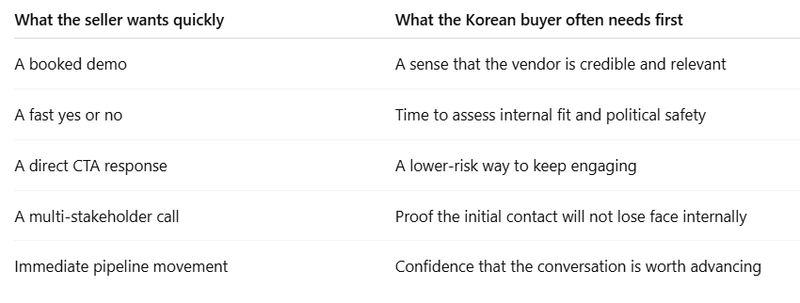
Description:
In Korea, the first job of outreach is often not progression. It is risk reduction.
That is why trust is not a nice extra in B2B lead generation in South Korea. It is part of the conversion path itself.
What Korean decision-makers look for in a first interaction
Korean buyers do not only evaluate the product. They also evaluate the sender, the tone, the level of respect, and the degree to which the vendor appears to understand the market.
That is why localization is not just translation. It is message adaptation.
A Korean decision-maker usually wants to feel five things early:
- this sender understands our context
- this approach is respectful, not pushy
- this vendor looks commercially credible
- this next step is safe to accept
- this conversation will help me, not trap me

This is where email outreach strategies for B2B need a local layer. The best outreach does not force urgency. It reduces ambiguity, lowers risk, and gives the buyer something they can safely engage with.
Before the next section, this comparison makes the trust issue easier to apply.
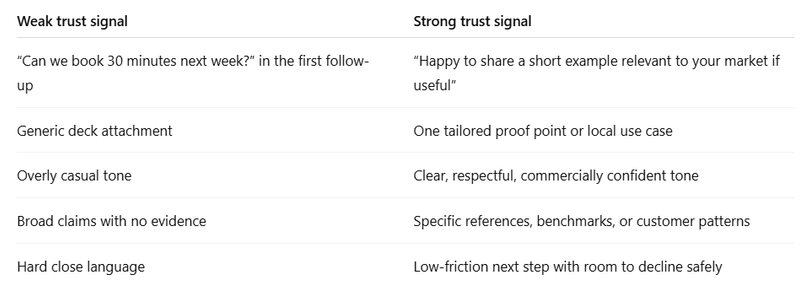
Description:
Trust grows when the buyer feels informed and respected, not cornered.
What trust-building outreach actually looks like
If your goal is to book more sales meetings in APAC, especially in Korea, then the sequence should create comfort before commitment.
That means your first few touches need to do three jobs well:
- establish credibility
- demonstrate relevance
- offer a safe next step
Place the first designed visual here.
Infographic 1: The trust-building sequence for Korean outbound
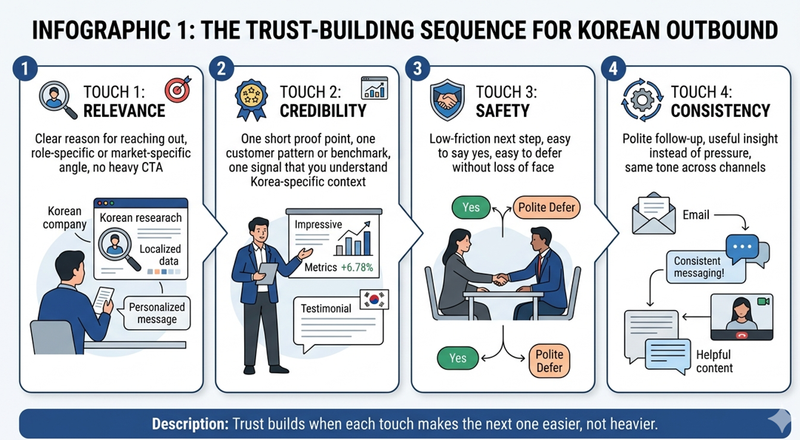
Description:
- Touch 1: Relevance
Clear reason for reaching out, role-specific or market-specific angle, no heavy CTA - Touch 2: Credibility
One short proof point, one customer pattern or benchmark, one signal that you understand Korea-specific context - Touch 3: Safety
Low-friction next step, easy to say yes, easy to defer without loss of face - Touch 4: Consistency
Polite follow-up, useful insight instead of pressure, same tone across channels
Trust builds when each touch makes the next one easier, not heavier.
This is where best practices for multi-channel outbound sales matter. Korean buyers are often comfortable building familiarity gradually across channels, but that only works when the outreach feels coherent and respectful. The sequence should feel like one thoughtful conversation, not five disconnected sales pushes. Asialink also notes that email, scheduled calls, and relationship-building around business interactions all matter in Korea’s commercial environment.
A practical trust-building sequence often looks like this:
- first email with a role-specific insight and no hard ask
- follow-up with one proof point, not a brochure
- LinkedIn touch that reinforces credibility
- short note with a useful market observation
- only then a lighter meeting ask or scoping question
That is usually far more effective than sending three versions of “just checking if you saw this.”
The mistakes that damage credibility fastest
Most failed Korea outreach is not offensive. It is simply too blunt, too generic, or too fast.
The biggest credibility killers in Korean outbound usually look like this:
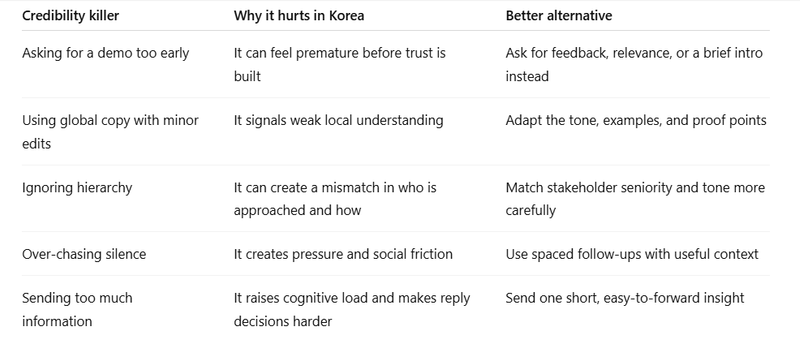
Description:
In Korea, many outreach mistakes are not about bad intent. They are about poor signal reading.
This is also where the buying process matters. In a slower, more people-led process, trust has to arrive early because the contact is already thinking about internal comfort level. If your outreach makes them feel exposed, they delay. If it makes them feel prepared, they engage.
That is why lead qualification tips for B2B companies need a local layer in Korea:
- does this contact look comfortable owning the next step
- is the problem framed clearly enough to forward internally
- is the ask small enough to feel safe
- have we shown enough proof to reduce perceived risk
A concrete example of trust-building versus pressure
Here is a simple side-by-side example.
Weak version:
“Just following up to see if you had time to review my last note. Are you free Thursday at 2 for a demo?”
Stronger version:
“Sharing one short example that may be more relevant to your team. We often see companies in your position wait until the internal use case is clear before exploring vendors further. Happy to send a brief outline if useful.”

The difference is not cosmetic. The weak version asks for time before trust is built. The stronger version gives context, reduces pressure, and offers a lower-friction next step.
This is also where segmentation matters. A chaebol-style enterprise environment may require more internal comfort, stakeholder mapping, and proof before a meeting gets traction, while a smaller Korean company may move faster once relevance is clear. The principle is the same in both cases: reduce risk first, then ask for progression.
How to follow up without forcing the buyer
A strong Korean follow-up should feel calm, useful, and proportionate.
In Korea, your follow-up should not sound like a chase. It should sound like a responsible continuation of a relevant conversation. That means fewer nudges for the sake of nudging, and more follow-ups that actually help the buyer think.
Place the second designed visual here.
Infographic 2: A lower-pressure follow-up model for Korea
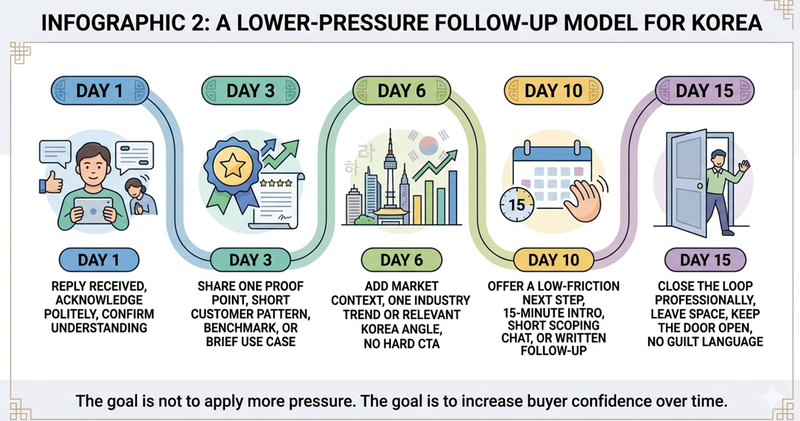
Description:
- Day 1: Reply received, acknowledge politely, confirm understanding
- Day 3: Share one proof point, short customer pattern, benchmark, or brief use case
- Day 6: Add market context, one industry trend or relevant Korea angle, no hard CTA
- Day 10: Offer a low-friction next step, 15-minute intro, short scoping chat, or written follow-up
- Day 15: Close the loop professionally, leave space, keep the door open, no guilt language
The goal is not to apply more pressure. The goal is to increase buyer confidence over time.
This is especially useful for sales prospecting in South Korea, where buyers may prefer to keep evaluating before giving a direct yes. It also aligns with a broader truth about outbound sales in APAC markets: a sequence that works in one country can underperform in another if it ignores local trust dynamics.
Benchmarks matter, but only if you read them honestly
A lot of teams use early activity metrics to convince themselves the motion is working.
Open rates, reply rates, and first-touch engagement can be useful indicators. But they become misleading if they are treated as proof that trust is already there.
Across APAC outbound, SDR.sg commonly sees decent opens, some polite replies, and then a sharp drop before real meetings happen. That pattern also broadly matches external outbound benchmarks from sales execution platforms and agencies, where the biggest conversion drop often happens after the first positive signal rather than before.
For SDR.sg, typical campaign patterns often sit around 20% to 30% opens, 3% to 6% replies, and roughly 1% to 2% meetings booked, though results vary heavily by market, list quality, and offer. This should be read as observed campaign reality, not a universal market average.
The takeaway is simple. Do not confuse interest with internal comfort. In Korea, that gap is often where the real work begins.
The compliance and professionalism layer buyers notice
Trust in Korea is not only emotional. It is also operational.
If you are collecting prospect data, storing Korean contact details abroad, or using offshore tools in your outbound motion, your process needs to look serious. Guidance from Korea’s Personal Information Protection Commission makes clear that overseas businesses can fall within PIPA scope in certain situations, including when they provide goods or services to Korean data subjects or process Korean personal information in ways that affect them. PIPC guidance also highlights breach reporting and notification obligations in applicable cases.
That matters commercially, not just legally. Sloppy sourcing, vague data handling, and inconsistent workflows quietly damage confidence. A disciplined go-to-market strategy for South Korea should include clean data sourcing, clear governance, and a basic review of cross-border prospecting workflows before scale.
What this means for founders, heads of sales, and APAC teams
If your company is planning B2B sales expansion APAC, Korea is one of the clearest tests of whether your outbound is genuinely localized.
The teams that win tend to do five things better:
- they adapt tone, not just language
- they lead with relevance before meetings
- they use proof instead of pressure
- they respect hierarchy and internal safety
- they follow up in a way that builds trust rather than forcing speed

For some teams, that can be handled in-house. For others, especially those entering North Asia for the first time, it may make more sense to use specialist support or outsourced SDR services in South Korea through a partner that already understands the market.
FAQ, Common Questions
Q1. Why is trust so important in Korean outbound outreach?
Because the buyer is often judging whether moving the conversation forward is safe internally, not just whether the product sounds interesting.
Q2. Is translation enough for outreach into Korea?
No. Localization includes tone, pacing, proof points, and message framing, not only language. (Asialink)
Q3. Should I ask for a demo in the first follow-up?
Usually not. A lower-friction next step tends to work better early because it reduces buyer risk.
Q4. What kind of proof works best with Korean decision-makers?
Short, relevant proof points, customer patterns, and clear business context usually work better than long decks or broad claims.
Q5. Does hierarchy really affect outbound in Korea?
Yes. Rank sensitivity and internal alignment matter, so who you approach and how you phrase the ask can affect response quality.
Q6. Do privacy and data handling matter at the prospecting stage?
Yes. Clean sourcing, disciplined workflows, and clear governance improve both compliance and buyer confidence.
Q7. What is one practical way to improve trust signals fast?
Review your first three touches and remove anything that creates pressure before credibility is established.
Conclusion
The best outbound lead generation strategies in Korea do not just get noticed. They make the buyer feel informed, respected, and safe enough to keep moving.
That is the real shift.
If your outreach to Korea sounds like a copy-paste global sequence, the problem is probably not your list. It is the way you are trying to build trust. In this market, trust signals often matter more than aggressive CTAs, and relevance often beats speed.
If you want to improve B2B lead generation in South Korea, start by asking a harder question: does our outreach reduce buyer risk, or increase it?

Ready to pressure-test your Korea outbound?
If your outbound to Korea sounds locally adapted but still is not converting,
SDR.sg can help you review the real issue.
We can audit your messaging, sequence structure, and post-reply flow to see where trust is being built, or quietly lost.