Published on:
Estimated Reading Time: 11 minutes
Written by Jasmina C., Head of Marketing at SDR.sg
Most Malaysian B2B deals are won before the sales call. Learn how enterprises actually close deals using proven B2B lead generation in APAC, APAC go-to-market strategies, hybrid sales team AI and human models, and outsourced SDR services Singapore—with real data, case studies, and actionable insights to increase pipeline conversion and close rates.
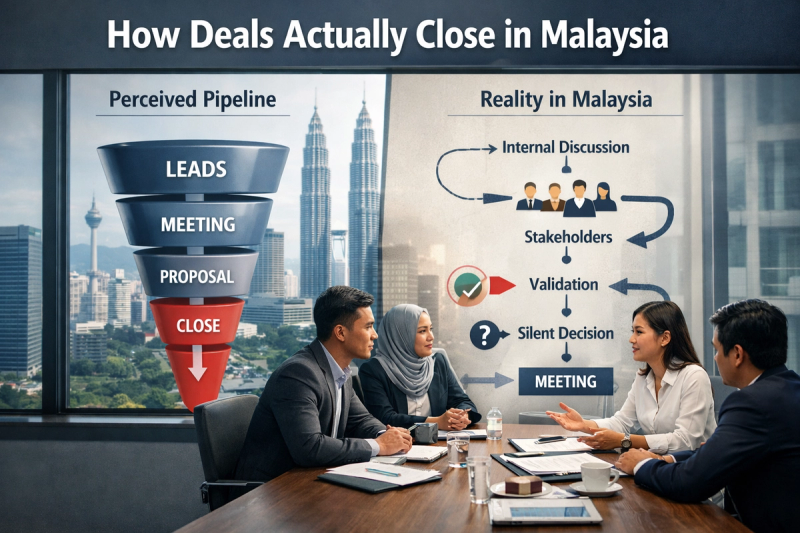
Introduction – What Actually Closes Deals in Malaysia
This article is the third part in our Malaysia B2B series:
👉 Why Most B2B Deals in Malaysia See Early Pipeline Decay Before the First Call
👉 Why Malaysian B2B Buyers Decide Before Your First Call
In the first two pieces, we broke down:
- Why B2B lead generation in APAC pipelines decay before the first meeting
- How Malaysian buyers form decisions before sales conversations even begin
This is the next step.
Because understanding pipeline decay and pre-call decision-making only explains part of the problem.
The real question is:
How do Malaysian enterprises actually close deals?
Across multiple B2B sales expansion APAC engagements, one consistent pattern emerges:
High activity does not translate into closed revenue.
Teams investing in APAC go-to-market strategies, outbound lead generation strategies, and outsourced SDR services Singapore often generate strong early metrics—but struggle to convert pipeline into revenue.
The reason is structural.
In Malaysia:
- Deals are internally aligned before formal sales engagement
- Stakeholders are activated before SDR qualification
- Trust is established before conversations happen
This creates a gap between what your pipeline shows—and how deals actually close.
The Pipeline You See vs The Pipeline That Closes
Before optimizing outbound lead generation strategies, it is critical to understand that the visible pipeline is only a partial representation of reality.
Most SDR teams track linear progress.
Malaysian enterprises operate through parallel internal validation loops.
Table 1: Visible vs Real Pipeline Dynamics in Malaysia
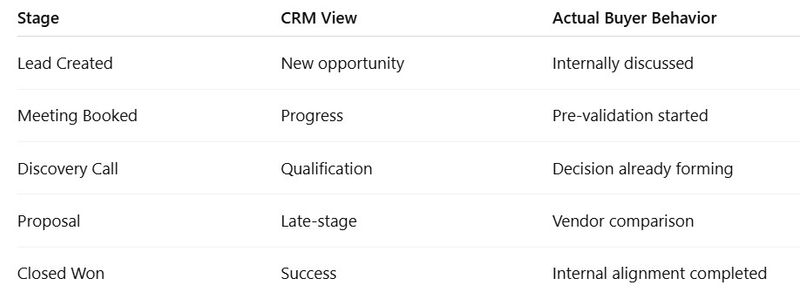
Explanation:
According to Gartner and Forrester, up to 70–80% of B2B buyers define preferences before engaging sales. In Malaysia, this effect is amplified due to trust-based decision-making.
Implication for APAC go-to-market strategies:
If you are only managing CRM stages, you are missing the actual decision process.
How Deals Actually Progress
Malaysian B2B Deal Flow (Real vs Perceived): Malaysian enterprise deal flow vs CRM pipeline stages
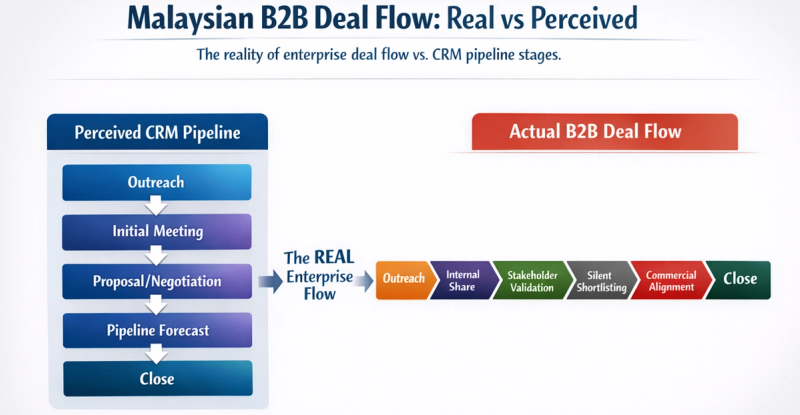
Flow:
Outreach → Internal Share → Stakeholder Validation → Silent Shortlisting → Meeting → Commercial Alignment → Close
Description:
This model reflects real execution across B2B lead generation in Asia campaigns.
Key implication:
- Meetings are outputs of internal alignment, not triggers of it
- Pipeline quality depends on internal shareability of your outreach
For teams focused on increase sales meetings with outsourced SDR, this is critical:
More meetings ≠ better pipeline
Better pre-call alignment = higher close rate
Behavioral Signals That Actually Predict Closed Deals
Standard metrics (reply rate, meeting rate) are insufficient in Malaysia.
The real indicators come from behavioral signals during early engagement.
Before reviewing the data, it is important to understand:
Not all engagement is equal.
Table 2: High-Signal vs Low-Signal Engagement
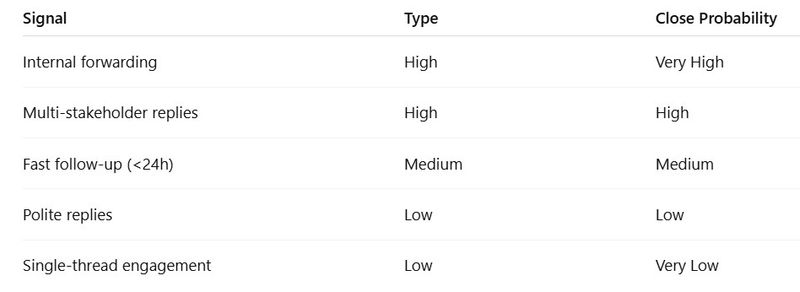
Explanation:
Across outsourced sales development for SMBs and SaaS expansion projects:
- Deals with internal forwarding closed 2–3x more often
- Single-thread deals stalled in 70%+ of cases
- Fast follow-up only matters if multiple stakeholders are involved
Example from execution:
A Singapore-based SaaS company using AI-powered sales prospecting tools saw:
- 16% reply rate
- But only deals with ≥3 stakeholders engaged converted
Conclusion:
Pipeline strength is defined by internal spread, not SDR effort.
Case Study – SaaS Expansion into Malaysia
Scenario:
B2B SaaS company entering Malaysia using sales development outsourcing for SaaS companies.
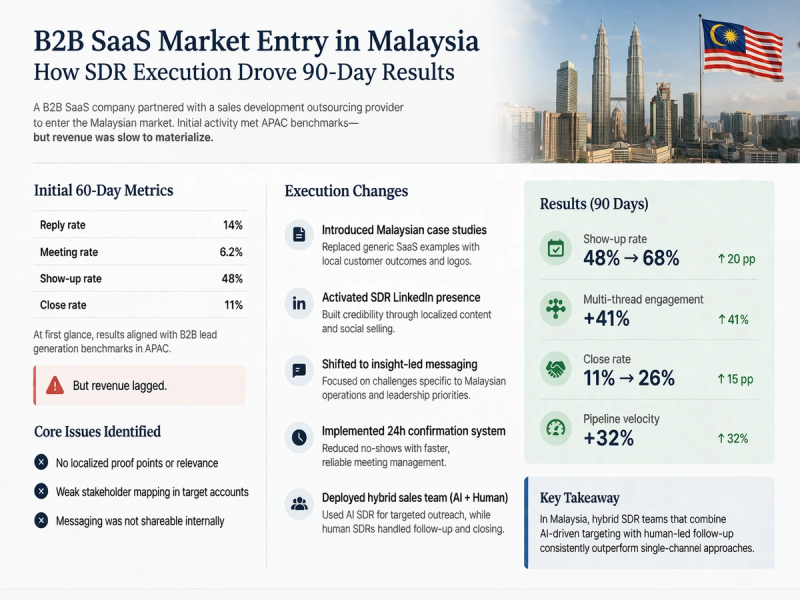
Initial 60-Day Metrics:
- Reply rate: 14%
- Meeting rate: 6.2%
- Show-up rate: 48%
- Close rate: 11%
At first glance, this aligns with B2B lead generation APAC benchmarks.
But revenue lagged.
Core Issues Identified:
- No localized proof
- Weak stakeholder mapping
- Messaging not shareable internally
Execution Changes:
- Introduced Malaysian case studies
- Activated SDR LinkedIn presence
- Shifted to insight-led messaging
- Implemented 24h confirmation system
- Deployed hybrid sales team AI and human
Results (90 Days):
- Show-up rate: 48% → 68%
- Multi-thread engagement: +41%
- Close rate: 11% → 26%
- Pipeline velocity: +32%
Additional observation:
Deals where AI SDR handled targeting and human SDR handled follow-up consistently outperformed single-channel approaches.
The Internal Alignment Loop
Malaysian Enterprise Buying Loop: Malaysia B2B internal stakeholder alignment loop before deal closure
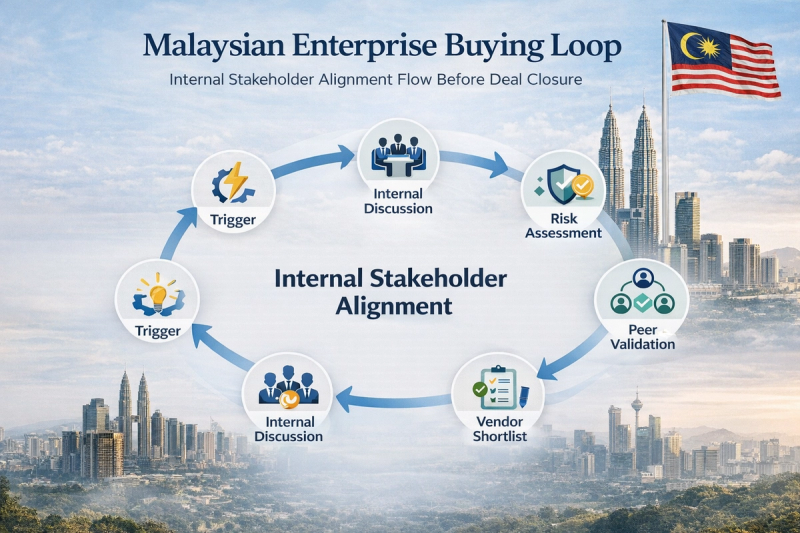
Flow:
Trigger → Internal Discussion → Risk Assessment → Peer Validation → Vendor Shortlist → Meeting → Decision
Description:
Supported by McKinsey and Edelman–LinkedIn Trust data, this reflects how enterprise buying works in trust-driven markets.
Key implication:
- Sales calls do not create decisions
- They validate decisions already forming
For B2B prospecting APAC markets:
If your outreach is not entering internal discussions, you are not in the deal.
Why Most Outbound Strategies Fail to Close
Many outbound lead generation strategies are built on incorrect assumptions.
Before optimizing execution, these assumptions must be corrected.
Table 3: Common GTM Mistakes vs Reality
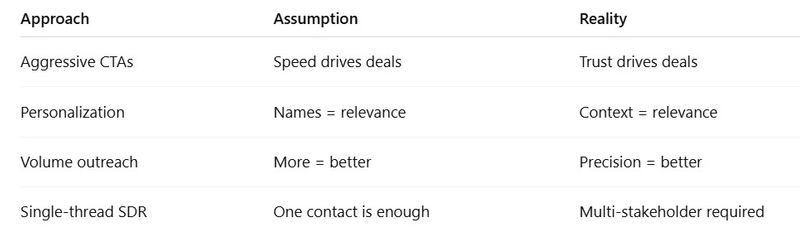
Explanation:
Across lead generation services Singapore deployments:
- Aggressive CTAs reduced reply quality
- Personalization without insight had no measurable impact
- Multi-thread outreach increased meeting quality significantly
Concrete example:
Two campaigns targeting Malaysian fintech:
Campaign A (standard personalization):
- “Hi Ahmad, saw you're in fintech…”
Result: Low engagement
Campaign B (insight-led):
- “Most MY fintech pipelines lose 30–40% pre-call—are you seeing this?”
Result:
- Higher replies
- More internal sharing
- Better meeting quality
Conclusion:
Relevance built on insight outperforms personalization at scale.
What Actually Moves Deals to Close
Based on execution across APAC sales development services, five consistent drivers determine deal success.
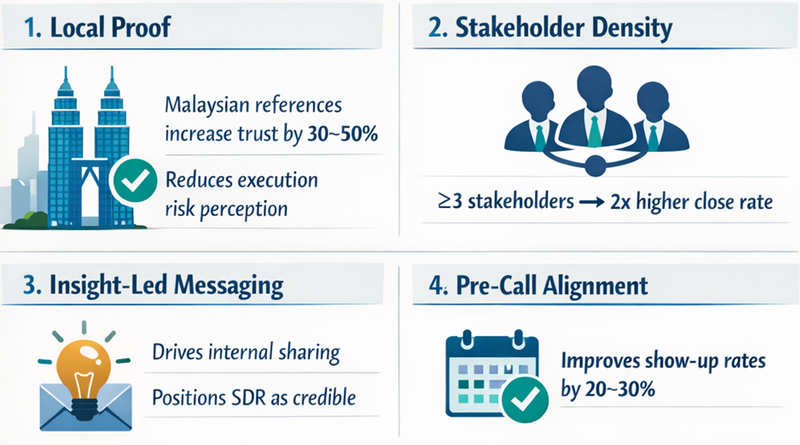
1. Local Proof
- Malaysian references increase trust by 30–50%
- Reduces execution risk perception
2. Stakeholder Density
- ≥3 stakeholders → 2x higher close rate
3. Insight-Led Messaging
- Drives internal sharing
- Positions SDR as credible
4. Pre-Call Alignment
- Improves show-up rates by 20–30%
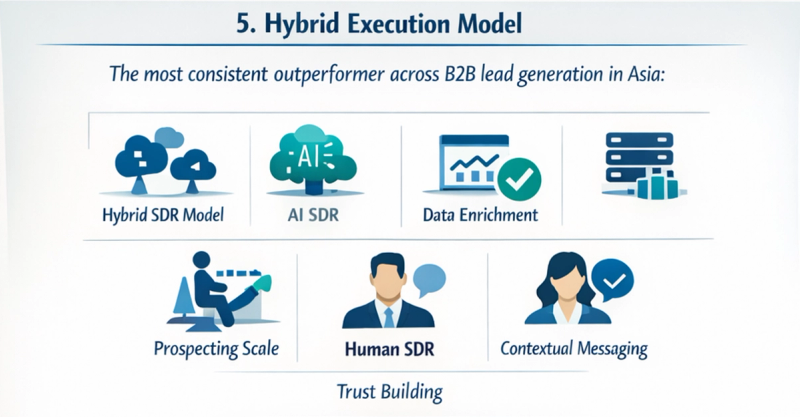
5. Hybrid Execution Model
The most consistent outperformer across B2B lead generation in Asia:
Hybrid SDR model
- AI SDR
- Data enrichment
- Prospecting scale
- Human SDR
- Contextual messaging
- Trust building
Supported by McKinsey:
Hybrid sales teams drive up to 30% higher revenue growth in complex B2B environments.
For companies using outsourced SDR services Singapore, this is no longer optional—it is baseline.
External Benchmarks and Market Validation
👉 Forrester: 70–80% of buyers decide before sales interaction
👉 Gartner: 6–10 stakeholders in B2B buying groups
👉 McKinsey: Hybrid models outperform by up to 30%
👉 Edelman–LinkedIn: Trust is the primary decision driver
These align directly with observed results in B2B lead generation APAC campaigns.
Internal Resources
👉 https://sdr.sg/blog/why-malaysia-pipeline-decays-before-first-call
👉 Hybrid Sales Team: Why AI + Human is the Best Model for APAC B2B Sales in 2026
👉 Key Differences in B2B Outbound Between APAC and Western Markets
FAQ – Common Questions
Q1: What actually closes B2B deals in Malaysia?
A1: Internal alignment, stakeholder density, and pre-call trust signals.
Q2: How many stakeholders are involved?
A2: Typically 3–6, sometimes more in enterprise deals.
Q3: Why do deals stall after strong meetings?
Because alignment did not happen before the call.
Q4: Is outbound effective in Malaysia?
A4: Yes—but only with relevance, trust, and shareability.
Q5: Do AI SDR tools work?
A5: Yes, within a hybrid sales team AI and human model.
Q6: How to increase sales meetings with outsourced SDR?
A6: Focus on pre-call validation, not volume.
Q7: What is the biggest pipeline mistake?
A7: Treating booked meetings as qualified opportunities.
Key Takeaways
- Malaysian deals are aligned before they are discussed
- CRM pipeline ≠ real buying process
- Internal validation defines deal success
- Hybrid SDR models outperform traditional approaches
- Closing starts before the first meeting

If you are:
- Scaling with APAC go-to-market strategies for startups
- Using SDR outsourcing Singapore
- Trying to increase sales meetings with outsourced SDR
- Facing low close rates despite strong pipeline
You need to fix how deals are built—not just how meetings are booked.
👉 Book a strategy session: HERE
👉 Explore services: HERE
Immediate action:
Review your last 20 deals:
- % with multi-stakeholder engagement
- % with local proof
- % internally shared before first call
Final Insight
In Malaysia, pipeline is not built on activity.
It is built on pre-call perception, internal alignment, and trust signals.
If those are not in place — the deal is already lost before the meeting begins.