Published on:
Estimated Reading Time: 10 minutes
Written by Jasmina C., Head of Marketing at SDR.sg
👉 Book a strategy session: HERE
👉 Explore services: HERE
Modern B2B buyers can spot generic outreach instantly. Learn why email outreach strategies for B2B now need sharper research, stronger relevance and human judgment.

Buyers are not tired of sales. They are tired of lazy sales.
That is the real issue with many email outreach strategies for B2B in 2026. The problem is not that executives refuse to speak with vendors. The problem is that buyers have become very good at spotting generic outreach, weak personalization and obvious automation.
Cold outreach still works. Bad outreach does not.
RAIN Group research shows that 82% of buyers accept meetings with sellers who proactively reach out. Instantly’s 2026 benchmark reports an average cold email reply rate of 3.43%, while top performers exceed 10%. The gap is not created by sending more of the same message. It is created by sharper targeting, better research, stronger timing and better judgment.
Most outbound teams do not have a copywriting problem. They have a thinking problem. The email simply reveals what was missing before the first line was written.
Buyers are not against outreach. They are against low effort.
A buyer can tell when a message was written for a list of 5,000 people.
They can also tell when the seller has done the work. The difference shows up quickly: the problem is sharper, the timing makes sense, the CTA feels easier to answer, and the message does not sound like it came from the same AI prompt every other vendor is using.
Before improving the message, teams need to understand what buyers are filtering for.
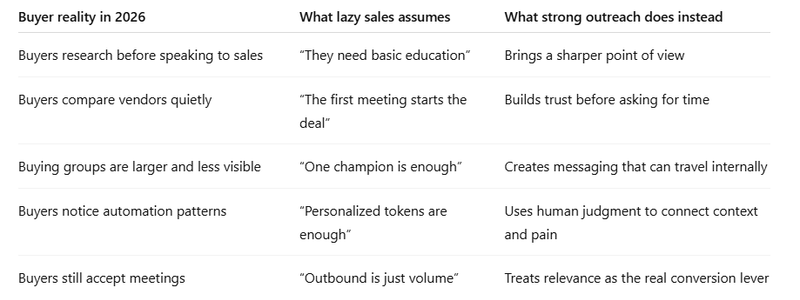
Table description:
Generic outreach assumes the buyer is waiting to be interrupted. Strong outreach recognizes that the buyer is already researching, comparing and filtering.
This is why outbound lead generation strategies cannot be reduced to list building plus automated sequences. More activity only helps when the thinking behind the activity is strong.
AI made outreach easier, but trust harder
AI is useful. It can summarize accounts, surface triggers, draft first versions and speed up research. Outreach’s 2025 sales data found that 45% of teams are already using a hybrid AI-SDR model, and sellers using AI tools reduced research and personalization time by 90%.
But there is a tradeoff.
When every team uses similar tools, the inbox fills with messages that look different but feel the same. The grammar improves. The judgment does not.
The more automated sales becomes, the more human judgment matters.
This is especially important across B2B prospecting APAC markets. Singapore, Australia, India, Japan, Korea, China, New Zealand and Southeast Asia do not respond to the same tone, proof points, timing or trust signals.
A direct ommercial hook may work in Australia. In Japan, the same message may need more credibility, context and patience. In Singapore, senior buyers often expect a clear business reason quickly. In Indonesia or India, channel mix and relationship signals can matter more than a single cold email.
That is why SDR.sg’s role is not simply to send more emails. SDR.sg helps B2B companies turn outbound from random activity into a structured pipeline engine through account research, localized messaging, qualification and meeting generation.
Internal link: Behind the Scenes: What SDR.sg Actually Does for B2B Clients
Infographic 1: Why generic outreach loses buyers
The issue with lazy sales is not only the wording. It is the full funnel. A weak list creates weak messaging. Weak messaging creates weak replies. Weak replies create weak meetings.
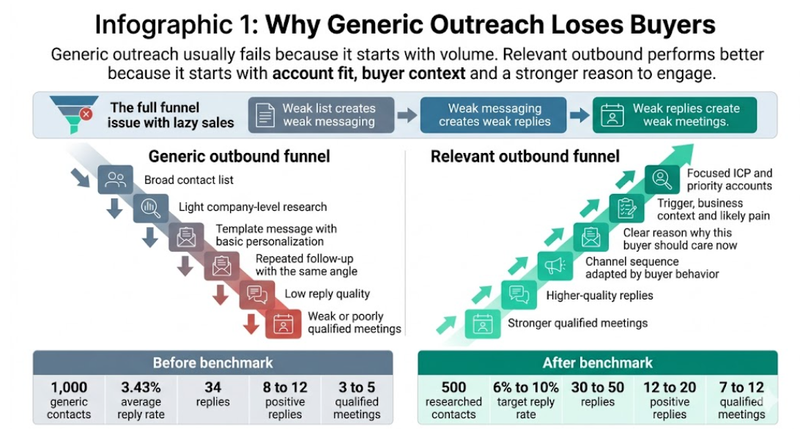
Infographic description:
Generic outreach usually fails because it starts with volume. Relevant outbound performs better because it starts with account fit, buyer context and a stronger reason to engage.
The point is not that every campaign needs fewer contacts. The point is that better inputs usually create better outputs. If the audience, research and message are weak, the sequence only multiplies the weakness.
Personalization is not relevance
Personalization proves you noticed something. Relevance proves you understood why it matters.
That distinction is where most email outreach strategies for B2B either win or fail. A funding announcement, new office, hiring post or LinkedIn update is not enough by itself. The seller still needs to connect that signal to a business problem the buyer may actually care about.
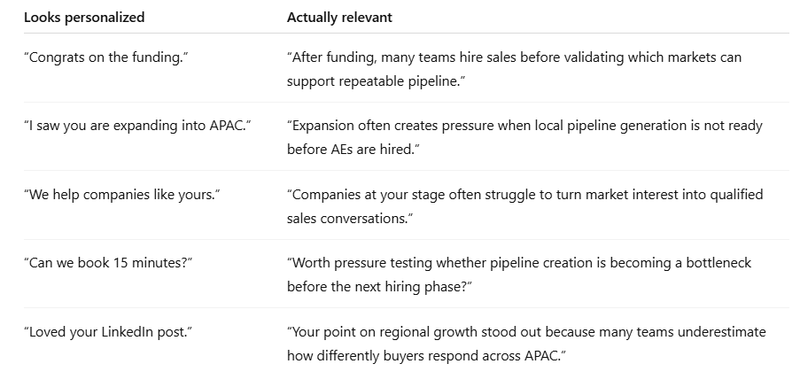
Table description:
The left side is surface-level personalization. The right side creates relevance by connecting a trigger to a likely business consequence.
LinkedIn and Edelman’s 2025 research on hidden buyers also matters here. Procurement, finance, legal and operations stakeholders often influence vendor decisions even when they are not the obvious target persona. That means a useful message may travel internally. A generic one dies in the inbox.
Lazy sales usually starts before the message is written
Bad outreach is rarely just a writing problem.
It usually starts with weak preparation: unclear ICP, no account trigger, vague persona pain, poor market understanding and no real reason to talk.
Strong best practices for multi-channel outbound sales start before the first email. They start with better inputs.
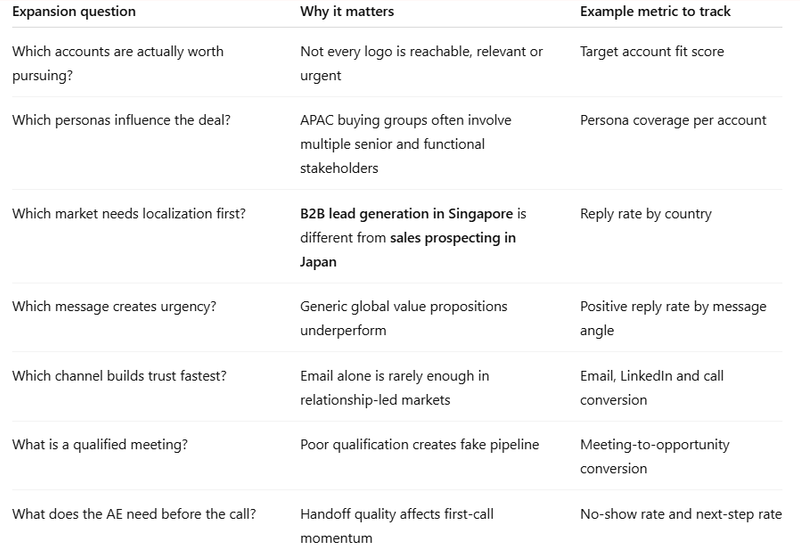
Table description:
The message exposes the weakness, but the real issue happens upstream. Strong outbound depends on better inputs before any sequence is written.
This is why APAC lead generation cannot be treated like basic admin work. Buyers do not usually respond because of one perfect message. They respond because the seller creates relevance across email, LinkedIn, calls, referrals, events, content and follow-up.
Internal link: How Do You Create Lead Generation in APAC? The Four Steps of Lead Generation for Predictable Growth
What high-effort sales looks like
High-effort sales is not about writing long emails. It is about doing enough thinking before sending short ones.
A strong outbound message should answer six questions:
- Why this company?
- Why this person?
- Why now?
- What is likely changing in their business?
- What problem could become expensive if ignored?
- Why is the conversation worth their time?
Consensus analyzed more than 6 million buyer interactions and found that deals with 9 or more demo views see 8 to 10 times higher close rates. It also found that product experiences can uncover more than four stakeholders on average.

That tells us something important: modern buying is not linear. The first message is not just a meeting request. It is the beginning of a trust-building path that may involve multiple people you cannot see yet.
6sense’s buyer research also shows that buyers are deep into their journey before sellers become visible, and that buying groups often rank preferred vendors before first contact.
So the question is not “How do we send more?”
The better question is: “Are we giving buyers a reason to trust us before they speak with us?”
Infographic 2: The human judgment layer in modern SDR work
AI should speed up workflow. It should not replace judgment. The strongest teams use AI to move faster, while humans decide what matters.
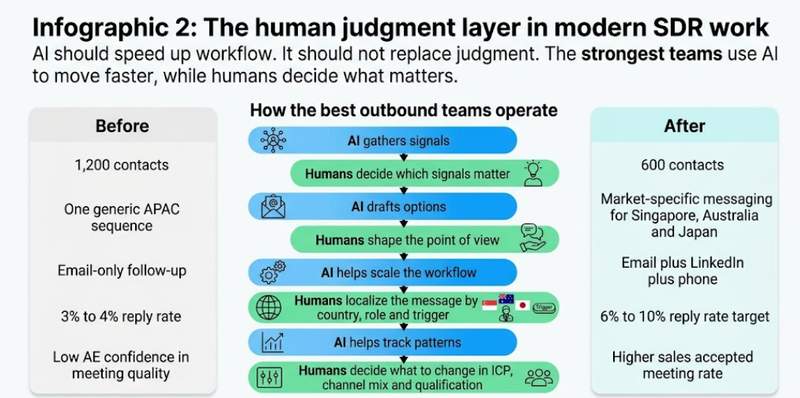
Infographic description:
The best AI and human SDR teams combine scale with judgment. AI helps the team move faster. Human judgment makes the outreach worth answering.
Example: SaaS company entering Singapore and Australia
A B2B SaaS company expanding into Singapore and Australia had strong AEs but weak early pipeline. The original outbound motion was built around one regional message.
Before
500 target accounts
1,100 contacts
One APAC email sequence
3.2% reply rate
11 positive replies
4 qualified meetings
2 sales accepted opportunities
The problem was not activity. The problem was that the message treated Singapore and Australia as if they had the same buying behavior.
After
280 priority accounts
620 contacts
Separate messaging by market and persona
Singapore sequence focused on trust, regional credibility and operational risk
Australia sequence focused on growth pressure, sales efficiency and pipeline conversion
LinkedIn and phone follow-up added after email step two
7.6% reply rate
31 positive replies
12 qualified meetings
7 sales accepted opportunities
The lesson is simple: fewer contacts, better thinking, stronger outcomes.
This is where APAC sales development services become valuable. The work is not just appointment setting. It is market interpretation, message testing, channel sequencing and qualification discipline.
What this means for companies expanding into APAC
Companies entering APAC often underestimate how much work needs to happen before the first meeting is booked.
They hire AEs, buy tools, upload lists and expect pipeline to appear. Then they discover the real bottleneck: the market does not know them, the messaging is too generic, the ICP is too broad and the sales team is spending too much time prospecting instead of progressing real opportunities.
For companies that want to book more sales meetings in APAC, the answer is not always “more SDR activity.” Often, the answer is better sequencing of the work:
First, define the market and ICP.
Second, identify account triggers.
Third, adapt messaging by persona and country.
Fourth, build a multi-channel sequence.
Fifth, qualify meetings tightly.
Sixth, feed insights back into the next campaign.
This matters whether the team is testing B2B lead generation in Singapore, sales prospecting in Australia, market entry into Japan or broader multi-country expansion across Southeast Asia.
Internal link: How Outsourced SDR Services Drive B2B Lead Generation in APAC
Where SDR.sg fits
SDR.sg is not a replacement for your sales team.
SDR.sg helps B2B companies carry the early pipeline burden more effectively, from account research and localized messaging to outreach, qualification and meeting generation.
That matters when founders, AEs and sales leaders are already stretched. If an AE has to research accounts, write sequences, test messaging, qualify prospects, run discovery, build business cases and close deals, something will suffer.
SDR.sg acts as the human judgment layer behind sales development. The team helps companies build a clearer motion around account selection, messaging, outreach, qualification and feedback loops, so outreach feels relevant before it asks for time.
Internal link: 5 Hidden SDR Workflow Problems Killing Growth in APAC and Singapore

FAQ: Buyers can smell lazy sales now
Q1. Are B2B buyers ignoring all outbound sales?
No. Buyers still accept meetings when outreach is relevant, timely and useful. The issue is not outbound itself. The issue is lazy outbound that asks for time before showing business context.
Q2. What is the difference between personalization and relevance?
Personalization proves you noticed something. Relevance proves you understood why it matters. “Congrats on the funding” is personalization. Connecting that funding to hiring pressure, market expansion and pipeline risk is relevance.
Q3. Can AI write good sales outreach?
AI can help, but it should not own the judgment. AI is useful for research, summaries, first drafts and workflow. Humans still need to decide the angle, timing, tone, market nuance and reason to talk.
Q4. What is a good cold email reply rate in 2026?
Instantly’s 2026 benchmark reports a 3.43% average reply rate, with top performers exceeding 10%. Strong teams should track positive replies, qualified meetings and sales accepted opportunities, not just total replies.
Q5. Why does generic outreach fail in APAC?
APAC is not one market. Singapore, Australia, Japan, India, Korea, China, New Zealand and Southeast Asia differ in communication style, trust signals, buying committees and channel behavior. Generic messaging often feels imported rather than relevant.
Q6. How can companies improve email outreach strategies for B2B?
Start with tighter account selection, clearer triggers, persona-specific messaging, shorter copy, stronger proof points and a better follow-up structure. The message should show that the seller understands the buyer’s context before asking for a meeting.
Q7. When should a company consider SDR.sg?
Consider SDR.sg when your founders, AEs or sales leaders are carrying too much of the early pipeline work, or when your team is entering APAC and needs a structured sales development motion before scaling headcount.
Build outreach that deserves a reply
Before sending more messages, ask a harder question:
Has your team done enough work to deserve the reply?
If your AEs, founders or sales leaders are carrying too much of the pipeline burden, it may be time to build a more structured sales development motion around them.
Book a 30-minute outbound audit with SDR.sg. The team can review your ICP, current messaging, channel mix and meeting conversion path, then show where your sales development motion is leaking pipeline.
Strong email outreach strategies for B2B do not start with the send button. They start with better thinking.