Published on:
Estimated Reading Time: 11 minutes
Written by Jasmina C., Head of Marketing at SDR.sg
👉 Book a strategy session: HERE
👉 Explore services: HERE
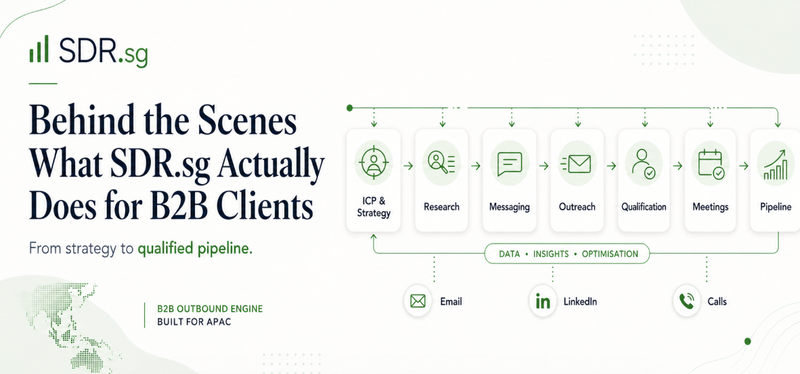
Behind the scenes, SDR.sg helps B2B clients turn outbound from random activity into a structured pipeline engine. Through outsourced SDR services APAC, we identify the right accounts, reach the right decision makers, qualify real interest, and book meetings that sales teams can actually progress.
Most companies do not lose deals because their salespeople cannot close.
They lose momentum because the right conversations are not happening often enough.
That is where outsourced SDR services APAC become valuable. Not as “extra hands” to send more emails, but as a structured system for finding the right accounts, reaching the right decision makers, qualifying real interest, and giving the client’s sales team better conversations to progress.
This matters more in 2026 because buyers are harder to influence through generic outreach. Gartner’s 2026 sales survey found that 67 percent of B2B buyers prefer a rep-free experience, up from 61 percent in 2025. That does not mean sellers are irrelevant. It means low-value seller interaction is easier to avoid, while relevant human engagement still matters.
At SDR.sg, this is what happens behind the scenes.
Why outsourced SDR services APAC need more than activity
Outbound fails when it becomes a volume exercise.
More emails do not automatically create more pipeline. More contacts do not mean better targeting. More meetings do not mean better opportunities.
Forrester’s 2025 buyer research found that 68 percent of B2B buyers already have a front-runner vendor in mind at the start of the purchasing process, and that front-runner wins 80 percent of the time. That is why companies cannot wait until buyers are formally “in market.” They need to build relevance earlier.
Before looking at the SDR.sg process, here is the practical difference between basic outbound and a disciplined campaign.
Table 1: Weak outbound vs SDR.sg campaign process
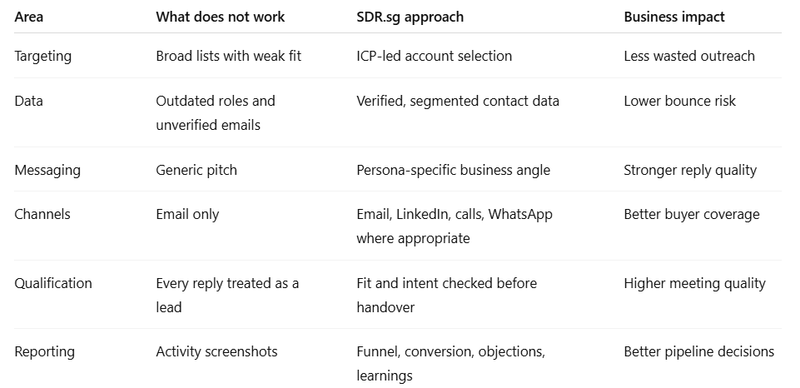
Table description:
This table shows why outsourced SDR work is not just activity. The biggest improvement usually comes from sharper targeting, cleaner data, stronger qualification, and tighter feedback loops.
Step 1: We understand the client before we touch the market
A good campaign starts with commercial understanding.
We need to know what the client sells, who buys it, why they buy it, what pain creates urgency, what objections usually appear, and what a qualified opportunity looks like.
This is where many campaigns fail. They start outreach before the positioning is clear.
If a SaaS company is entering Singapore, the message should not simply say, “We help companies improve productivity.” It should connect to a real business situation: regional expansion, local hiring, cost pressure, compliance, operational complexity, or sales execution.
This is also where we define what not to chase. Not every company is worth prospecting. Not every lead deserves a meeting. Not every reply should be handed to sales.
For deeper context, read SDR.sg’s guide on defining ICP for outbound sales in APAC.
Step 2: We build the account and contact strategy
Once the commercial foundation is clear, we build the target account list.
For B2B prospecting APAC markets, that means looking at company size, industry, market presence, hiring signals, funding, expansion activity, technology stack, job changes, and regional relevance.
Data quality matters. ZeroBounce’s 2026 Email List Decay Report found that at least 23 percent of an email list decays within one year, which means poor data can damage deliverability before a campaign gets a fair chance to perform.
That is why list building is not admin work. It is pipeline work.
SDR.sg commonly uses or evaluates tools such as LinkedIn Sales Navigator, Apollo, ZoomInfo, Lusha, ZeroBounce, Clay, HubSpot, Salesforce, Outreach, Salesloft, and enrichment workflows depending on the campaign. The tools help. The process matters more.
Infographic 1: The SDR.sg campaign engine
Before launch, the campaign should be seen as a system, not a one-off sequence.
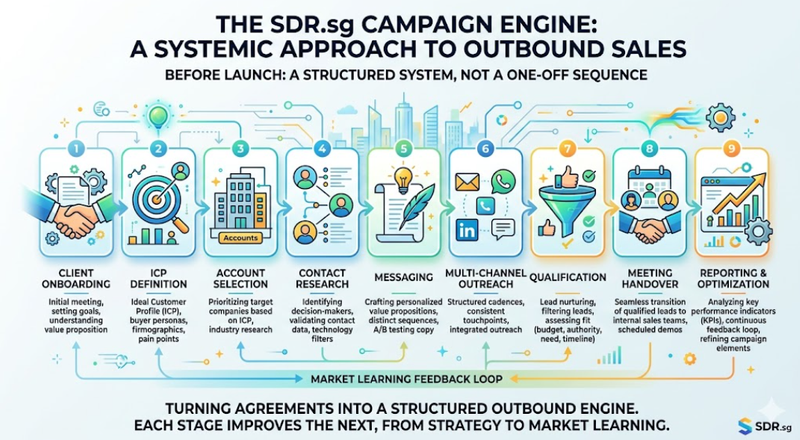
Infographic description:
This infographic shows how SDR.sg turns a signed client agreement into a structured outbound engine. Each stage improves the next one, from strategy to market learning.
Step 3: We write messaging that sounds like it belongs in the market
Good outbound does not sound like a brochure.
It sounds like someone has done the work.
For outbound lead generation strategies, the first question is not, “What do we want to say?” The better question is, “What would this buyer recognize as relevant?”
A CEO may care about growth speed. A CRO may care about predictable pipeline. A Head of Sales may care about keeping account executives focused on qualified opportunities. A Country Manager may care about local execution. A Marketing leader may care about turning awareness into real conversations.
Apollo’s 2026 cold prospecting benchmark puts average cold email reply rates around 3 to 4 percent, with top-performing campaigns reaching 8 to 12 percent. Its sales email guidance also notes that top 10 percent campaigns can exceed 10 percent through micro-segmentation.
That is why SDR.sg does not treat a high reply rate as a generic promise. In APAC, a 10 to 12 percent reply rate can already be strong for cold outbound. Higher numbers are possible, but usually only with narrow account lists, strong localization, warm signals, event follow-up, referral context, or highly specific persona messaging.
Step 4: We run multi-channel outbound, not inbox spam
Multi-channel outbound sales APAC works because buyers do not all respond in the same place.
Some reply to email. Some notice LinkedIn first. Some need a call. Some only respond after seeing a relevant post, comment, or event invitation.
But more channels do not automatically mean better outreach.
A bad campaign repeats the same pitch everywhere. A strong campaign uses each channel for a clear purpose.
The next table shows how SDR.sg thinks about channel discipline.
Table 2: Channel strategy, use case, and metric
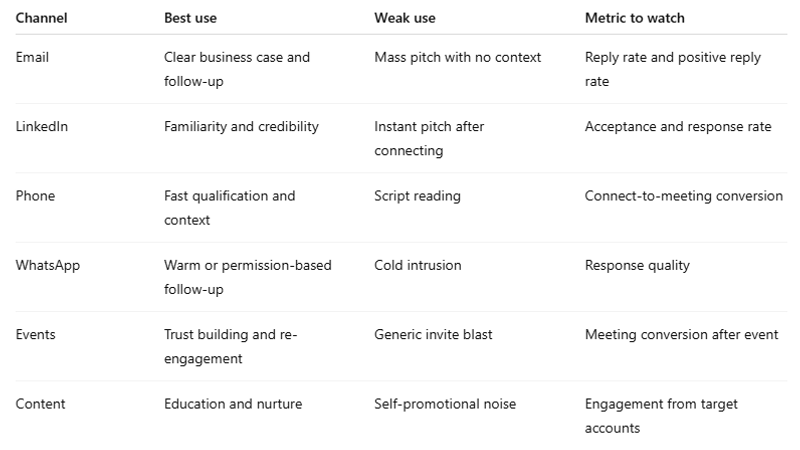
Table description:
This table shows how SDR.sg uses channels with discipline. The goal is not more noise. The goal is relevant touchpoints that match how buyers actually engage.
Step 5: We qualify before handing meetings to the client
A meeting is not automatically valuable.
A qualified meeting needs context. Why did the prospect agree to speak? What problem is relevant? Is the company a fit? Is the person senior enough or influential enough? Is there timing? Should someone else join?
This is where SDR.SDR.sg process creates a clear edge.
Many agencies optimize for meeting count. SDR.sg optimizes for meeting quality, handover context, and sales progression.
For appointment setting services APAC, this distinction matters. A calendar full of weak meetings creates fake pipeline. A smaller number of qualified, better-briefed meetings gives the sales team a better chance of moving deals forward.
Infographic 2: Before and after SDR.sg involvement
After a campaign is structured properly, the improvement should show across the funnel, not only in meeting volume.
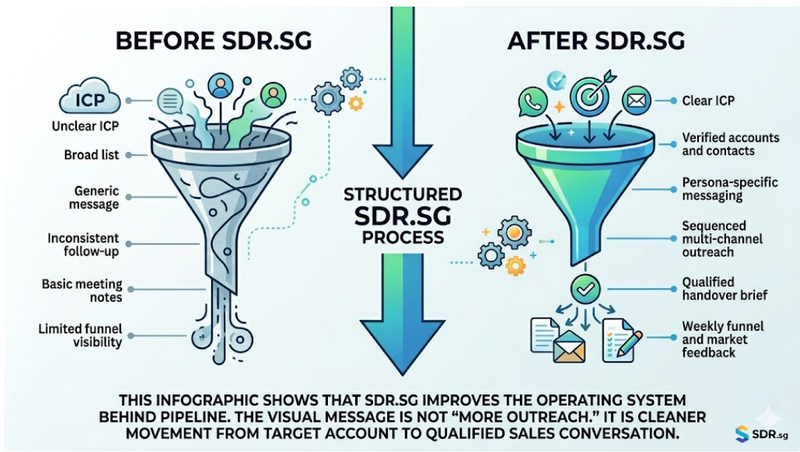
Infographic description:
This infographic should show that SDR.sg improves the operating system behind pipeline. The visual message is not “more outreach.” It is cleaner movement from target account to qualified sales conversation.
Real campaign examples and realistic benchmarks
SDR.sg has published APAC campaign examples with results across Singapore, Indonesia, and Australia. One article references localized sequences achieving a 38 percent reply rate across selected APAC projects, but that should be read with context. This is not a normal baseline for broad cold outbound. It is more credible as a result from localized, tightly targeted, high-relevance campaigns where list quality, timing, and messaging were heavily controlled.
The same SDR.sg benchmark article includes examples such as a fintech scale-up in Indonesia generating USD 1.2 million in pipeline in four months, a SaaS HR tool in Australia producing 180 SQLs in 90 days, and a logistics startup in Singapore improving pipeline visibility by 70 percent.
The table below gives the numbers context.
Table 3: Real APAC campaign benchmarks
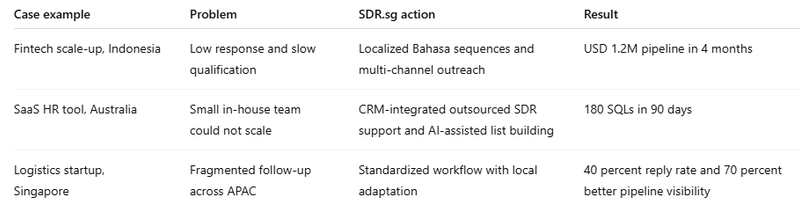
Table description:
These examples show the practical value of APAC sales development services when local market knowledge, AI-assisted research, human outreach, and disciplined qualification work together.
For deeper reading, see SDR.sg’s guides on B2B prospecting for APAC expansion and how to structure your outbound sales organization in APAC.
Where AI helps and where humans still matter
AI-powered sales prospecting tools are useful for research, enrichment, segmentation, scoring, workflow speed, and draft messaging.
But AI does not replace judgement.
AI can suggest a contact. A human decides if the contact is commercially relevant.
AI can draft a message. A human makes it sound credible.
AI can detect signals. A human understands whether those signals matter in Singapore, Indonesia, Australia, Japan, Malaysia, or the Philippines.
This is why the strongest model is not AI-only or human-only. It is a hybrid SDR model with human ownership.
What makes SDR.sg different in APAC
The edge is not one tool or one script.
It is the combination of local context and process discipline.
SDR.sg understands that B2B lead generation in Singapore is different from B2B lead generation in Indonesia, and both are different from B2B lead generation in Australia. Senior buyers in each market respond to different cues, proof points, and communication styles.
That is why the process is localized, but not random.
The list is researched.
The message is adapted.
The channels are chosen intentionally.
The qualification is structured.
The handover is documented.
The reporting turns market response into learning.
That is what separates serious outsourced SDR services APAC from simple lead generation vendors.
FAQ: outsourced SDR services APAC
Q1. What does SDR.sg actually do for clients?
SDR.sg builds and runs the top-of-funnel sales development process. That includes ICP definition, prospect research, list building, messaging, multi-channel outreach, qualification, appointment setting, reporting, and campaign optimization.
Q2. Are outsourced SDR services APAC only about booking meetings?
No. Meeting booking is one output. The deeper value is qualified pipeline creation, buyer insight, market feedback, and a repeatable outbound system.
Q3. How does SDR.sg qualify a lead before booking a meeting?
SDR.sg checks whether the company fits the ICP, whether the person is relevant, why they are interested, what business problem is connected, and whether the meeting gives the client’s sales team a real opportunity to progress.
Q4. What makes B2B lead generation in Singapore different?
Singapore is a mature, competitive market. Decision makers receive a lot of outreach, so generic messaging performs poorly. Strong B2B lead generation in Singapore needs precise targeting, credibility, relevance, and professional follow-up.
Q5. Which tools are useful for outsourced sales development?
Useful tools can include LinkedIn Sales Navigator, Apollo, ZoomInfo, Lusha, ZeroBounce, Clay, HubSpot, Salesforce, Outreach, Salesloft, and email verification platforms. The tool stack matters, but the operating process matters more.
Q6. How fast can a client expect results?
It depends on the market, ICP, offer, sales cycle, and available proof points. In strong cases, structured campaigns can shorten time to first SQL from around 7 to 8 weeks to around 3 to 4 weeks, but every campaign needs proper setup, testing, and optimization.
7. When should a company use SDR.sg instead of hiring in-house?
A company should consider SDR.sg when it wants speed, local market learning, structured outreach, lower hiring risk, and better APAC coverage without immediately building a full internal SDR team.
Final takeaway
The best outsourced SDR services APAC are not about replacing sales teams. They are about giving sales teams better conversations.
SDR.sg helps clients find the right accounts, reach the right decision makers, qualify real interest, and turn outbound from random activity into a structured pipeline engine.
For companies expanding across APAC, the goal is not more noise. The goal is a repeatable system for sales pipeline building for B2B companies that need the right conversations in the right markets.
Want to see what this could look like for your market?
Contact SDR.sg to book a strategy session. We can review your ICP, target accounts, current outbound motion, and APAC expansion goals, then show where your pipeline process can be improved.