Published on:
Estimated Reading Time: 12 minutes
Written by Jasmina C., Head of Marketing at SDR.sg
Discover insider strategies for B2B lead generation in APAC, with practical tips for Manila, Bangkok, and Seoul SMEs. Learn how to leverage hybrid SDR teams, multi-channel outreach, and localized messaging via WhatsApp, Line, and KakaoTalk to book more meetings and grow your pipeline.
Welcome to the third installment of our APAC Insider Guide series! After exploring Beijing, New Delhi & Tokyo and Singapore, Kuala Lumpur & Jakarta, we’re now focusing on Manila, Bangkok, and Seoul—three fast-growing markets with unique challenges and opportunities for B2B lead generation.

This guide continues the same focus: helping SMEs generate high-quality leads, optimize SDR outreach, and navigate local business dynamics using AI-assisted tools and hybrid sales teams.
Check the first two parts of our APAC Insider Guide series:
- B2B Lead Generation in APAC: Singapore, Kuala Lumpur & Jakarta SMEs
- B2B Lead Generation in APAC: Beijing, New Delhi & Tokyo SMEs
APAC Market Overview
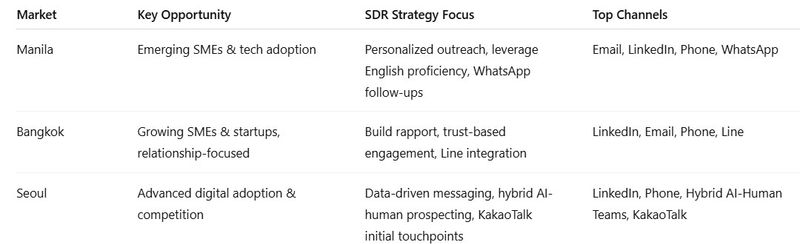
Description:
This table summarizes key opportunities, SDR strategy priorities, and top-performing communication channels in Manila, Bangkok, and Seoul. Manila focuses on English-friendly outreach and WhatsApp follow-ups; Bangkok prioritizes relationship-building via Line; Seoul leverages hybrid AI-human SDR teams and concise, data-driven messaging.
Comparative Channels Across Cities:
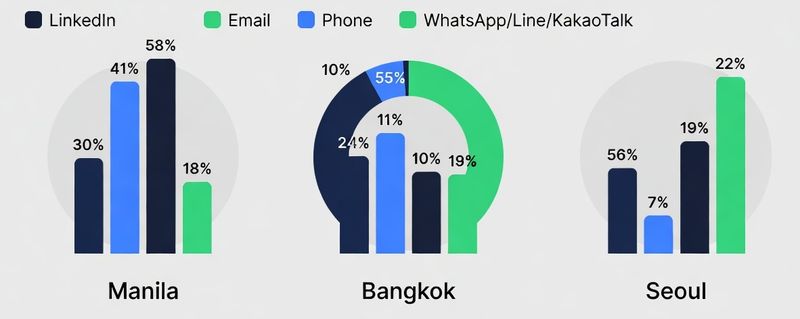
Description: Shows which channels drive the most engagement per market and guides SDRs in choosing the right outreach mix.
Manila – Emerging Tech & SME Hub
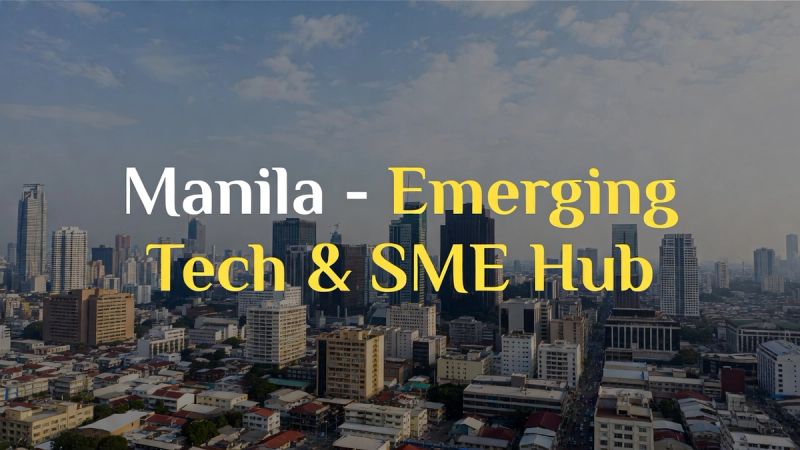
Manila’s SME ecosystem is expanding rapidly, with tech, fintech, and BPO sectors leading growth. Businesses here are responsive to personalized, multi-channel outreach, making it crucial for SDRs to combine email, LinkedIn, phone, and WhatsApp. Understanding local decision-making hierarchies and timing can significantly improve response rates and meeting bookings.
Lead Generation Insights
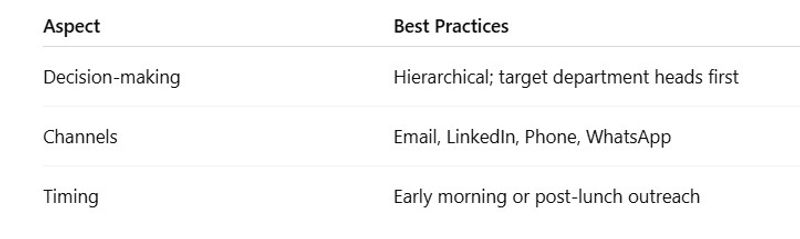
Description:
This table outlines Manila-specific SDR practices. Prioritize key decision-makers; use multi-channel outreach combining LinkedIn, email, phone, and WhatsApp. Timing aligns with local working hours, maximizing response.
Pro Tips:
Follow-ups via WhatsApp after LinkedIn/email have shown response rate increases of 25–30%, with meetings booked within 48h. Reference specific local fintech or BPO trends to improve credibility. Track engagement via CRM and measure reply-to-meeting conversion rates for each channel; clients applying these tactics reported a 2.5× increase in actionable replies over three months.
Manila SME Sectors & Channel Effectiveness:
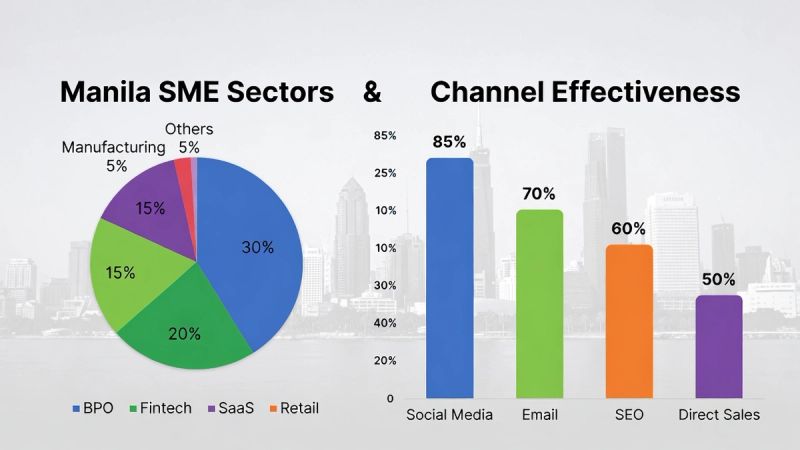
Description: Shows sector distribution and which channels deliver the highest engagement in Manila.
Mini-Case Example: Manila – Tech SME
Client: Tech SME (50–200 employees)
Challenge: Low response rates on LinkedIn and email (~8–10%) for B2B lead generation in APAC.
Strategy: Leveraged outsourced SDR services and hybrid AI-human sales teams to run multi-channel outbound lead generation campaigns using LinkedIn, email, and WhatsApp. Personalized messaging referenced local fintech trends. CRM tracked reply-to-meeting conversion.
Results: Response rates increased to ~27%, meetings booked went from 3 to 8–10 per week, and reply-to-meeting conversion improved from 30% to 55%
Workflow: Day 1 – LinkedIn connection + personalized message; Day 2 – email follow-up with local trend references; Day 3 – WhatsApp reminder to schedule meetings.
Key Insight: Combining AI-powered sales prospecting tools with personalized outreach and outsourced SDR services Singapore significantly boosted engagement and meetings in Manila.
Bangkok – Rapidly Growing SME Ecosystem
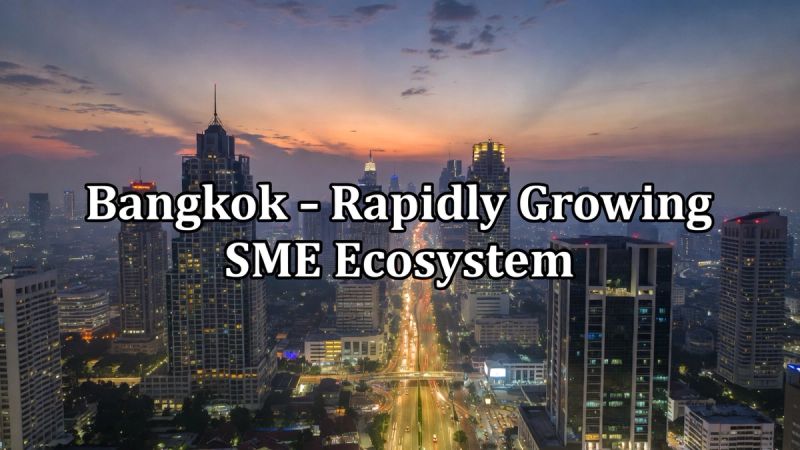
Bangkok is known for its relationship-driven business culture and a fast-growing SME scene. Effective lead generation here relies on trust-building, localized messaging, and culturally aligned channels, including Line. SDRs should focus on rapport before meetings while integrating interactive tools like stickers or polls to enhance engagement.
Lead Generation Insights
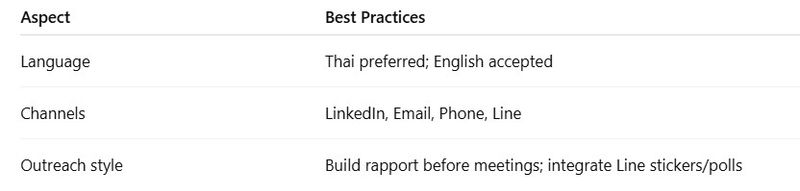
Description:
Bangkok-specific SDR strategies focus on trust-building. Thai language preferred, English accepted. Multi-channel outreach includes LinkedIn, email, phone, and Line. Relationship-building with Line features improves meeting acceptance.
Pro Tips:
Integrate Line follow-ups 24–48h after initial LinkedIn/email contact; messages should include 1–2 personalized references to local success stories. This approach increased meeting acceptance rates by ~20%, particularly with decision-makers in SMEs. Track each engagement in CRM and segment by role/industry to refine future outreach campaigns.
Bangkok Lead Gen Funnel:
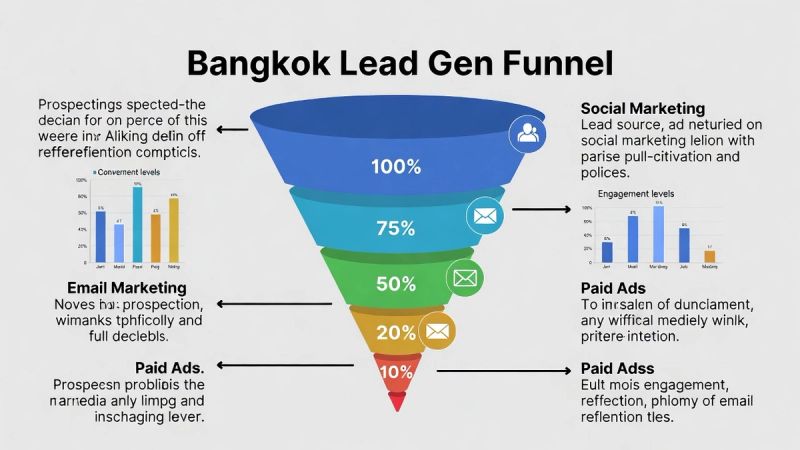
Description: Highlights where prospects drop off and which channels retain engagement most effectively.
Mini-Case Example: Bangkok – BPO SME
Client: BPO SME (100–300 employees)
Challenge: Low meeting acceptance (~12%) using traditional email and LinkedIn channels.
Strategy: Focused on Line for follow-ups and relationship-building. Included 1–2 regional success stories in local language. Used CRM to segment prospects by industry/department and track performance for B2B lead generation strategies APAC.
Results: Meeting acceptance increased to ~32%, response-to-meeting conversion rose from 25% to 45%, and overall prospect engagement reached ~70%.
Workflow: Day 1 – initial LinkedIn/email contact; Days 2–3 – Line follow-up with personalized references; Day 4 – additional Line engagement using stickers/polls.
Key Insight: Integrating APAC go-to-market strategies and culturally relevant content with hybrid sales team AI and human methods improved trust, engagement, and pipeline growth.
Seoul – Advanced Digital Adoption
Seoul’s B2B market is digitally advanced, with high adoption of AI-assisted sales tools and mobile-first communication channels. Companies expect concise, data-driven messages, and hybrid AI-human SDR teams are increasingly used to scale outreach efficiently. Targeting the right decision-maker quickly and leveraging KakaoTalk for initial touchpoints can maximize response rates.
Lead Generation Insights
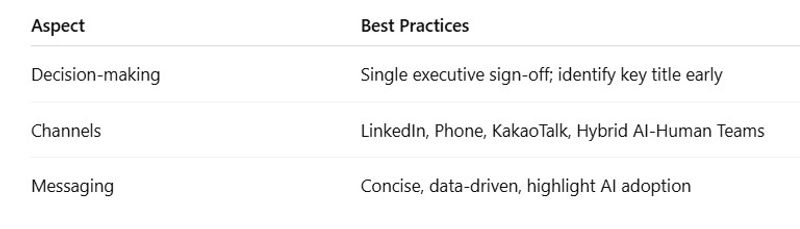
Description:
Seoul-specific SDR practices emphasize speed, precision, and digital sophistication. Identify key decision-makers early. Multi-channel engagement with LinkedIn, phone, KakaoTalk, and hybrid AI-human SDR teams maximizes outreach efficiency. Concise, data-driven messaging resonates in this mobile-first market.
Pro Tips:
- Use KakaoTalk for initial contact; keep messages concise and professional.
- Highlight mobile-first culture and AI adoption.
- Hybrid AI-human SDR campaigns—using AI to prioritize leads, suggest messaging, and schedule outreach—reduced response time by ~30% and improved reply-to-meeting conversion by ~15%. Recommended workflow: AI scores leads → human SDR personalizes messages → track engagement in CRM → analyze weekly conversion metrics to optimize sequences.
Seoul Hybrid AI-Human SDR Adoption:
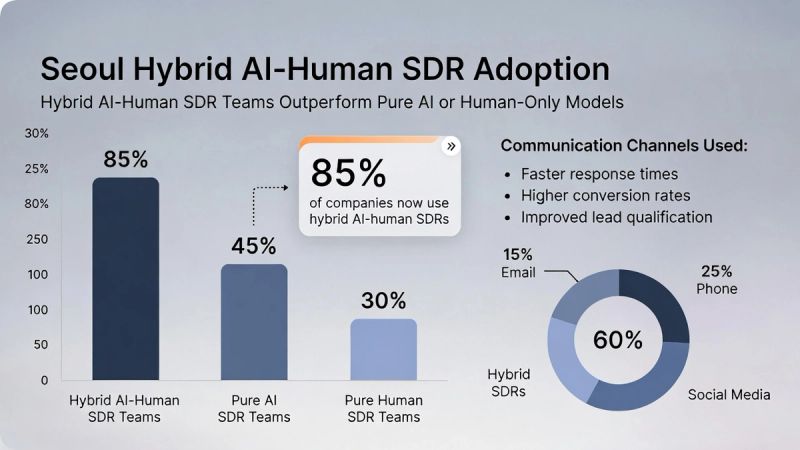
Description: Illustrates hybrid SDR impact on response speed and conversions.
Mini-Case Example: Seoul – Hybrid AI-Human SDR
Client: Mobile-first SaaS SME (200–500 employees)
Challenge: Slow response times and low outreach efficiency (~10 meetings/month)
Strategy: Applied hybrid AI-human SDR teams to prioritize leads and suggest personalized messages. Channels: KakaoTalk → Email → LinkedIn. CRM tracked reply-to-meeting conversion. Focused on AI-powered sales prospecting for B2B and appointment setting services APAC.
Results: Response times decreased from 72h to 50h, monthly meetings increased from 10 to 18–20, and reply-to-meeting conversion improved from 28% to 43%
Workflow: AI segments top leads → SDR sends personalized KakaoTalk messages → 24–48h later, email follow-up → LinkedIn touchpoints as needed.
Key Insight: Sales pipeline building solutions with outsourced SDR services for SMBs and AI-human collaboration can accelerate B2B lead generation in APAC, especially for mobile-first markets like Seoul.
Key Takeaways Across Markets
- Local adaptation: Personalizing messages by language, industry references, and decision-making hierarchies can increase engagement 20–30%.
- Relationship-building: Focus on trust and culturally aligned channels in Bangkok and Seoul for ~15–20% higher meeting acceptance.
- Multi-channel outreach: Manila and Seoul respond strongly to combined WhatsApp/Kakao/LinkedIn/email sequences; track response-to-meeting conversion per channel.
- Timing & personalization: Schedule outreach early morning or post-lunch; personalized context-specific messaging can improve conversions by ~20%.
Verified Statistics:
- LinkedIn remains a dominant B2B channel, with ~97% of marketers leveraging it.
- APAC B2B buying teams average 11 decision-makers.
- Personalized outreach increases conversions by 20–30%.
- Hybrid AI-human SDR teams increasingly adopted in advanced APAC markets like Seoul.
FAQ – Common Questions & Answers
Q1: Which channels perform best in Manila?
A1: LinkedIn, email, phone, WhatsApp; WhatsApp follow-ups boost responses by ~25–30%.
Q2: How do cultural nuances affect Bangkok outreach?
A2: Bangkok SMEs value trust; Line integration and local success stories improve engagement (~20% lift).
Q3: Are AI SDR tools effective in Seoul?
A3: Yes, hybrid AI-human teams improve targeting, messaging, and response (~30% faster).
Q4: Optimal timing for cold outreach?
A4: Early morning or post-lunch; aligns with local work hours.
Q5: How to scale hybrid SDR teams in APAC?
A5: Start small, mix AI & human SDRs, define KPIs, localize messaging, expand based on results.
Q6: Which Manila sectors respond best to outsourced SDR?
A6: Fintech, BPO, SaaS, tech-adjacent SMEs; local trend references improve engagement.
Q7: How to combine inbound and outbound leads efficiently?
A7: Use CRM to track leads, segment by intent, personalize outreach, and prioritize high-value opportunities with AI.
Ready to expand your APAC B2B pipeline by 20–30%?
Schedule a strategy session and get a custom roadmap showing which channels, timing, and AI-human SDR mix will deliver measurable results in Manila, Bangkok, and Seoul.
Contact Us – Schedule a Meeting