Published on:
Estimated Reading Time: 12 minutes
Written by Jasmina C., Head of Marketing at SDR.sg
Explore city-specific B2B lead generation strategies for Beijing, New Delhi & Tokyo SMEs. Learn hybrid SDR tactics, WeChat, LinkedIn, and high-intent webinars to book more sales meetings and build a predictable pipeline.

In our previous blog, we covered the Insider Guide for Singapore, KL & Jakarta SMEs, exploring how B2B lead generation in APAC works for Southeast Asian SMBs.
Now, we continue with Beijing, New Delhi & Tokyo, three major business hubs with unique buyer behaviors, channel preferences, and sales cycles. This guide provides practical strategies for hybrid SDRs, multi-channel cadences, and outsourced sales development, helping SMBs book more meetings and build predictable pipelines.
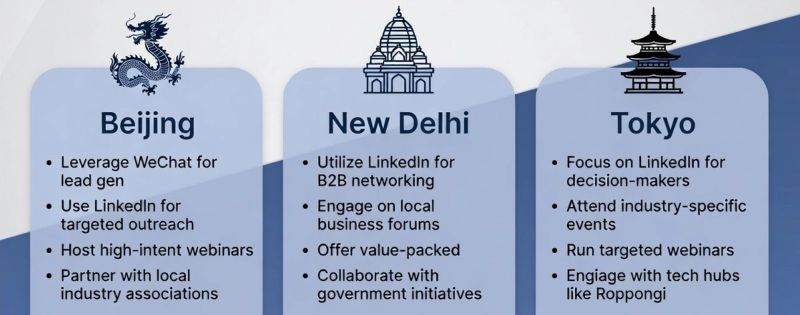
The focus is simple: give your SDR team actionable steps that deliver results in each city.
APAC Lead Generation: Channel Benchmarks
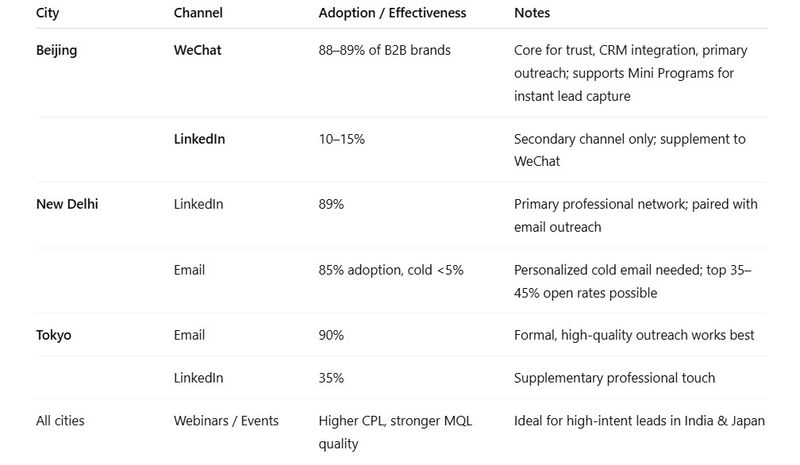
In APAC, B2B lead generation strategies vary greatly by city due to local platform preferences, professional behavior, and cultural norms. Understanding which channels deliver the best adoption and engagement is essential for building a predictable sales pipeline. Beijing relies on WeChat for trust and CRM integration, New Delhi favors LinkedIn and email, while Tokyo prefers formal email outreach supplemented with LinkedIn. The table below provides city-specific channel benchmarks to guide SDR and hybrid AI-human campaigns.
Table 1: Channel Benchmarks by City
Description:
This table highlights the adoption and effectiveness of key B2B channels across Beijing, New Delhi, and Tokyo. It shows how local preferences — like WeChat dominance in Beijing, LinkedIn in New Delhi, and email in Tokyo — shape SDR outreach strategies and optimize pipeline results.
APAC B2B channel adoption 2025–2026 across Beijing, New Delhi & Tokyo
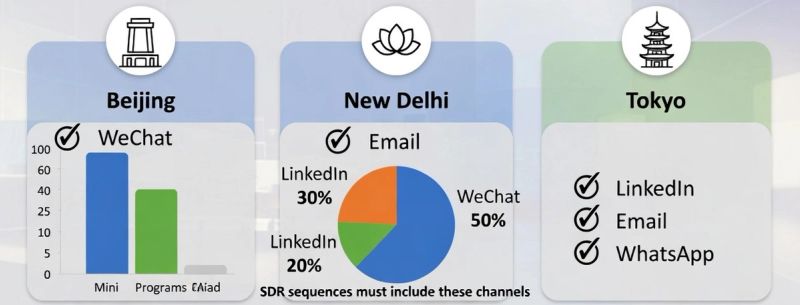
Description: Hybrid, multi-channel SDR sequences improve pipeline efficiency. Beijing relies heavily on WeChat and Mini Programs, while New Delhi and Tokyo favor LinkedIn/email supplemented with webinars/events.
External Sources:
- Martal Group LinkedIn Insights 2025
- Dux-Soup B2B Marketing Report 2026
- Green Hat APAC Buyer Journey 2025
Market Snapshot by City
To effectively generate B2B leads across APAC, it’s crucial to understand city-level business culture and channel preferences. Beijing, New Delhi, and Tokyo each have distinct buyer behaviors, preferred platforms, and SDR focus areas. The table below summarizes these nuances to help teams localize outreach and maximize engagement.
Table 2: City-specific lead generation overview.
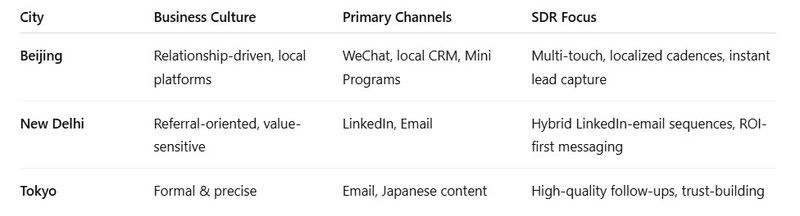
Description: Cultural nuances dictate outreach success. A generic APAC SDR playbook underperforms without city-level adaptation.
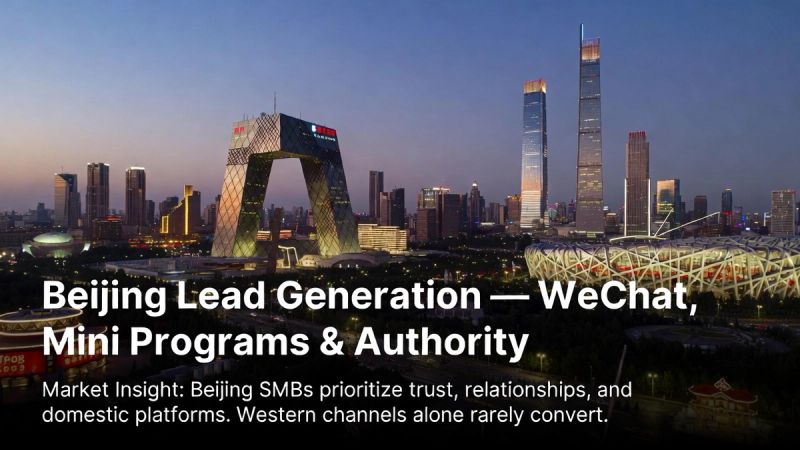
Beijing Lead Generation — WeChat, Mini Programs & Authority
Market Insight:
Beijing SMBs prioritize trust, relationships, and domestic platforms. Western channels alone rarely convert.
Tactics That Work:
- WeChat-first multi-touch sequences (WeChat → Email → Phone).
- Use WeChat Mini Programs for instant lead capture and qualification (95%+ adoption among Chinese SMBs in 2025–2026).
- Localized Mandarin content with relevant case studies.
- Integrate with local CRM for pipeline tracking.
Mini-Case Example:
Global SaaS provider targeting manufacturing SMBs in Beijing (2025) increased booked meetings by 32% using Mandarin content + WeChat sequences + Mini Programs.
Beijing 2025–2026 Hybrid SDR Multi-Touch Flow – WeChat + Email + Phone + Mini Program.
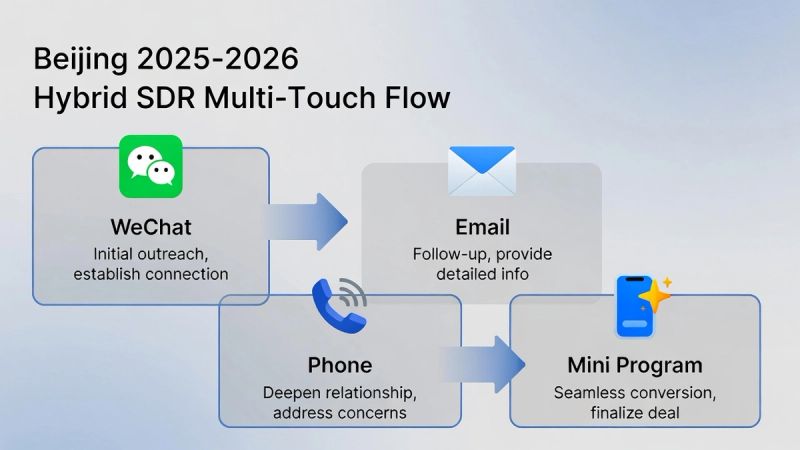
Description: Sequential touches bridge trust gaps and improve engagement in platform-dominant markets.
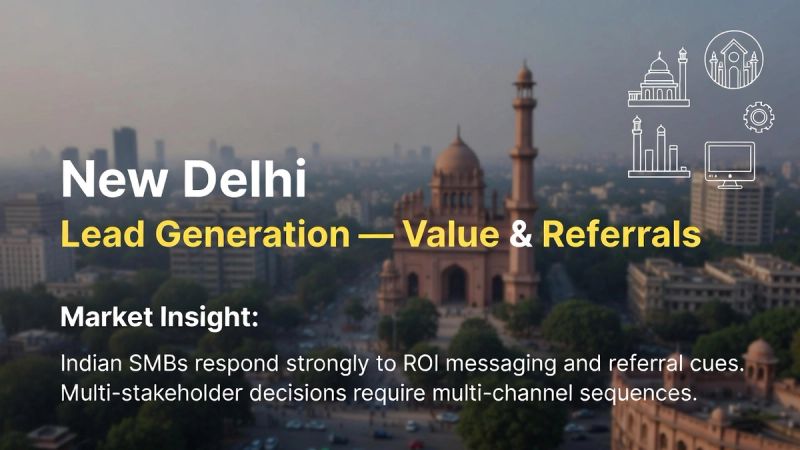
New Delhi Lead Generation — Value & Referrals
Market Insight:
Indian SMBs respond strongly to ROI messaging and referral cues. Multi-stakeholder decisions require multi-channel sequences.
Tactics That Work:
- LinkedIn connection with concise value snippet.
- Follow-up email with ROI metrics and local examples.
- Interactive content (webinars, guides, demos) for lead education.
Mini-Case Example:
Cloud services client in the SMB fintech sector, 2025, improved demo bookings by 25% using hybrid LinkedIn-email cadences tailored to Indian SMBs.
Tip: Highlight measurable business impact early to capture attention.
Tokyo Lead Generation — Precision & Respect
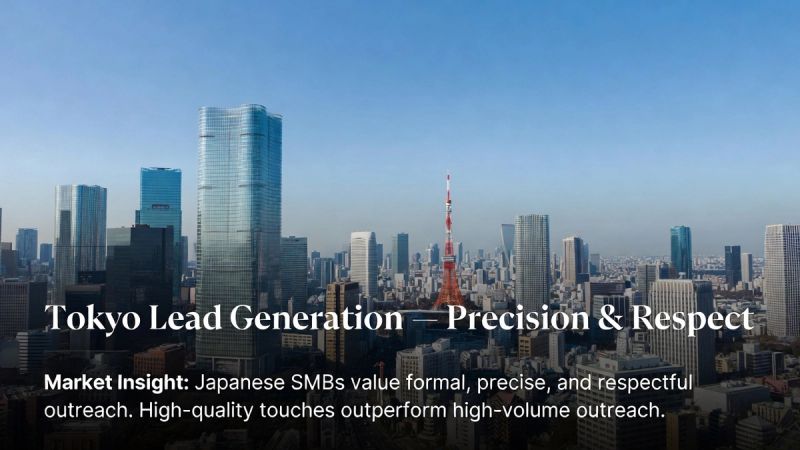
Market Insight:
Japanese SMBs value formal, precise, and respectful outreach. High-quality touches outperform high-volume outreach.
Tactics That Work:
- Formal emails with Japanese localization.
- Minimal but high-value touches.
- Schedule follow-ups during local business hours.
Mini-Case Example:
Anonymous B2B SaaS client (2025) tripled meeting rates using Japanese-language case studies and precision outreach.
SDR Workflow & KPI Table
Optimizing SDR workflows requires hybrid teams that combine AI-assisted insights with human personalization. Table 3 provides recommended stages, best practices, and KPI benchmarks to guide APAC outreach.
Table 3: SDR workflow & KPIs.
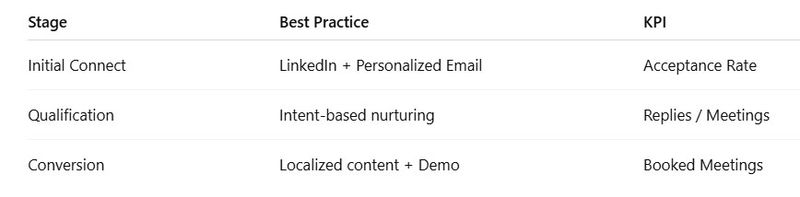
Description: Hybrid SDR teams using AI + human personalization optimize efficiency while maintaining engagement quality.
Strategic Insights & ROI Evidence
- Website visitor → lead conversion: ~2% (Shno.co)
- LinkedIn leads globally ~97%, but varies in APAC; WeChat dominates China. (LinkedIn B2B Marketing Insights 2025)
- High-intent webinars: higher CPL but stronger MQL quality in India & Japan (Green Hat APAC report 2025). (Green Hat APAC Buyer Journey 2025)
Best Practices:
- Track MQL → SQL → Closed pipeline flow.
- Prioritize high-intent leads using intent data.
- Equip SDRs with localized assets to boost response and engagement.
Internal Resource Links
🔗 How Outsourced SDR Services Drive B2B Lead Generation in APAC (2026 Real Cases & Benchmarks) – real metrics i benchmarking za outsourced SDR services u APAC‑u.
🔗 Hybrid Sales Team: Why AI + Human is the Best Model for APAC B2B Sales in 2026 – dubinski vodič o hybrid SDR teams i kako ih koristiti.
🔗 AI‑Powered Sales Prospecting in APAC: Tools, Use Cases, and Limits – praktični vodič o AI SDR alatima u kombinaciji s ljudskim SDR‑ima za APAC.
FAQ – Top Questions with Answers
Q1: What is the biggest challenge in APAC B2B lead gen?
A1: Multi-channel outreach and local cultural adaptation.
Q2: Is LinkedIn effective in China?
A2: LinkedIn alone underperforms; combine with WeChat (see Beijing section).
Q3: How many touches in an SDR cadence are ideal?
A3: 8–12 touches combining email, social, webinars, and Mini Programs.
Q4: Should content always be localized?
A4: Yes — language and regional case studies improve trust and engagement.
Q5: Are webinars worth investing in?
A5: Yes — higher CPL, but stronger MQL quality, especially in India and Japan.
Q6: Can AI replace human SDRs?
A6: No — AI amplifies efficiency, but human nuance drives conversion.
Q7: Which KPI matters most?
A7: Booked meetings leading to qualified pipeline and revenue.
Internal links added: FAQ questions link back to relevant city sections and internal SDR.sg blogs.

Ready to scale your APAC sales expansion and book more meetings?
👉 Book a Strategy Session with SDR.sg experts
👉 Request an Outsourced SDR Assessment for Beijing, New Delhi, or Tokyo
Turn your B2B lead generation into a predictable, high-quality pipeline across Asia in 2026.