Published on:
Estimated Reading Time: 13 minutes
Written by Jasmina C., Head of Marketing at SDR.sg
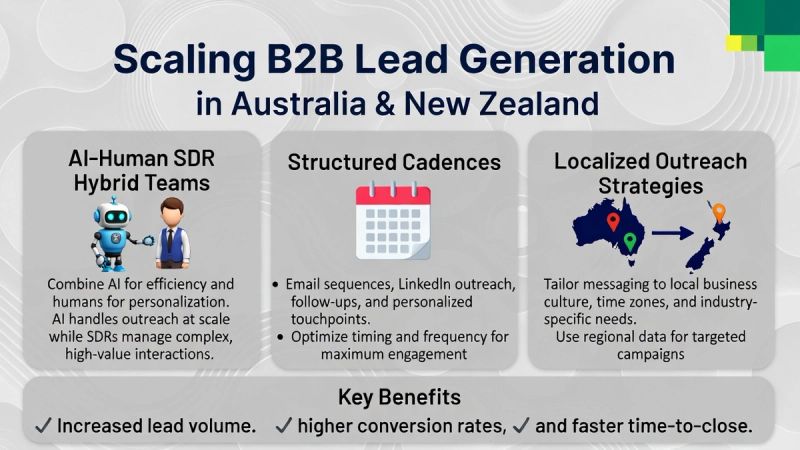
How to scale B2B lead generation in Australia & New Zealand using hybrid AI-human SDR teams, structured cadences, and localized outreach strategies.
Part 4 of 4: Completing the APAC B2B Lead Generation Framework
This article concludes our four-part series on B2B lead generation in APAC & ANZ — a structured breakdown of how companies should approach regional expansion across Asia-Pacific markets.
- Part 1: Singapore, Kuala Lumpur & Jakarta
- Part 2: Beijing, New Delhi & Tokyo
- Part 3: Manila, Bangkok & Seoul
- Part 4: Sydney, Melbourne & Auckland (ANZ)
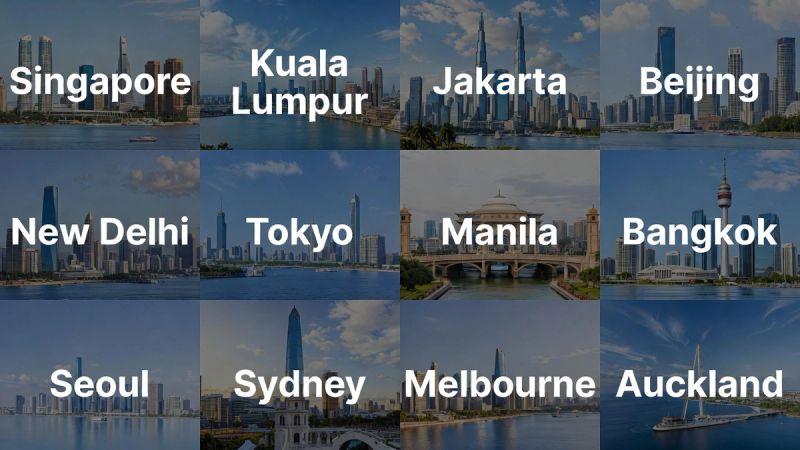
Each cluster demonstrated different buyer psychology, outreach velocity, and pipeline dynamics. Southeast Asia rewards speed. North Asia rewards precision.
ANZ rewards system discipline.
As the most commercially mature and compliance-sensitive region in this framework, ANZ requires structured execution, hybrid workflows, and measurable performance modeling. This final chapter completes the broader APAC go-to-market strategies blueprint for scalable B2B lead generation in Asia.
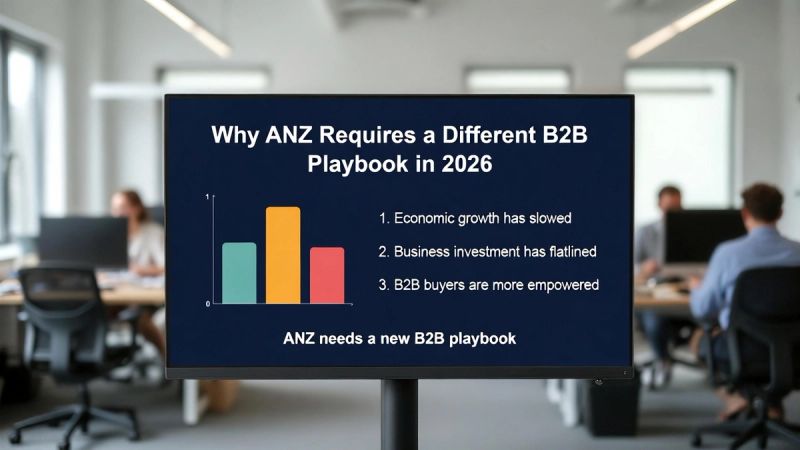
Why ANZ Requires a Different B2B Playbook in 2026
Australia and New Zealand operate at a higher buyer maturity level than most APAC markets. Committees are common. Validation behavior is strong. AI adoption in sales teams is mainstream.
According to recent data from Statista, 68% of ANZ decision-makers review LinkedIn before replying to outreach, and 52% engage more when messaging references local context.
If your approach to B2B lead generation in APAC is template-driven, ANZ will expose it quickly.
1. ANZ Market Structure & Decision Velocity
Before building outreach sequences, you need realistic expectations about sales cycles and channel preferences. ANZ is not one homogeneous block.
Understanding city-level behavior is critical for Sales pipeline building for B2B companies.
Table 1: ANZ B2B Market Snapshot (2026)
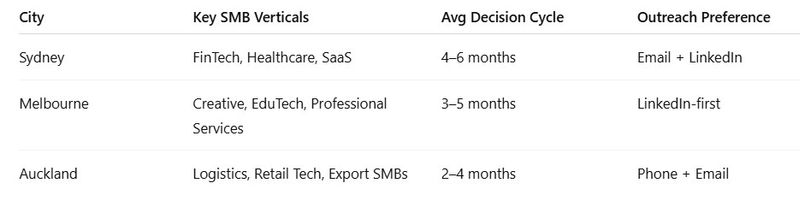
Table Explanation:
Sydney deals are committee-heavy and financially scrutinized. Melbourne buyers engage through thought leadership and peer validation. Auckland moves faster but expects relationship continuity.
Forecasting errors often come from ignoring these structural differences when deploying Outbound lead generation strategies.
2. Persona Psychology & Intent Alignment
City dynamics matter. Persona psychology determines conversion.
In 2026, automation noise is high. What works is intent-driven personalization using AI-powered sales prospecting for B2B, validated by experienced SDRs.

This is where Hybrid sales teams: AI and human SDR models outperform manual-only or AI-only systems.
Table 2: ANZ Buyer Personas (2026)
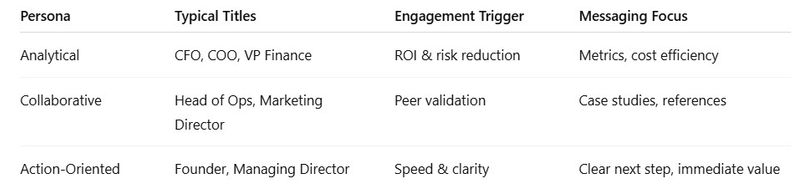
Table Explanation:
Analytical personas need numbers early. Collaborative personas require proof. Founders prioritize clarity.
According to benchmarking from HubSpot (2026 Sales Trends), persona-segmented outreach improves reply rates by 28–35% compared to generic sequencing.
That margin compounds pipeline predictability.
3. Hybrid SDR Workflows: The 2026 Baseline
Manual outreach alone is inefficient. Automation alone lacks credibility.
High-performing ANZ teams combine intent detection with human validation. AI intent signal detection (website visits, hiring spikes, funding announcements) can be implemented using tools like Apollo.io and Instantly.ai.
Workflow Structure:
- AI intent signal detection (website visits, hiring spikes, funding announcements)
- ICP scoring & prioritization
- SDR contextual personalization
- Multi-channel cadence deployment
- Weekly data optimization loop
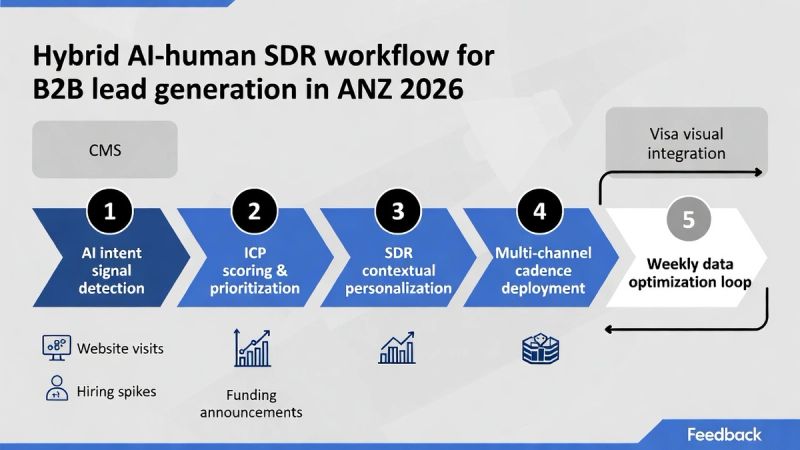
Infographic Explanation:
AI surfaces opportunity windows. SDRs convert them.
Research from Forrester shows hybrid SDR models generate 35–45% higher meeting booking rates than automation-only outreach.
In ANZ, hybrid is not a competitive advantage anymore — it is the operational baseline for serious Lead generation services.
4. Multi-Channel Cadence Discipline
Execution discipline matters more than creativity in ANZ markets.
A structured cadence protects brand perception while increasing meeting velocity — critical for Appointment setting services APAC.
Example Cadence:
- Day 1 – Intro email with local industry insight
- Day 3 – LinkedIn connection + + reference to relevant local event (e.g., Startup Week Sydney, Connect Expo)
- Day 5 – Email including micro-case
- Day 7 – Phone attempt
- Day 10 – Structured follow-up with soft CTA
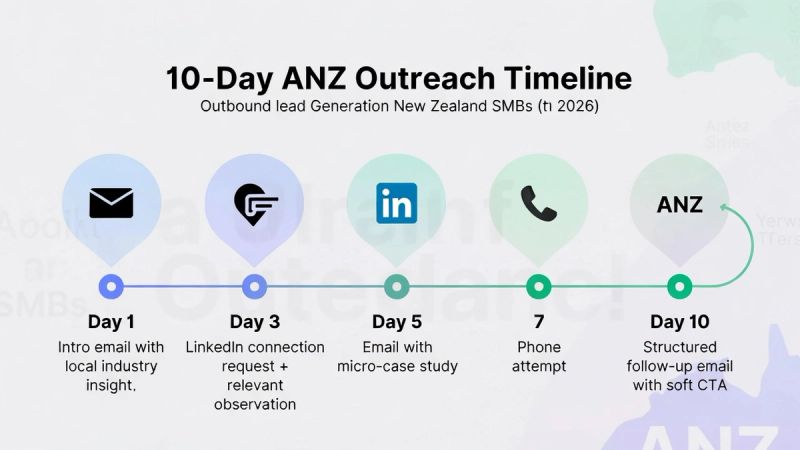
Infographic Explanation:
LinkedIn-first performs well in Melbourne. Sydney responds strongly to data-backed emails. Auckland requires faster follow-up cadence. Referencing local business and tech events (like Startup Week Sydney or Connect Expo) builds trust and relevance. Engagement benchmarks from Salesforce indicate this can increase reply rates by up to 40%.
Engagement benchmarks from Salesforce indicate referencing local events can increase reply rates by up to 40%.
Consistency drives conversion. Random follow-up kills momentum.
5. Real Micro-Case: Sydney SaaS SMB (Q1 2026)
A Sydney-based SaaS company targeting mid-market healthcare implemented:
- AI intent monitoring
- Persona-based segmentation
- Hybrid SDR review layer
- Structured 10-day cadence
90-Day Results:
- 22 qualified meetings booked
- 31% improvement in reply rate
- 18% faster opportunity progression
- 3 closed-won deals within 4 months
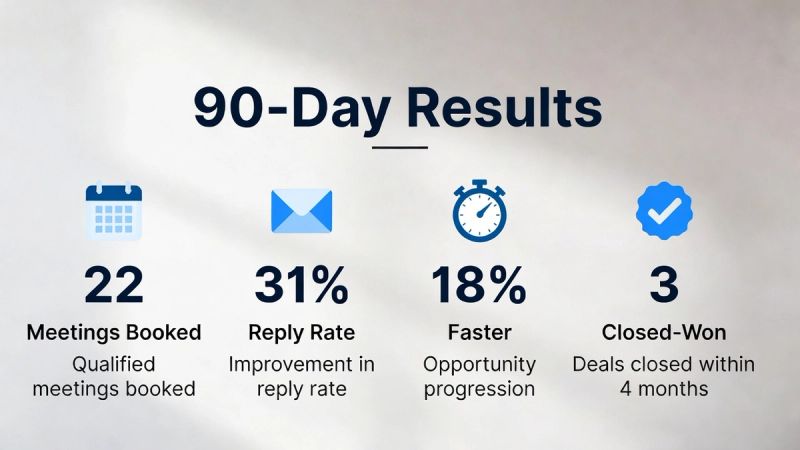
This reflects what happens when Increase sales meetings with outsourced SDR is executed with structure instead of volume.
6. Common ANZ Outreach Mistakes
Even experienced teams underperform when automation becomes lazy.
Before scaling Outsourced sales development for SMBs, review these risks.
Table 3 – Outreach Pitfalls in ANZ (2026)
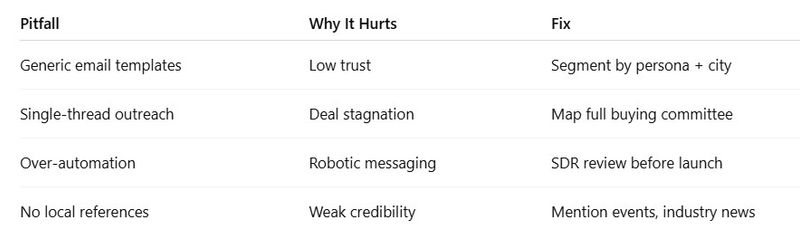
Table Explanation:
ANZ buyers expect contextual intelligence. Without it, conversion drops rapidly.
Top-performing B2B lead generation companies integrate automation with disciplined human oversight.
7. How ANZ Fits into the Broader APAC Expansion Model
Across this four-part series, one pattern is consistent:
- Southeast Asia rewards speed.
- North Asia rewards precision.
- ANZ rewards operational maturity.
If you are designing scalable B2B lead generation strategies APAC, your systems must flex per region — not replicate globally.
ANZ is where weak process design becomes visible.

FAQ – 2026 Reader Questions
Q1: What works best for B2B lead generation in Sydney?
A1: Email + LinkedIn with data-backed positioning.
Q2: Are AI SDR tools effective in ANZ?
A2: Yes — when combined with human validation.
Q3: What is the average ANZ sales cycle?
A3: Sydney: 4–6 months. Melbourne: 3–5. Auckland: 2–4.
Q4: Is outsourcing SDR viable in Australia?
A4: Yes, if localized and structured properly.
Q5: How important is LinkedIn in ANZ outreach?
A5: Critical. Most buyers validate profiles before engaging.
Q6: What improves meeting rates fastest?
A6: Persona segmentation + local context.
Q7: How do you scale without harming brand trust?
A7: Structured cadence, responsible AI usage, and controlled targeting.
Final Takeaway
In 2026, ANZ markets reward precision, not volume.
Winning frameworks combine:
- Intent data
- Hybrid AI-human collaboration
- Persona-driven messaging
- Structured multi-channel cadences
- Local market awareness
If you are expanding across Asia-Pacific, this completes the execution blueprint.

If you are building or refining B2B lead generation in Singapore, expanding into ANZ, or evaluating outsourced SDR services, SDR.sg can help you design a localized, hybrid SDR model aligned with your ANZ expansion goals.
👉 Book a strategy session with SDR.sg to implement the proven 2026 framework for AI-human hybrid outreach, structured multi-channel cadences, and persona-driven messaging.
Predictable pipeline growth isn’t about sending more emails — it’s about building smarter systems with SDR.sg.