Published on:
Estimated Reading Time: 11 minutes
Written by Jasmina C., Head of Marketing at SDR.sg
Learn 5 practical lessons foreign vendors often overlook before entering South Korea, from localization and trust-building to positioning and market-entry execution.

This is the third article in the series. The first looked at why momentum often dies after first contact. The second explained why trust has to be built before a Korean buyer feels safe moving forward. This final piece zooms out.
The bigger lesson is simple. South Korea is not a market where a foreign vendor can translate a few emails, buy a list, and expect the same motion to work. For many teams, the real issue is not effort. It is that their APAC market entry strategy was never properly adapted to Korea in the first place.
That is what makes Korea attractive and unforgiving at the same time. It is a sophisticated B2B market with high expectations, strong local players, and buyers who often notice very quickly when a foreign vendor is using a copy-paste playbook. For SDR.sg, that usually shows up in familiar ways: decent open rates, a few polite replies, early optimism, and then very little real movement.
This blog is built around five lessons that foreign vendors, especially SaaS and B2B tech companies, often learn the hard way.

Lesson 1: Translating the message is not the same as localizing the motion
A lot of foreign vendors think they have localized for Korea because they translated a deck, a landing page, or a cold email.
That is not enough.
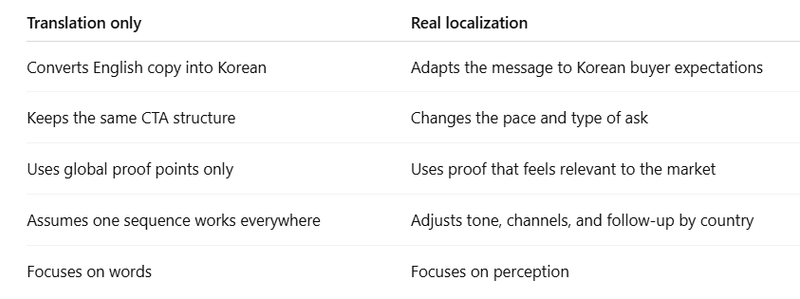
Localization is not just language. It is how you frame value, how direct you sound, what proof you use, how quickly you ask for a meeting, and whether the buyer feels your approach was built for their market or imported from somewhere else.
Here is the difference in practical terms.
Description:
A message can be linguistically correct and still feel commercially foreign.
A realistic SDR.sg-style example: a U.S. workflow software company enters Korea with a translated sequence that says, “Would you be open to a 30-minute demo next week?” The grammar is fine. The problem is the motion still feels globally templated.
A stronger version would say something closer to: “We often see regional operations teams delay vendor conversations until the internal use case is clearer. Happy to share a short outline relevant to your team if useful.”
Same product. Same market. Completely different level of risk for the buyer.
That is why a real go-to-market strategy for South Korea starts with message perception, not just language accuracy.

Lesson 2: The buying process is slower, quieter, and more consensus-driven than it looks
Foreign teams often interpret slow movement as weak demand.
In Korea, that is often the wrong read.
One of the most common mistakes SDR.sg-style teams see is this: a foreign vendor gets two or three positive replies from Korean managers or directors, assumes traction, and immediately pushes for demos in the same week. The team thinks the market is responding. Then the conversations go quiet.
Usually the problem is not the list.
Usually the problem is that the contact was not yet ready to sponsor the vendor internally.
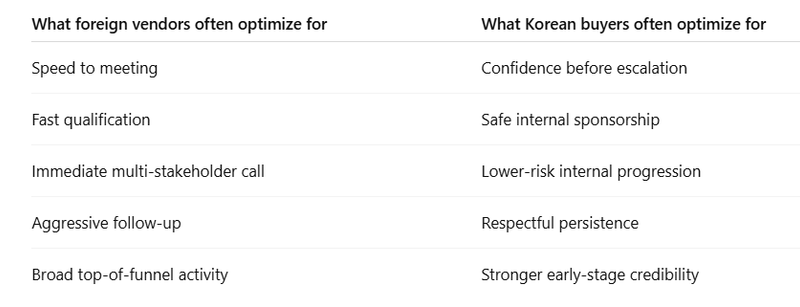
That changes how sales pipeline building for B2B companies should be handled in Korea. The seller usually wants speed to meeting. The buyer usually wants confidence before escalation.
Here is the tension more clearly.
Description:
In Korea, buyer comfort is often the gate that controls speed.
A realistic example: a foreign SaaS vendor targeting Korean manufacturers gets a reply from a director saying, “This looks interesting. Please send more information.” A global SDR team treats that as a near-meeting signal and sends a calendar link plus a long deck. The contact never books.
What likely happened is simple. The buyer may have been interested, but not yet comfortable enough to move the vendor into a real internal discussion.
That is why lead qualification tips for B2B companies need a local layer in Korea. The question is not only “Is this account a fit?” It is also “Is this contact ready to carry the next step internally?”
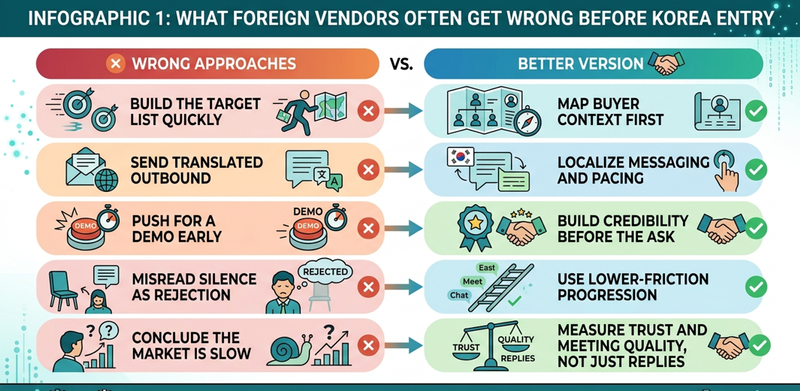
Infographic 1: What foreign vendors often get wrong before Korea entry
Description:
- Build the target list quickly
- Send translated outbound
- Push for a demo early
- Misread silence as rejection
- Conclude the market is slow
Better version
- Map buyer context first
- Localize messaging and pacing
- Build credibility before the ask
- Use lower-friction progression
- Measure trust and meeting quality, not just replies
Many Korea entry problems look like demand problems at first. They are often sequencing problems instead.

Lesson 3: Trust signals matter more than aggressive CTAs
This is one of the biggest differences between generic outbound and effective Korea outbound.
The best early signal is often not urgency. It is credibility.
A lot of foreign vendors overestimate how much the buyer wants speed. In reality, many Korean decision-makers want enough confidence before they expose themselves internally by bringing in a new vendor too early.
That is why outbound lead generation strategies that over-index on urgency often underperform here. If the buyer feels cornered, progression slows down. If the buyer feels informed and safe, progression gets easier.
Here is the contrast.
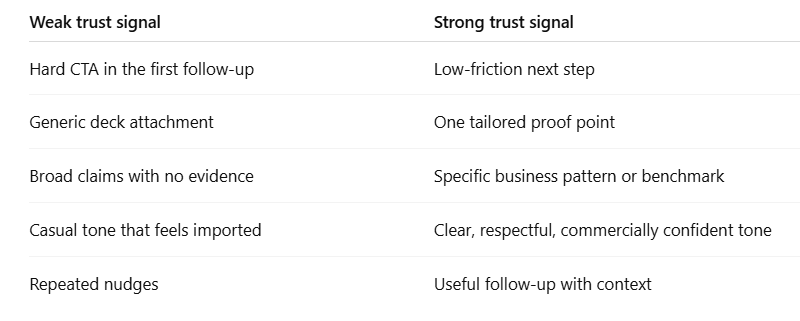
Description:
In Korea, trust grows when the buyer feels informed and respected, not cornered.
A realistic example: a cybersecurity vendor reaches out to a Korean fintech leader.
Weak version:
“Can we book 30 minutes next week to walk you through our platform?”
Stronger version:
“We often see regional fintech teams delay vendor discussions until the internal use case is clearly framed. Happy to share a short example from APAC if helpful.”
The second version works better because it reduces perceived risk. It gives the buyer a safer response path.
This is also where best practices for multi-channel outbound sales matter. The buyer should experience one coherent, confidence-building sequence, not email pressure, LinkedIn pressure, and call pressure all at once.

Lesson 4: Foreign SaaS vendors usually need to adjust positioning, not just outreach
A lot of teams think the issue is only the SDR layer.
Often it is not.
Sometimes the deeper problem is that the company has not positioned itself in a way that feels credible in Korea. A message that works in Australia, Singapore, or the U.S. may feel too promotional, too casual, or too thin on operational credibility in Korea.
This is especially relevant for SaaS.
A realistic example: a workflow automation platform enters Korea positioning itself as “the fastest way to automate team productivity.” That may work elsewhere. In Korea, the positioning often needs to shift toward operational reliability, support responsiveness, governance, and clearly explainable business outcomes.
In other words, the buyer may need reassurance that this is not just interesting software. It is a vendor that can be trusted in a serious operating environment.
That changes B2B sales expansion APAC in practical ways:
- proof points need to feel easier to forward internally
- support expectations need to be addressed earlier
- references should feel relevant to the buyer’s business context
- the value proposition may need to sound more disciplined and less promotional
Here is a simple before-and-after view.
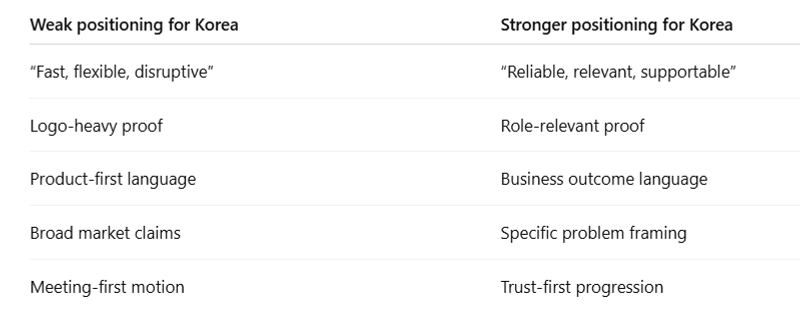
Description:
Positioning for Korea is not just about translating the same promise. It is about making the promise feel safer, clearer, and more credible.
Infographic 2: How positioning should evolve before Korea scale
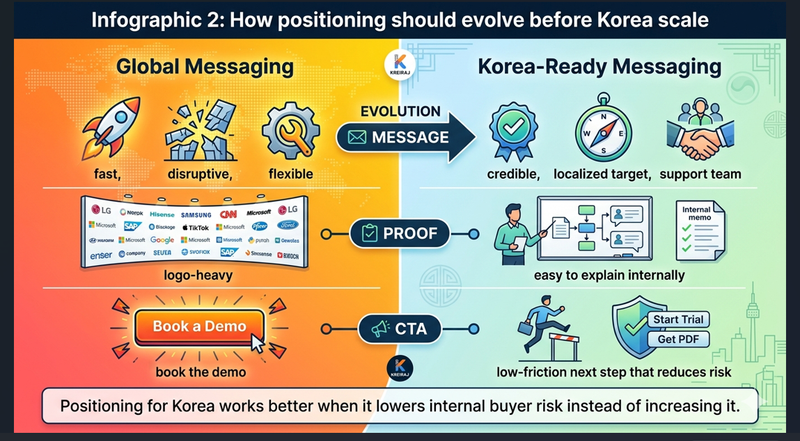
Description:
- Global message: fast, disruptive, flexible
- Korea-ready message: credible, relevant, supportable
- Global proof: logo-heavy
- Korea-ready proof: easy to explain internally
- Global CTA: book the demo
- Korea-ready CTA: low-friction next step that reduces risk
Positioning for Korea works better when it lowers internal buyer risk instead of increasing it.
Lesson 5: Korea entry requires local nuance before scale
This is the lesson that usually comes last, because teams often learn it only after wasting activity.
Korea is a market where local nuance should come before scale, not after it.
A lot of foreign vendors try to scale outreach first and learn the market second. That is backwards.
A more effective market entry strategy for South Korea usually starts with:
- testing messaging before scaling volume
- validating proof points before pushing demos
- mapping stakeholder comfort before forcing progression
- tightening data and workflow discipline before expanding outreach
- adjusting channel mix and tone before assuming the global sequence works
This is where SDR.sg-style execution becomes more realistic. Before scaling a Korea campaign, a good operator would usually want to answer five practical questions:
- Does the messaging sound localized or just translated?
- Is the first proof point strong enough to forward internally?
- Is the next step easy enough to accept without risk?
- Does the follow-up build trust or create pressure?
- Does the whole motion make the vendor look ready for Korea?
That is why B2B expansion into South Korea is not only a sales problem. It is an execution-readiness problem.
What this means for foreign vendors
If you are planning APAC market entry strategy work that includes Korea, the main lesson is simple: do not treat Korea as a lighter version of another APAC market.
It needs its own logic.
A better APAC go-to-market strategy for Korea usually includes:
- localized messaging, not just translation
- trust signals earlier in the sequence
- proof designed for internal forwarding
- more careful stakeholder mapping
- lower-friction next steps
- cleaner operational and data practices
For some companies, this can be built internally. For others, especially those entering multiple APAC markets at once, it may make more sense to use specialist support before scaling outbound volume.

FAQ, Common Questions
Q1. Is South Korea a difficult market for foreign B2B vendors?
It can be demanding, but not impossible. The usual issue is not demand. It is whether the vendor adapts properly to local buying behavior.
Q2. Is translating outreach enough for Korea?
No. Translation helps, but real localization also changes tone, proof, sequencing, and the type of next step you ask for.
Q3. Why do early replies in Korea not always lead to meetings?
Because a reply may show interest without enough internal comfort to escalate the discussion.
Q4. What kind of proof works best in Korea?
Short, relevant proof that is easy to understand and easy to forward internally usually works better than long generic decks.
Q5. Does hierarchy really affect market entry and outbound?
Yes. Rank sensitivity, relationship signals, and internal confidence shape how quickly a buyer is willing to move.
Q6. Do privacy and data handling matter during early prospecting?
Yes. Clean sourcing, disciplined workflows, and credible operating processes affect both compliance and buyer confidence.
Q7. What is the fastest way to improve Korea conversion before scaling?
Review your first three touches, your proof points, and your next-step asks. Most teams do not have a volume problem first. They have a trust and sequencing problem.
Conclusion
The biggest lesson foreign vendors learn before entering Korea is that the market does not reward superficial adaptation for long.
If your APAC market entry strategy assumes Korea will bend to your global sequence, your pipeline may look active before it looks stalled. The better path is to localize earlier, build trust sooner, reduce internal buyer risk, and treat operational discipline as part of credibility.
If your team is preparing a go-to-market strategy for South Korea, start by asking a harder question: are we adapting the message only, or the entire motion?
Ready to pressure-test your Korea entry motion?
If your team is preparing for B2B expansion into South Korea and wants to review messaging, sequencing, proof points, or outbound execution before scaling, SDR.sg can help.